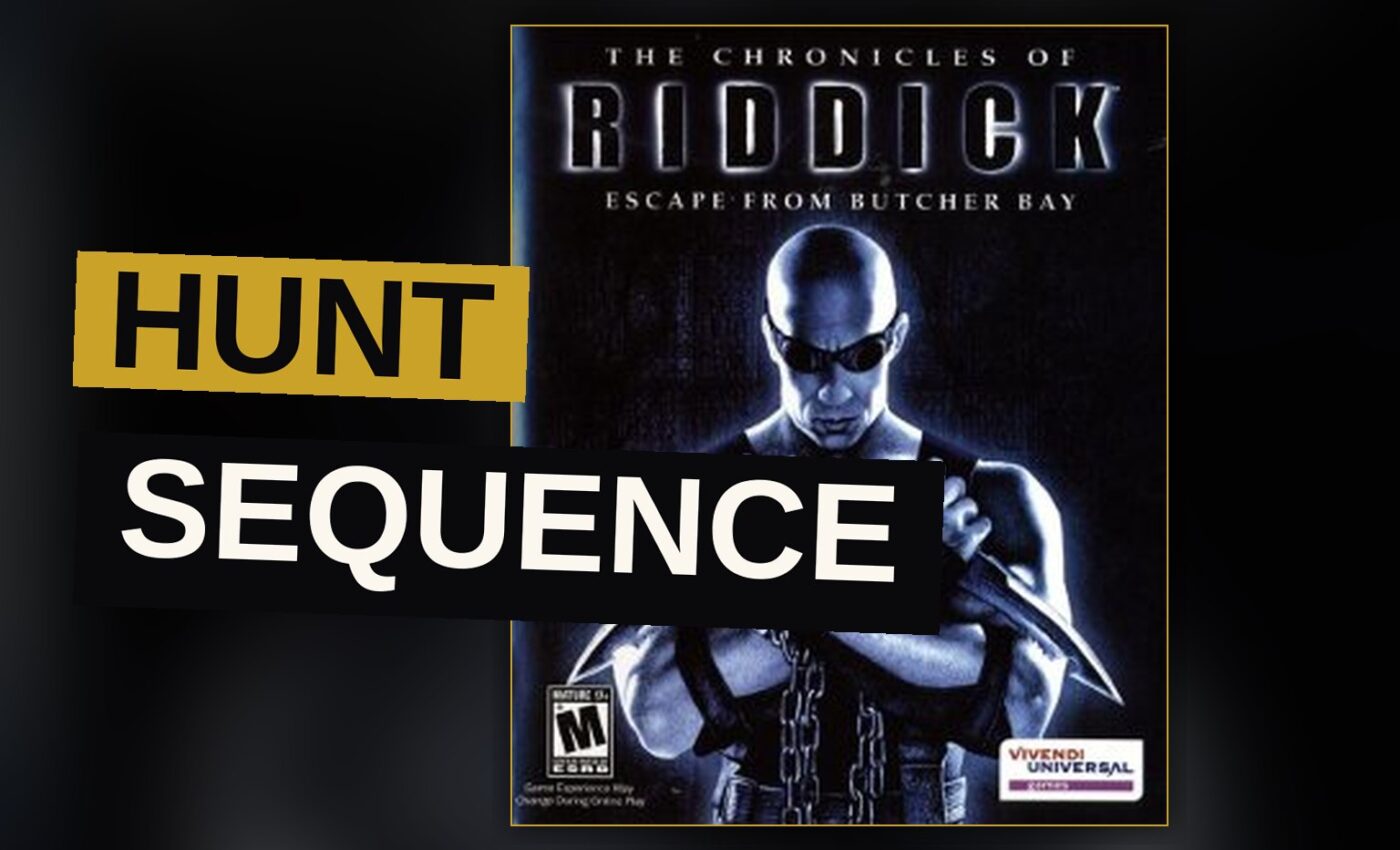
The Chronicles of Riddick: Escape from Butcher Bay opens with a cinematic of Riddick in hiding, hair and beard grown long, before the opening scene of The Chronicles of Riddick film. He hunts an animal and kills it. A disembodied voice asks where he got his eyes. He says a “slam preacher” gave them to him.
Escape from Butcher Bay is a prequel to Pitch Black. Released in 2004 for the Xbox and Microsoft Windows, developed by Starbreeze Studios and Tigon Studios and published by Vivendi Universal Games, it should not work. Film tie-in games in 2004 were a punchline. This one is cited as one of the greatest video games ever made.
Richard B. Riddick Walks Into Single-Max
Vin Diesel reprises his role as Richard B. Riddick, and he was involved in the game’s development. Riddick is a murderer recently confined in Butcher Bay, resourceful, and looking to break out by any means necessary. The designers focused on exploring Riddick’s character in a prison break setting specifically to differentiate the game from the film.
His capturer is the bounty hunter William J. Johns, reprised by Cole Hauser, and the two have had previous encounters. Butcher Bay’s warden is a man named Hoxie, played by Dwight Schultz. Abbott, a prison guard the inmates dislike, is played by Xzibit. Pope Joe, an insane old man who lives in the sewer tunnels beneath the prison, is played by Willis Burks II.
The prison itself is the co-star. Butcher Bay is a maximum-security facility built on a barren planet, and no prisoner has ever escaped it. It holds three increasingly secure holding areas and a subterranean mining operation.
Another opening cinematic shows Riddick being transported for collection on the bounty. He and Johns have a brief conversation, and Riddick tells Johns there is no way he is going to get the price he wants. Riddick wakes as they land and stands out front of Butcher Bay waiting for the warden. He sneaks up behind Johns, breaks his neck and proceeds to escape. After getting his hands on a gun, he goes through the ventilation ducts and seemingly escapes into the desert. Everything fades to white as Riddick hears Johns saying, “Rise and shine, Riddick.”
It turns out this escape was simply a dream. Riddick wakes up and Johns escorts him off the ship. Johns meets with Hoxie to negotiate his pay, while Abbott escorts Riddick to his cell in the security area.
No On-Screen Map, No Hand-Holding
Escape from Butcher Bay plays primarily from a first-person perspective, switching to third person during certain scenes. It mixes first-person shooter, adventure and stealth elements.
Unlike many first-person shooters, the game contains no head-up display. On-screen cues are limited to flashes when a new weapon is selected and small white boxes that show health when damage is taken. Health refills in designated areas. Cigarette packs hidden in levels unlock concept art and video files.
The player may interact with and receive quests from the prison’s residents, and earns information, tools and other rewards by completing quests. Violent conflict often occurs between the player, inmates and prison guards. Riddick fights with bare hands or improvised weapons such as shivs and clubs, and stringing punches together builds combos. A DNA-scanning security system initially prevents him from using firearms, but a limited arsenal later becomes available.
Crouching activates a stealth mode. The player moves silently, the edges of the screen tint blue when hidden, and bodies can be dragged out of sight. The mode grants attacks that quickly kill enemies; Riddick can drop on enemies from above or execute them from behind. He also acquires eyeshine, which lets him see in the dark but temporarily blinds him in brightly lit areas.
The game’s influences include the film Escape from Alcatraz and video games such as Half-Life, Thief: The Dark Project and Tom Clancy’s Splinter Cell.
Three Holding Areas and a Sewer
Butcher Bay’s layout gives the game its shape. Three increasingly secure holding areas sit above a mining operation dug into the planet below.
The systems the player works with:
- Quests from inmates that pay out in information, tools and rewards
- Improvised weapons, including shivs and clubs, before firearms unlock
- Stealth mode, entered by crouching, with silent movement and body dragging
- Hidden cigarette packs that unlock concept art and video files
- Eyeshine, which trades bright-light blindness for vision in the dark
The design team drew on the film Escape from Alcatraz and on Half-Life, Thief: The Dark Project and Tom Clancy’s Splinter Cell.
What the game gets right, ranked by how much it matters:
- The stealth mode, which carries most of the tension
- The prison setting, which gives every room a reason to be hostile
- The stripped-back screen, with no head-up display to clutter it
- The character work, which treats Riddick as a subject rather than a mascot
- The length, which is the game’s clearest weakness
The Brevity Problem
Critics praised the game’s graphics and the way it wove stealth, action and adventure together. Some went further and called it better than the film it ties into, which almost never happens for a licensed game. The same reviews faulted it for being short and for shipping without multiplayer.
That complaint is fair. Escape from Butcher Bay ends before its systems get room to breathe. The absence of multiplayer in 2004 was a knock.
The game won several accolades, including the Golden Joystick Award for Unsung Hero Game of the Year and the Spike Video Game Award for Best Game Based on a Movie. In 2009, the game was included in a re-release.
What Butcher Bay Got Right
The dream escape in the opening cinematic is the game’s sharpest piece of storytelling. It gives the player the fantasy first, then reveals it as a dream.
The weaknesses are structural, not cosmetic. The game is short. There is no multiplayer. None of that touches the core, which is a stealth game wearing a licensed property like a coat it actually fits.
The score of 8.9 of 10 reflects a game that does almost everything right and stops too soon. Some critics consider it superior to the film, a rarity among film tie-in games. That is the review this game earned, and it has held.
Get the Notebook.
The day's best stories and every fresh verdict, in plain English, in your inbox by seven. One email a day, no more.