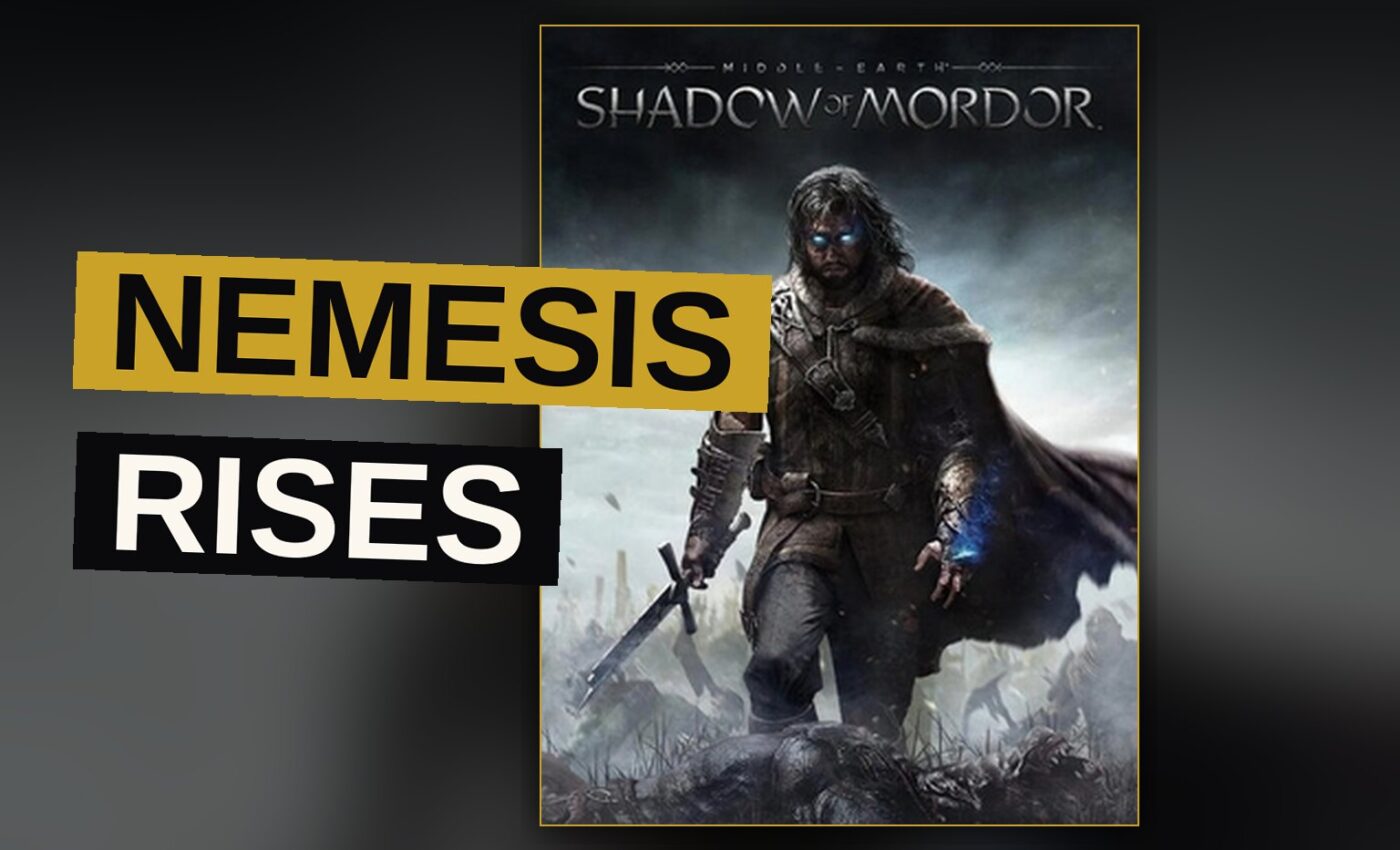
Middle-earth: Shadow of Mordor arrived in 2014 as an original story stitched into the most familiar fantasy map in the medium. Monolith Productions built it for PlayStation 3, PlayStation 4, Xbox 360, Xbox One, PC, Mac and Linux. Warner Bros. Interactive Entertainment published it.
The premise sounds like a licensing exercise: take J.R.R. Tolkien’s legendarium, drop a revenge plot into the 60-year gap between The Hobbit and The Lord of the Rings, and let a ranger cut through orcs. What Monolith actually shipped is stranger and better than that pitch.
You play Talion, a Gondorian Ranger who guards the Black Gate, loses his wife Ioreth and his son Dirhael to a ritual sacrifice, and refuses to stay dead. The wraith of the Elf Lord Celebrimbor merges with him, and the two go hunting.
Trailer, via IGDBcom.
Talion, Celebrimbor, and the Black Gate
The setup is grim and efficient. Talion is a captain of Gondor at the Black Gate of Mordor. Sauron’s Uruk forces, led by three Black Númenórean captains — the Hammer of Sauron, the Tower of Sauron, and the Black Hand of Sauron — overrun the garrison. The Black Hand sacrifices Talion’s family in an attempt to summon Celebrimbor’s wraith. The summoning misfires. Celebrimbor, amnesiac in death, binds himself to Talion instead, and the ranger walks out of Mordor with a dead elf in his skull and a vendetta to feed.
Troy Baker voices and motion-captures Talion. Alastair Duncan plays Celebrimbor. Liam O’Brien turns up as Gollum. Nolan North, John DiMaggio and JB Blanc handle the Black Hand, the Hammer and the Tower. The cast is doing recognizable work, and the story knows what it is: a revenge engine with a mystery bolted to it. Celebrimbor does not remember who he is. Talion does not care yet. Both of them are going to find out.
Mordor Before the Wasteland
The setting is the smartest choice in the game. This is Mordor before it became the dead country of the films — not yet a barren waste. Monolith consulted Tolkien scholars from Warner Bros and Peter Jackson himself to keep the environment consistent with the books and the movies, and Wētā Workshop advised on the special effects. That research shows in the geography. You are walking through a place that still has grass and slaves and trade routes, which makes the later ruin implicit in every vista.
Christian Cantamessa served as lead writer. Dan Abnett wrote the Orc dialogue, and that assignment matters more than it sounds, because the Orcs carry much of the game’s personality. The rest of the cast is locked into a revenge plot. The Orcs have their own business to attend to.
The Nemesis System Is the Whole Game
Every enemy in Shadow of Mordor has a name, a rank and a memory. They keep working their jobs when they are off screen. If you fail to kill one in an encounter, he remembers you, and his tactics and his lines change the next time you meet. Monolith had already experimented with the idea in a cancelled Batman game based on Christopher Nolan’s films. Here it becomes the reason to keep playing.
The system generates its own narrative. A grunt you humiliated in the first hour gets promoted, acquires a title, and shows up later with a grudge and a better weapon. You can brand enemies later in the game and turn them into allies. The hierarchy shifts whether or not you are watching it.
That is the achievement. The Nemesis system turns enemy AI into a story generator, and it is the reason Mordor feels occupied rather than populated.
Fighting, Parkour, and Forge Towers
Combat borrows heavily from the Batman: Arkham series, and Monolith does not hide it. Freeflow melee, counter-attacks, a combo multiplier that rewards a good rhythm — it is the Arkham fight with swords and a bow. Ranged combat and stealth round out the options, and some missions pay more if you complete them a particular way. Celebrimbor’s abilities layer on top: focus-based attacks that slow time while you aim, drain focus from an enemy, or brand a foe outright.
Movement is generous. You cross Mordor by parkour, by riding monsters, or by unlocking Forge Towers that act as fast travel points. The map is fully open.
The content splits into a few clear categories:
- Main story missions following Talion’s quest for revenge
- Side missions tracking Gollum to find artifacts tied to Celebrimbor’s past
- Missions to free human slaves captured by the Uruk armies
- Quests to forge new abilities for Talion’s sword, bow and dagger
- Open-world activities: collecting flora, hunting creatures, finding artifacts and Elvish seals
That is a lot of structure. The collectible layer is the thinnest part of it, but the source material does not rate these activities against each other, and neither will this piece. The list is the list.
What the Story Does With Its 60 Years
Placing the game between The Hobbit and The Lord of the Rings gives Monolith room to invent without breaking anything. Talion is not in the books. Celebrimbor is, but not like this. The game treats the gap as a sandbox for original characters while the films’ imagery supplies the look. It is a licensed game that respects the license enough to hire the people who made it and then goes off to do its own thing.
The amnesia is a functional choice, not a lazy one. Celebrimbor not knowing who he is gives the player a reason to chase artifacts and a reason to care about a wraith who would otherwise be a power-up with a voice. The revenge plot is thinner. Talion’s family dies in the first ten minutes, and the game never really replaces that loss with anything except momentum.
The Nemesis System Earns the Score
Shadow of Mordor scores 8.4 out of 10. The Nemesis system is the reason. It is the rare mechanical idea that turns enemy AI into a story generator.
The caveats are real. The Arkham debt is heavy enough that the combat never quite feels like its own thing. The collectibles are padding. The revenge story runs thin across its length.
Still, this is a licensed game that takes a world everyone knows, picks a corner nobody has used, and hires the right writers and scholars. Talion and Celebrimbor make a workable pair. The Orcs are the actual achievement. Score: 8.4 of 10.
Get the Notebook.
The day's best stories and every fresh verdict, in plain English, in your inbox by seven. One email a day, no more.