
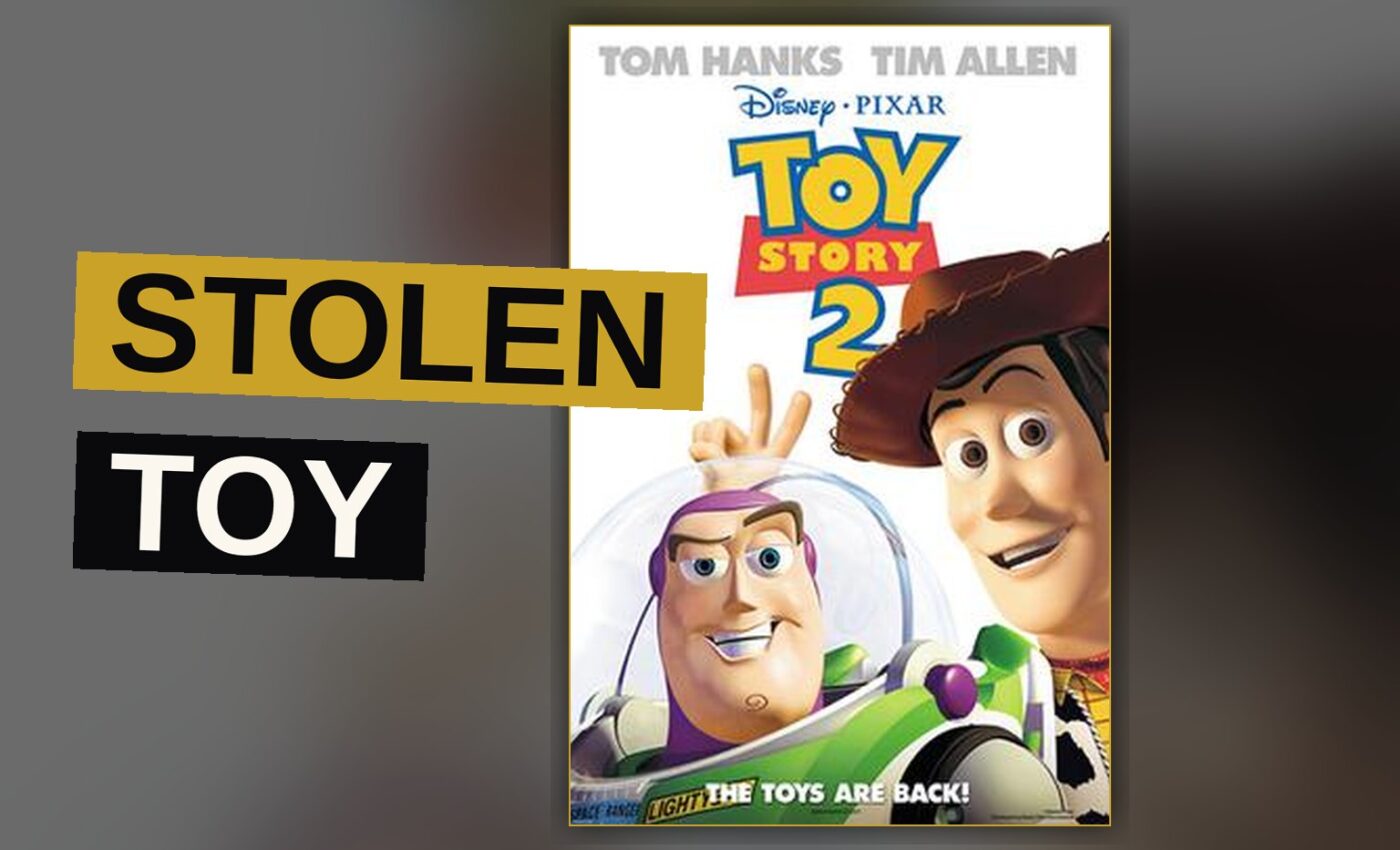
“Toy Story 2” opens with a question most sequels never bother to ask: what does a toy actually fear? John Lasseter’s film answers early. Not the dark, and not the dumpster. Being outgrown. That idea drives everything that follows, and it is why a movie Disney first planned as a cheap direct-to-video product ended up as one of the most assured animated features of its decade.
The setup is small. Andy leaves for Cowboy Camp, and his toys are left to their own devices. During a brief playtime he accidentally rips Woody’s arm. Andy’s mother places Woody on a shelf, and Woody begins to fear that Andy will soon discard him. Then a yard sale, a rescue, and a kidnapping: Woody is stolen by a greedy toy collector, and Buzz Lightyear and his friends mount a rescue.
Trailer, via Disney UK.
Al McWhiggin and the Toy Barn
The thief is Al McWhiggin, owner of “Al’s Toy Barn.” Buzz fails to stop the theft but finds clues identifying him. At Al’s apartment, Woody learns he was designed as the main protagonist of “Woody’s Roundup,” a popular 1950s children’s Western series. There he meets his co-star toys: Jessie the Cowgirl, Bullseye the Horse, and Stinky Pete the Prospector.
Stinky Pete tells Woody that Al plans to sell the entire collection to a toy museum in Tokyo. Woody wants to go home. The group is dismayed, because the museum will not accept the collection without him, which would send them back into storage.
That is the engine of the film, and it is a real dilemma rather than a manufactured one. Woody’s choice is not good versus evil. It is a child who will forget him against a glass case that will never let him go.
The Cast Returns and Expands
Tom Hanks voices Woody and Tim Allen voices Buzz Lightyear, both reprising roles from the 1995 original. The returning ensemble includes Don Rickles as Mr. Potato Head, Jim Varney as Slinky Dog, Wallace Shawn as Rex, John Ratzenberger as Hamm, Annie Potts as Bo Peep, John Morris as Andy, and Laurie Metcalf as Andy’s Mom.
New to the franchise:
- Joan Cusack as Jessie
- Kelsey Grammer as Prospector
- Wayne Knight as Al McWhiggin
This is the last “Toy Story” film to feature Jim Varney as the voice of Slinky Dog before his death the following year. That fact sits quietly under the whole movie now. Varney’s Slinky is loyal and a little slow, and the performance carries no hint of an ending.
A Weekend That Saved the Movie
Disney initially envisioned “Toy Story 2” as a direct-to-video sequel. Production began in a building separated from Pixar, on a small scale, because most of the main Pixar staff were busy working on “A Bug’s Life” (1998).
When story reels proved promising, Disney upgraded the film to a theatrical release. Pixar was unhappy with its quality. Lasseter and the story team redeveloped the entire plot in one weekend. Most Pixar features take years to develop, but the established release date could not be moved, and the production schedule was compressed into nine months.
Lasseter had to add around 12 minutes of material and strengthen what was already there. The extra material could not be padding; it had to feel as if it had always been there, an organic part of the film. With the delivery date less than a year away, Lasseter called Stanton, Docter, Joe Ranft, and some Disney story people to his house for a weekend. He hosted what he called a “story summit.”
Jessie and the Case for the Sequel
The development of Jessie came from Lasseter’s wife Nancy, who pressed him to include a strong female character with more substance than Bo Peep. That push is the best thing that happened to this movie.
Jessie’s backstory lands hardest. Woody learns that Jessie was once loved by her owner Emily, until Emily outgrew her and donated her away. Convinced Andy might do the same, Woody decides to go to the museum. The scene does the work the plot needs without announcing it. It is the reason the second act holds.
The idea of Woody as part of a collectible set traces back to a 1990 pitch called “A Tin Toy Christmas,” a half-hour special Pixar brought to Disney. Al McWhiggin had appeared in a draft of the first “Toy Story” before being cut. Lasseter claimed Al was inspired by himself. The other toys in Woody’s set drew on 1940s–1950s Western and puppet shows for children, such as Four Feather Falls, Hopalong Cassidy and Howdy Doody.
Buzz Meets His Match
Separated from the gang at Al’s Toy Barn, Buzz encounters “Ultra Buzz Lightyear,” a Buzz toy with a utility belt who assumes he is a real space ranger. Ultra Buzz captures and imprisons Andy’s Buzz. He then meets the gang and accompanies them to Al’s apartment, assuming they are on a mission to defeat his arch-nemesis, Emperor Zurg.
It is a comedy detour that also functions as a joke about the first film. Buzz already learned he was a toy. Ultra Buzz has not, and watching the lesson play out again from the outside is funnier than it has any right to be.
The scope changed too. The original “Toy Story” extended over two residential homes, roadways, and a chain restaurant. Unkrich described “Toy Story 2” as something “all over the map.” You can feel that reach. The apartment, the toy store, the airport, the vents and the elevator shafts — the film keeps finding new rooms to play in.
What the Film Gets Right
Lasseter wanted the sequel to honor the first movie and rebuild its world rather than discard it. The premise came from a simple question he kept turning over: what would upset a toy, and what would it feel like to be ignored by a child — or worse, to watch that child move on. Brannon added the yard sale, where a collector spots Woody and recognizes him as a rare artifact.
That question is asked honestly, and the movie does not cheat the answer. Woody’s decision to stay with Andy is not a triumph over temptation. It is an acceptance that he will one day be shelved, and that the time he gets is still worth having.
The film runs 92 minutes. That is tight for the amount of plot it carries: the theft, the apartment, the rescue, the Buzz mix-up, the airport climax, and a Jessie flashback that could have sunk a lesser movie. The compressed schedule did not show up on screen. That is the small miracle here.
Why It Still Holds Up
“Toy Story 2” is a sequel that justifies itself. It expands the world without losing the first film’s central idea, and it introduces characters — Jessie above all — who carry weight the original never asked for. The animation holds up. The jokes land. The ending earns its sentiment.
It is not flawless. The Emperor Zurg material is thinner than the rest, and the movie occasionally moves faster than its own emotional beats can settle. But those are small complaints against a film that redeveloped its entire plot in a weekend and still came out coherent.
Get the Notebook.
The day's best stories and every fresh verdict, in plain English, in your inbox by seven. One email a day, no more.


