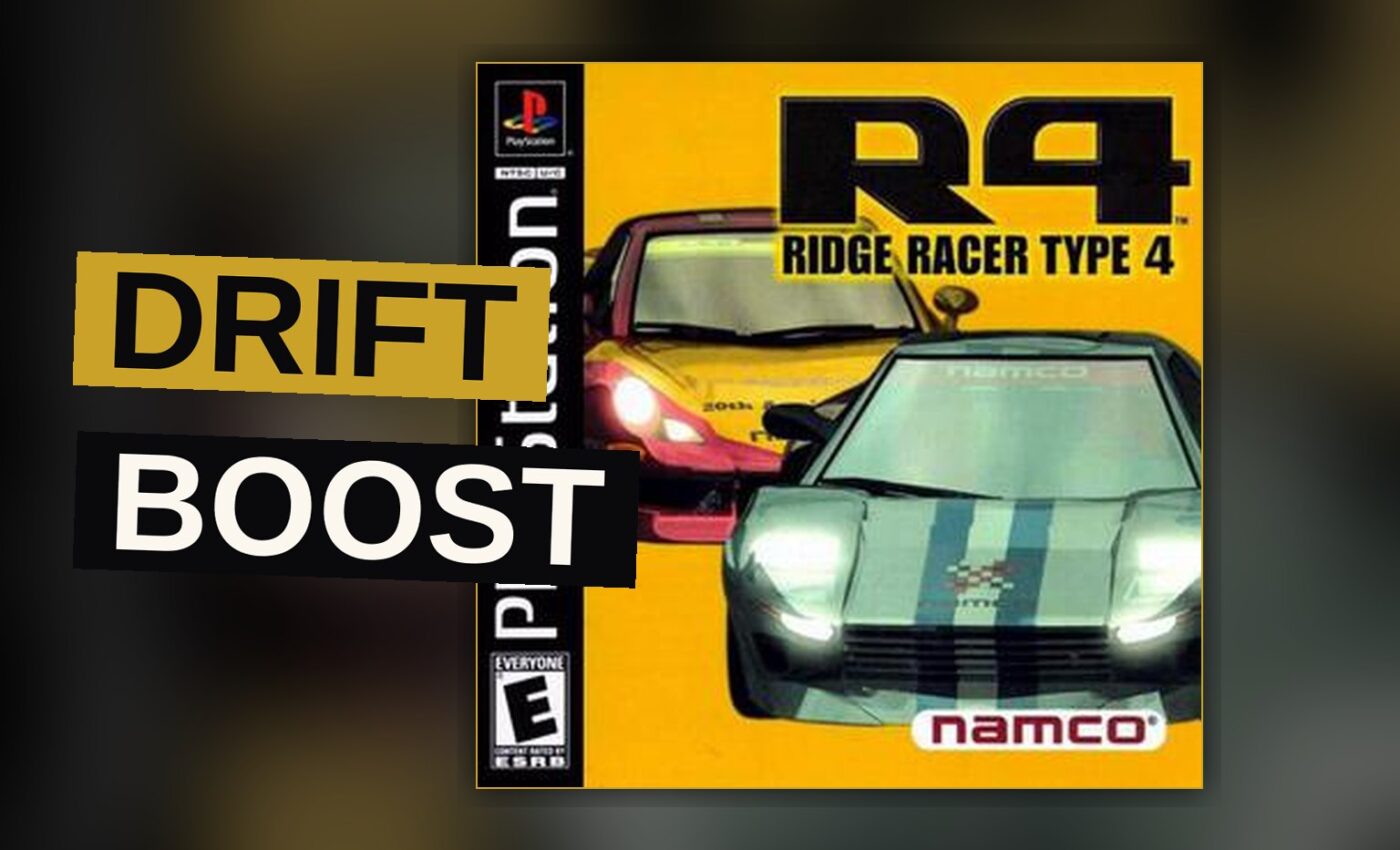
Ridge Racer Type 4 arrived on the original PlayStation as a sequel that refused to sit still. Where previous games in the series offered smooth driving and simple controls, Type 4 pushed the formula toward chaos. The result is a game that rewards skill over patience, and punishes anyone who tries to play it safe.
The setup is familiar to anyone who has played the earlier Ridge Racers. Players race cars around tight, winding tracks, trying to finish ahead of the computer-controlled racers. The twist here is the addition of drift turns, which let players slide through corners at high speed while boosting forward. It sounds simple on paper. In practice, it changes everything.
Drift Turns Change How You Race
Drift turns are the star of Ridge Racer Type 4. By holding down a button during a turn, players can enter a sliding motion that carries the car sideways across the track. Doing this correctly builds up a boost meter, and releasing the button sends the car hurtling forward at a speed that feels genuinely fast. Get the timing wrong, though, and the car spins out of control.
The system rewards aggression. Players who drift early and hold the turn get a bigger boost than those who wait until the last second. This creates a rhythm to each corner: drift, hold, release, repeat. It also means that the best drivers are not necessarily the ones who take the shortest path. They are the ones who take the fastest path, even if it looks reckless.
Tracks That Test Every Skill
The tracks in Ridge Racer Type 4 are varied and demanding. Some are wide and open, letting players build up speed in long straights. Others are narrow and winding, forcing players to use drift turns constantly just to keep the car on the road. The game includes several tracks, each with its own character, and none of them feel like filler.
What sets these tracks apart is the way they use elevation. Some courses rise and fall dramatically, dropping players off cliffs or sending them down steep hills. Others feature tight tunnels and narrow bridges that require precise timing to clear. These elements force players to pay attention to more than just the road ahead. They have to think about the ground below, the wall beside them, and the car behind.
The difficulty curve is steep. Early tracks are forgiving, letting new players learn the basics without too much punishment. Later tracks, especially the final championship races, demand near-perfect execution. A single mistake can send a player off the course, losing precious seconds that cannot be recovered.
Championship Races and the Ranking System
The game is built around championships, not individual races. Players move through a series of cups, each containing several tracks, and must perform well enough to advance. The ranking system is harsh: failing to finish a cup within a certain time limit sends the player back to an earlier track, forcing them to replay it. This creates a sense of urgency that is missing from other racing games of the time.
The ranking system is not just a time limit. It also grades players on their performance, rewarding those who complete tracks quickly and cleanly. A perfect run earns a gold medal, while a poor run earns nothing at all. This encourages players to try again, not to give up.
Sound and Presentation
The presentation is solid for its time. Tracks are rendered in bright, colorful environments, with detailed backgrounds that include buildings, trees, and water. The cars themselves are well-detailed, with distinct shapes and colors that make them easy to identify at a glance. The lighting effects, particularly in the nighttime tracks, add a layer of depth that few other racing games on the PlayStation could match.
The music is energetic and fitting for the action on screen. It changes pitch and intensity depending on how well the player is doing, which adds to the sense of urgency during a championship run. Sound effects for engines, tires, and collisions are crisp and immediate, giving players instant feedback on their actions.
Where the Game Falls Short
Ridge Racer Type 4 is not without flaws. The camera can be a problem on some tracks, especially those with tight turns and low ceilings. It sometimes fails to show the full width of the road, leaving players guessing where the edge is. This is a common issue in the genre at the time, but it is still a frustration when it happens during a crucial moment.
The game also lacks a mode for free roaming. Players who want to test a particular track or simply enjoy driving around cannot do so without entering a championship. This limits the game’s replay value for some players, who might otherwise spend hours exploring the tracks at their own pace.
A Formula That Still Works
Despite these issues, Ridge Racer Type 4 remains a strong entry in the series. The drift turns are a genuine innovation, and the tracks are some of the best in the genre. The championship format keeps players engaged, pushing them to improve their skills over time.
It is a game that rewards dedication. Players who stick with it will find themselves getting better week after week, unlocking new cars and new tracks along the way. Those who give up early will miss out on a rewarding experience.
Final Score
Ridge Racer Type 4 is a game that asks a lot of its players, but it delivers a lot in return. The drift turns are a standout feature, and the tracks offer a varied challenge that keeps the game fresh. The camera issues and lack of free roam modes are real problems, but they do not sink the overall package.
Key Facts
- Platform: original PlayStation
- Genre: arcade-style racing
- Main feature: drift turns for boost acceleration
- Format: championship cups with ranked results
- Difficulty: steep, especially in later cups
What Players Should Know
If you pick up Ridge Racer Type 4, expect to lose a few hours to the championship cups. The game is designed to be played in short sessions, but it will pull you back for one more run. The drift turns are the hook, and once you master them, the game opens up. Just be prepared for the camera to let you down at the worst possible moment.
Ridge Racer Type 4 is a worthy addition to the series. It takes a proven formula and pushes it forward, adding a mechanic that changes how the entire game is played. The presentation is strong, the tracks are varied, and the difficulty is fair. It is a game that rewards skill and punishes carelessness, and it does both with confidence.