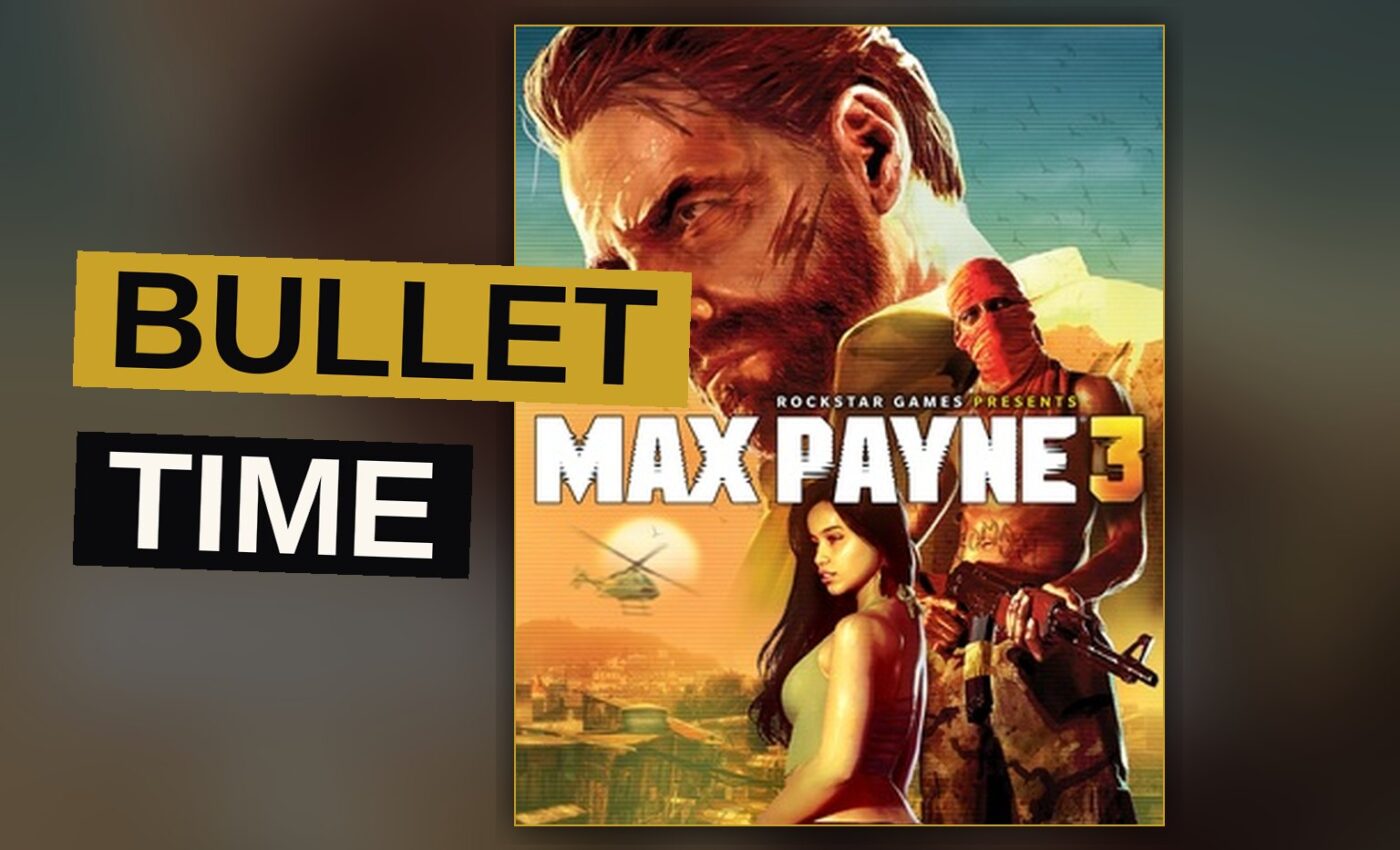
Max Payne 3 is a brutal, beautiful, and often baffling contradiction. It is a third-person shooter that feels like a John Woo film directed by Tony Scott, soaked in blood and Brazilian sunlight. It is also a game that asks you to care about a man who has given up caring about himself. The result is one of the most polished and punishing action games of its generation, and a fitting, if grim, end to the saga of the series’ titular hero.
Developed by Rockstar Games, Max Payne 3 was released in 2012 for PS3, PC, Mac, and Xbox 360. It arrived nine years after the last installment, and the gaming landscape had changed. Cover shooters were the norm, and the gritty, noir-ish detective story of the original games felt like a relic. Rockstar’s answer was not to modernize Max, but to break him. The game picks up years after the events of Max Payne 2, with Max retired from the NYPD, living in Hoboken, and drowning in whiskey and painkillers. He is a shell of a man, a walking corpse with a badge and a gun.
Trailer, via Duimschroef NL.
A Man Who Quit the Force
The story is a long, slow descent. Max is hired as a private security consultant for the Branco family, a wealthy and powerful clan in São Paulo, Brazil. His job is to protect Rodrigo Branco and his wife, Fabiana. It is a simple assignment that goes horribly wrong, dragging Max into a war between the police, the local militia, and a gang of drug traffickers. The plot is convoluted, full of double-crosses and shadowy figures, but the emotional core is simple: Max is tired. He is tired of the killing, tired of the pain, and tired of himself.
The writing is sharp, and the voice-over narration returns with a vengeance. Max’s internal monologue is a stream of cynical, self-loathing poetry. He does not crack jokes; he makes observations that are as bleak as the scenery. The game is not subtle about its themes, but the performance by James McCaffrey is so committed that it never feels overwrought. He delivers his lines with a weariness that is genuinely affecting.
Bullet Time and Body Counts
The gameplay is where Max Payne 3 both shines and frustrates. The core mechanic remains the signature “Bullet Time,” which allows Max to slow down time, dodge in any direction, and fire his weapons with pinpoint accuracy. The game’s physics engine makes every gunfight a chaotic ballet of shattered glass, flying debris, and ragdoll enemies. The shootdodge is a joy to use, and the slow-motion kill cams that follow your final bullet are gratuitous and glorious.
However, this is a hard game. The enemy AI is aggressive and accurate, and they will flank you, flush you out with grenades, and punish you for staying in cover for too long. Max is not a superhero; he is a middle-aged man who can only take a few hits before the screen goes red. The game forces you to keep moving, to use Bullet Time not as a crutch but as a survival tool. This creates a tense, exhilarating loop.
The problem is the difficulty spikes. Some encounters are brutally unfair, with enemies spawning from behind you or throwing grenades with pinpoint precision that leave you with no escape. Dying is frequent, and the load times on the PS3 version are long enough to break your momentum. The game wants you to feel Max’s pain, and it succeeds, sometimes at the cost of fun.
A Tour of Destruction
The game is structured as a series of linear levels, but Rockstar has dressed them up as a world tour. You start in the grimy streets of Hoboken, then move to the sun-drenched favelas of São Paulo, and later to a glitzy, dangerous nightclub and a sprawling construction site. Each location is rendered with stunning detail. The lighting is superb, the character models are expressive, and the environments are full of life, even when that life is being violently extinguished.
The variety is a blessing, and the pacing is relentless. The game is mostly a series of firefights, but the context changes. One level might have you protecting a VIP in a crowded hotel, another might have you fighting your way through a burning building, and another might have you on a rooftop with a sniper rifle. This keeps the experience fresh, even when the core loop is repetitive.
The sound design is equally impressive. Gunfire is loud and punchy, and the score, composed by Health, is a mix of industrial noise and electronic pulse that perfectly matches the game’s frantic energy.
The Painkiller Problem
One of the most controversial aspects of Max Payne 3 is its handling of painkillers. In the original games, painkillers were a limited resource that could heal you in the middle of a fight. Here, they are almost always available. You can hold a large number at a time, and they are frequently dropped by enemies. This makes the game easier in one sense, but it also changes the risk-reward dynamic. You are encouraged to be aggressive, because you can always pop a pill and keep fighting.
The game also features a “Last Stand” mechanic. When you take fatal damage, you enter a slow-motion state where you can draw your pistol and try to take down the enemy who shot you. If you succeed, you get back up with a sliver of health. This is a clever system that gives you a second chance, but it can also feel cheap when you are killed by an enemy you never saw.
Story Structure and Pacing
The narrative is a major part of the appeal, but it is also where the game stumbles. The plot is overly long and convoluted, with too many characters and too many twists. The game runs for about twelve hours, and the last third feels padded. The villain, a man named Victor Branco, is not particularly memorable, and the final confrontation feels anticlimactic.
The game also has a problem with its depiction of Brazil. The game is set in São Paulo, and it paints a picture of a country ravaged by poverty, corruption, and violence. The favelas are shown as dangerous, lawless places, and the police are as corrupt as the criminals. This is a valid artistic choice, but it borders on stereotyping. The game’s portrayal of the Brazilian characters is often one-dimensional, and the use of Portuguese subtitles for the local dialogue, while authentic, can be distracting.
The game is divided into three main acts, each with its own setting and tone. This structure gives the game a sense of progression, even if the middle section drags.
| Act | Setting | Main Event |
|---|---|---|
| Act 1 | Hoboken, New Jersey | Max’s descent into alcoholism and his first job |
| Act 2 | São Paulo, Brazil | The protection of the Branco family and the ensuing chaos |
| Act 3 | São Paulo, Brazil | The final confrontation and the resolution of the plot |
The Legacy of a Broken Hero
Despite its flaws, Max Payne 3 is a technical marvel. The animation is some of the best ever seen in a game at the time. Max’s movements are fluid and weighty, and the way he reloads his weapons, checks his surroundings, and reacts to being shot is incredibly detailed. The Euphoria physics engine makes the ragdoll deaths look realistic and brutal.
The game also includes a multiplayer mode, which was a major selling point at the time. It features a “Gang Wars” mode, a series of objective-based matches tied together by a narrative. The multiplayer is not the main draw, but it is a solid addition.
The Verdict
Max Payne 3 is a game of extremes. It is a technical showcase, a narrative tour de force, and a punishing challenge. It is also a game that is too long, too difficult, and too self-indulgent. It demands a lot from the player, but it also gives a lot in return.
The game’s strengths are its action, its presentation, and its atmosphere. The weaknesses are its pacing, its story, and its difficulty spikes. It will appeal to players who want a hardcore, cinematic experience, but it will alienate those who prefer a more relaxed, accessible shooter. It is a masterpiece of style, but it is not a masterpiece of design. The game’s published critical score was an 8.9 out of 10. That score feels right.
Here is a summary of the game’s key points:
- The shooting and Bullet Time mechanics are the best in the series.
- The story is compelling but overlong and convoluted.
- The presentation is stunning, with excellent graphics and sound.
- The difficulty is punishing, with some unfair encounters.
- The multiplayer is a solid but not essential addition.
Max Payne 3 is a game you have to work for. It will test your patience and your reflexes. It will make you feel the weight of its violence. It is not fun in the traditional sense, but it is compelling.
It is a fitting end to the Max Payne story, a story that was always about a man who could not escape his past. The game does not offer him redemption, only an ending. It is a broken, beautiful, and ultimately tragic figure of a game — a perfect reflection of its protagonist.
Get the Notebook.
The day's best stories and every fresh verdict, in plain English, in your inbox by seven. One email a day, no more.