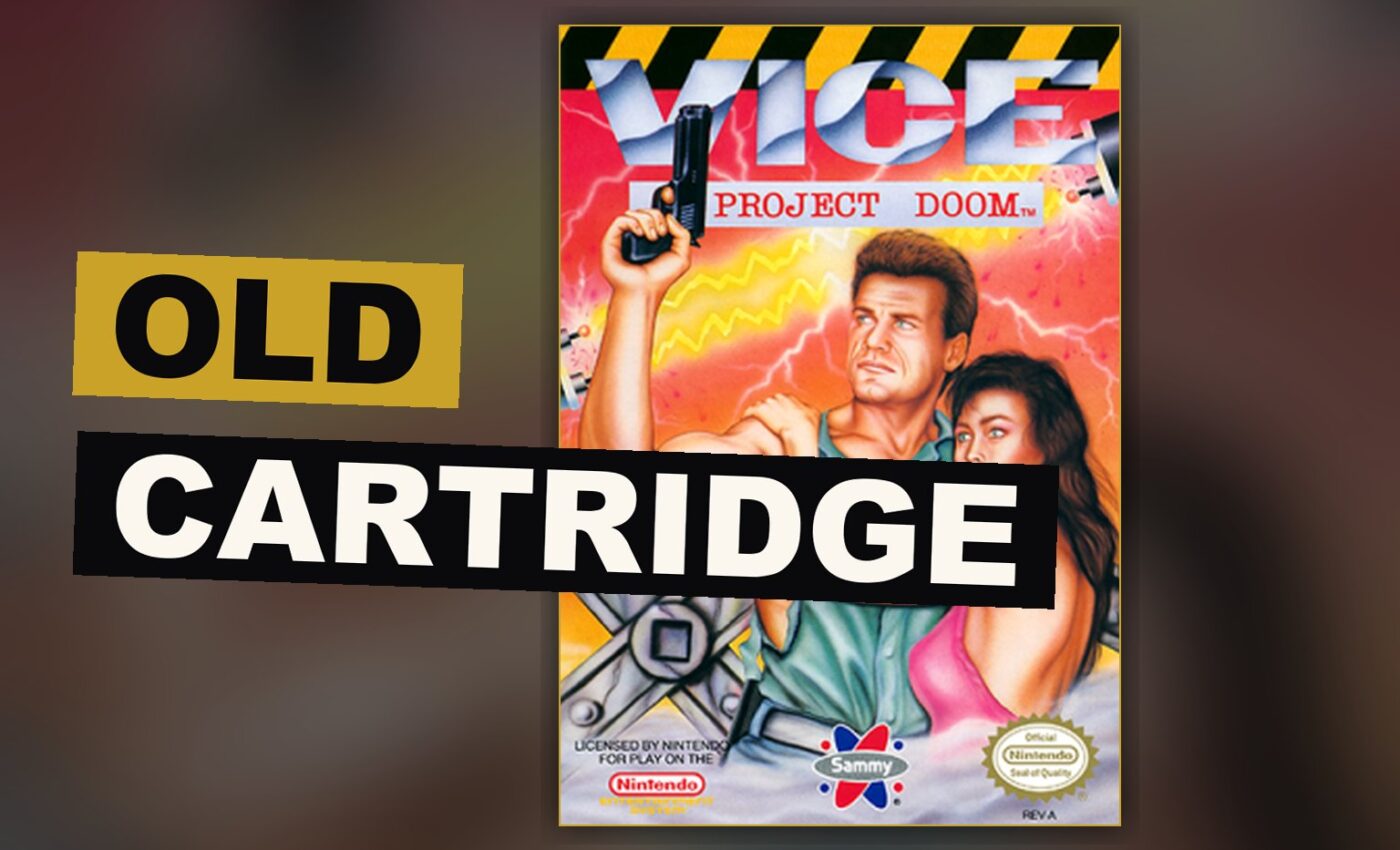
Vice: Project Doom opens with a man on a road and ends with a conspiracy that reaches off the planet. Between those points, Aicom built one of the strangest, most confident action games on the Nintendo Entertainment System.
The game came out in Japan on April 26, 1991, and in North America that November. Sammy Corporation published it. It runs on the NES and the Family Computer. A Sega Mega Drive conversion, titled Deep Scanner, was in development but never released. Sega put the game on the Nintendo Classics service in August 2019, since Sammy had kept the rights before merging with Sega.
Detective Hart and the B.E.D.A. Corporation
The player is Detective Hart, a member of the Vice unit. He is assigned to investigate the B.E.D.A. Corporation after his partner Reese disappears during an earlier case. B.E.D.A. builds electronic equipment and military weapons, but the company is really a front for aliens who have lived on Earth in secret for centuries.
Those aliens made a substance called “Gel.” It was meant as food for their species. It also works as an addictive drug in humans, with terrible side effects, and it is now sold in the underworld. Hart’s lover and fellow Vice agent, Christy, helps him, along with their acquaintance Sophia.
The plot unfolds in a large number of cut-scenes for its time, mixing anime, noir and biopunk. Hart chases a maniac down a road, beats an armed truck, and finds a monster behind the wheel. The cargo is an unknown substance. Christy and Sophia trace it to the mafia and a sorcerer named Kim Long. Hart goes to China, fights through mafia and monsters, and beats Kim.
Eleven Stages, Three Genres
Vice: Project Doom has 11 stages. The first level and Stage 10 are driving stages. Stage 4-2 and Stage 11-1 are shooting stages. The rest are side-scrolling and parallax-scrolling stages. Each one opens with a movie-style sequence that carries the story.
In the main stages, Hart jumps, attacks, crouches and climbs ladders. He can run while crouching. He carries three weapons: a laser whip, a .44 Magnum revolver, and M-24 Stick grenades. The laser whip works at short range and never runs out. Bullets and grenades are limited, so the player refills them from supplies dropped by defeated enemies.
Meat and other items restore health. Coins give an extra life for every 100 collected. The player has a health gauge, a limited number of lives, and unlimited continues.
Route 246 to the BEDA Headquarters
The driving stages switch to an overhead view. Hart drives a red Ferrari F-40, shifts between three gears, and fires the car’s gun at enemy vehicles. The shooting stages put the player behind Hart’s eyes, moving a target indicator across moving scenery, firing with one button and throwing grenades with the other.
The stage list runs Route 246, Waterfront (Construction Site), Chinatown, Port, Ricardo Range, Warehouse 0001, Train and Sewers, Power Plant, Bio-Tech Laboratory, Harbor, and the BEDA Corporate Headquarters.
That range is the game’s best argument. A lesser NES action title picks one mode and repeats it until the cartridge wears out. Vice: Project Doom keeps changing the question. The driving stages are thin on their own, and the shooting stages are a straight lift of the Operation Wolf idea, but they arrive when the platforming is about to go stale and they leave before they wear out their welcome.
The Revolver and the Laser Whip
The side-scrolling sections carry the most weight, and they invite the comparison the game has always lived with: Ninja Gaiden. The resemblance is not subtle. The difference is the gun. A revolver and a grenade supply change how a player reads a room, because the strongest weapon is also the one that runs dry. The laser whip is the safety net. The Magnum is the risk.
Reese, Ricardo, and the Jungle Base
Christy finds soil particles on Kim’s clothes from the city of Ricardo, in Central America. That leads Hart to a secret research base in the jungle, where he fights a flying cyborg. When he wins, he recognizes the machine’s pilot: Captain Reese, the friend he thought was dead. The story does not stop there, and neither does the game.
The cut-scenes deserve credit for ambition. They also deserve a warning. The translation wobbles, and the plot leans hard on a conspiracy that keeps adding layers faster than it resolves them. A player who wants clean answers will not get them.
Vice: Project Doom is a side-scrolling platformer with noticeable similarities to the Ninja Gaiden series for the NES, with the addition of gun shooting and driving segments as well.
The Verdict on Vice: Project Doom
What holds up is the structure. Eleven stages, three play styles, and a difficulty curve that trusts the player to keep up. What dates is the shooting stages, which are more a change of pace than a real idea, and the story, which is more interesting in its premise than in its telling.
Vice: Project Doom is not Ninja Gaiden. It is the game that watched Ninja Gaiden closely and then added a car, a revolver and a drug-running alien corporation. That should be a mess. It is not.
Key facts
– Released: April 26, 1991 (Japan); November 1991 (North America)
– Developer: Aicom
– Publisher: Sammy Corporation
– Platform: Nintendo Entertainment System / Family Computer
– Stages: 11
– Critical score: 7.3/10 (IMDb)
Get the Notebook.
The day's best stories and every fresh verdict, in plain English, in your inbox by seven. One email a day, no more.