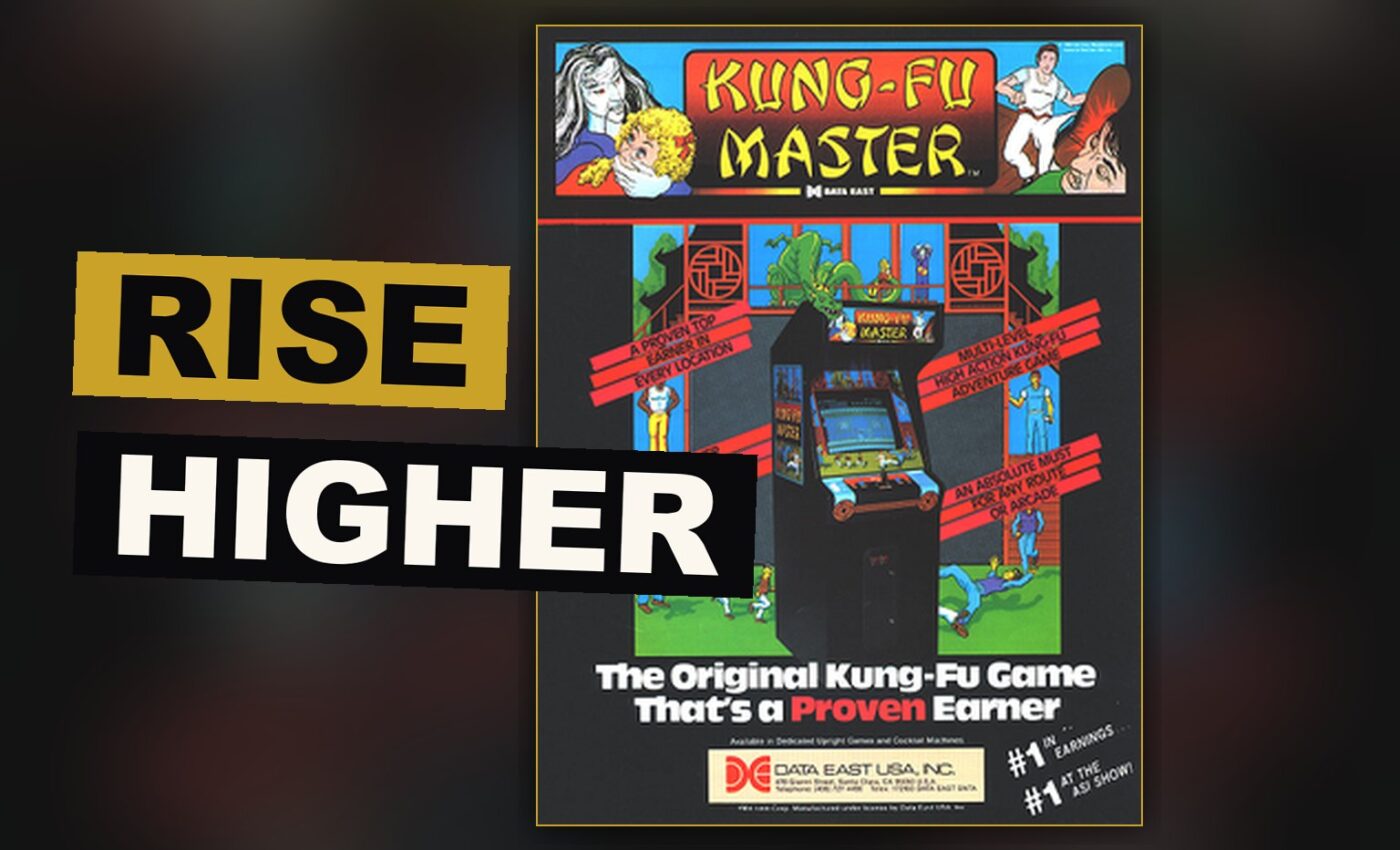
Kung Fu puts a single fighter against a building full of enemies, one floor at a time. The goal is plain: rise through five floors, beat a boss on each, and reach the top to save an ally taken captive. There is no chart of the building, no menu screen. Just fists, feet, and forward motion.
The Fight Itself
The player controls Thomas, who strikes with hands and feet through waves of enemies. The controls are limited to left, right, strike, kick, stoop, and spring upward. Enemies come in a small number of types, and once a player learns how they act, most floors become a matter of repeating the same few moves.
There is little change in how fights unfold. Enemies walk toward Thomas in fixed lines, and the correct answer is almost always the same move at the same distance. That repeating is not necessarily a weakness on its own, but it does mean the middle portion of play can feel like one long spell rather than a true advance.
The Boss Fights
Each floor ends with a boss, and these fights are the clear high point. The bosses hit harder, move unlike the regular enemies, and force the player to change timing rather than repeat what has already been learned. Some demand a particular approach that only becomes clear after a failed try or two.
That method of learning by failing extends the game’s length in a way that feels earned rather than forced. A player who dies to a boss usually understands why on the next attempt. That kind of understanding is not always present elsewhere in Kung Fu.
How Long It Takes
Kung Fu is short in its shape but not necessarily short in time spent, since its difficulty forces repeated attempts. Five floors does not sound like much on paper, but the rise through each one, together with harsh enemy timing, turns a short game into a longer sitting.
Here is a rough breakdown of how a play through moves across the game’s five floors:
| Floor | Enemy Focus | Boss Fight |
|---|---|---|
| 1 | Simple fighters | First boss |
| 2 | Faster foes, knife throwers | Second boss |
| 3 | Mixed enemy waves | Third boss |
| 4 | Thick groups of enemies | Fourth boss |
| 5 | Hardest enemy mix | Final boss |
This shape keeps the game easy to follow even without a chart or menu screen. A player always knows the next goal: get through the floor, beat the boss, rise higher.
Look and Sound
The look of the game is simple, in line with early NES titles. Character figures are small, scenery is bare, and motion is limited to a few frames per action. None of this stands out today, though it did its job at the time.
The sound is just as plain. A small number of effects cover strikes, kicks, and enemy falls, and the music repeats behind the action without much change. Neither element does much to raise the game beyond its core fighting design.
Where It Comes Up Short
The lack of change in regular enemy fights is the game’s clearest weakness. Once a player learns the small set of enemy ways, most of the game’s fights outside boss battles become dull work. There is no added move to earn, no branching path, and no reward beyond reaching the next floor.
The game also explains little of its own rules. Kung Fu does not tell the player much beyond the setup at the start, and it expects failure and repetition to fill in the rest. That approach works for boss fights, where failure teaches something clear, but it works less well for the ordinary enemy waves, where failure often just means trying the same move again.
Kung Fu
There is not much more to the presentation than that title screen and the rise that follows. What Kung Fu offers is a tight, if narrow, form: five floors, a small set of enemy types, and boss fights that ask for real attention. The game does not remain past its welcome by adding needless systems, but it also does not do much to grow its central idea once the core design is set.
Final Word
Kung Fu holds up as a plain, at times demanding action game with little in the way of depth. The core design rewards learning enemy ways, especially in its boss fights, but the space between those fights depends heavily on repeating. It is not a game that asks much of a player’s imagination, but it does ask for patience.