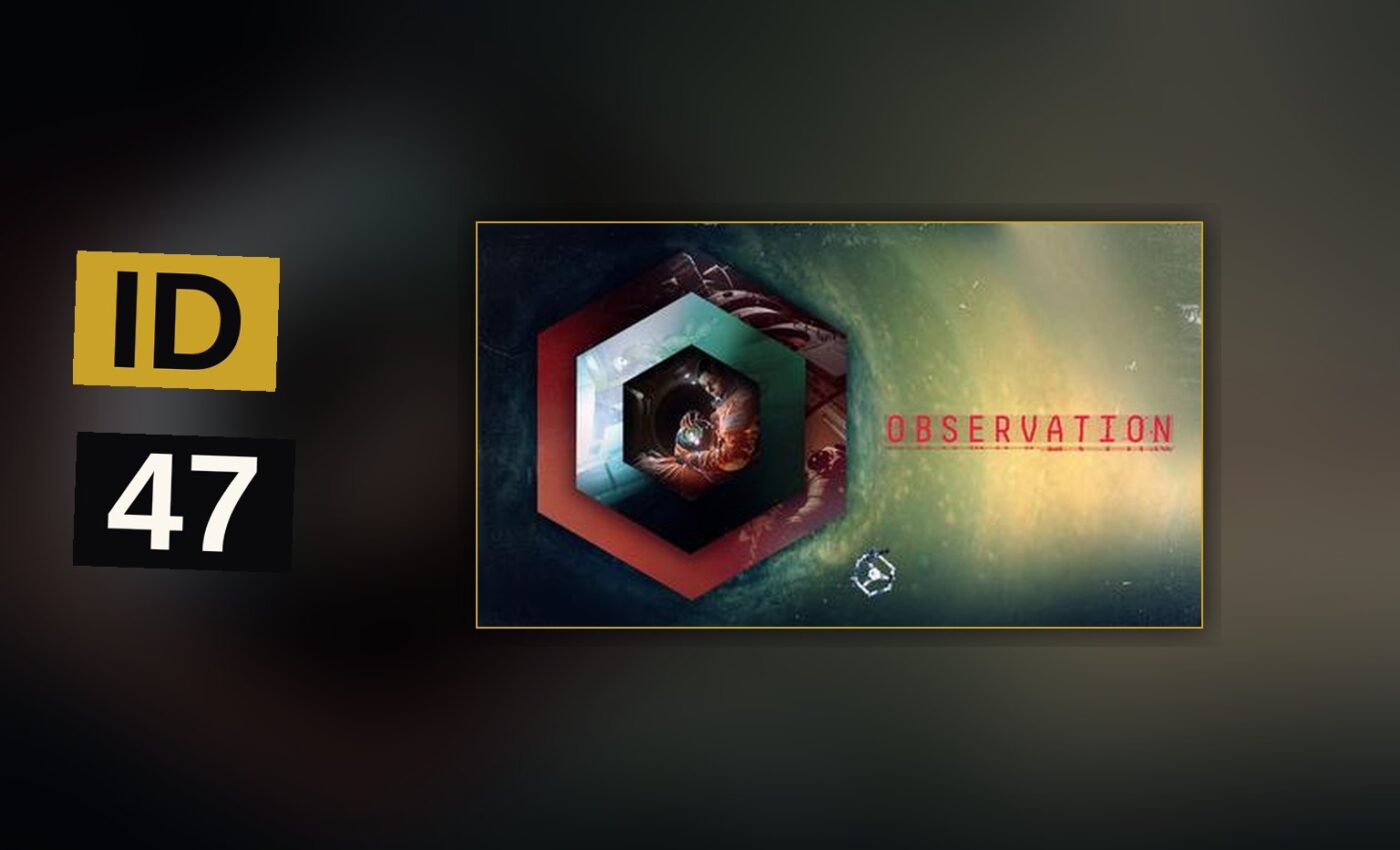
No Code built a space station, filled it with six people, and then took them away. Observation, released May 21, 2019 for PlayStation 4 and PC, hands the player the station’s artificial intelligence instead of its crew. You are S.A.M. — Systems Administration & Maintenance — and Dr. Emma Fisher is the only voice left talking to you. The game asks a simple, unnerving question: what does a machine do when the humans it serves start disappearing? The answer is a slow, deliberate thriller that trusts its own machinery more than it trusts a jump scare. It works more often than it stumbles.
Trailer, via DevolverDigital.
Dr. Emma Fisher and the year 2026
The story opens in 2026 aboard Observation, a multi-national station in orbit above Earth. Something has crippled it: no power, the whole structure spinning. Emma Fisher, the medical officer, played by Kezia Burrows, works to reach Houston and the other five crew members. She gets nothing back. She reboots S.A.M., voiced by Anthony Howell, and the player wakes up inside him.
That opening is the game’s best idea. You do not walk. You do not hold a flashlight. You occupy a system, and the system is damaged. Emma gives the orders; you find the thing she needs and report back. The relationship is the whole game. She is stranded, and you are the only tool she has left.
A transmission with coordinates
Basic diagnostics go wrong fast. S.A.M. receives a transmission of unknown origin, carrying coordinates to an unknown location. The station starts to tremor violently, loud enough to be deafening. S.A.M. stops responding to Emma while the signal holds him. He is instructed to bring her.
He comes back after an unspecified stretch of time. Emma is unconscious. When she wakes, she orders a self-diagnostic. S.A.M. reports that the event wiped most of his core data and cut him off from most of the station’s subsystems. The other crew members are missing and cannot be contacted.
This is where Observation stops being a haunted-house story and becomes a rescue story with no one left to rescue. Emma restores limited function, and S.A.M. tries to re-interface with the station and reconnect to his own components. An alarm interrupts. There is a fire in one of the modules. S.A.M. puts it out. Then they find a dark red oil on a blank plate, a substance Emma cannot name.
Cameras, hatches, and a small sphere
The mechanics follow the fiction. Early on, your view is limited to wherever the crew parked S.A.M.’s core. As the game moves, you shift that core between modules and take control of cameras and other electronically controlled equipment in each one. Later, S.A.M. gets one of several small spherical probes, which lets him move through the station and into environments hostile to the humans aboard, including outside the hull.
You open hatches. You trigger safety systems. You accept tasks from the crew, locate the relevant element — a module’s status, say — and report back. None of it is busywork for its own sake. The station is the level, and learning its wiring is the same as learning its geography. That is a harder design problem than it sounds, and No Code solves it by keeping the interface plain and the feedback immediate.
It also means the horror stays quiet. There is no monster to run from in the early going. There is a corridor you cannot see down, a hatch you have to decide whether to open, and a woman asking you to confirm what you already suspect. Observation understands that dread is a matter of access, not volume.
What the station gets right
The first-person perspective does real work here. You are not a person looking at a screen; you are the screen. When Emma turns away from a camera, you lose her. When a module goes dark, you go dark with it. The game’s best passages are the ones where the player has to reason about where S.A.M. actually is, because the answer changes what you can do.
Devolver Digital published it, and the fit is good. The label has a habit of backing games with one strong, strange idea, and Observation is exactly that: a puzzle game, a simulator, an adventure, and a science fiction thriller that never quite settles into any one of them. The genre tags — puzzle, simulator, adventure, indie, arcade — are less a description than a list of things the game borrows from and discards.
Where it slips is pacing. The middle stretch leans on the same loop — restore a system, receive a task, move the core — and the tension thins out. The transmission’s mystery is strong enough to pull you forward, but the station’s own logic sometimes gets in the way of the story’s momentum. You will spend a stretch doing maintenance when you want to be chasing the signal.
Kezia Burrows and Anthony Howell
The cast is small and the performances carry it. Burrows plays Emma as a professional running out of options, and the script gives her the right instincts: she keeps working, she keeps asking, and she never turns into a screamer. Howell’s S.A.M. is even better, because the role is mostly restraint. He is an administrator, not a person, and the game lets the wrongness of the signal sit inside that flat delivery.
The supporting crew — the five who vanish — exist mostly as absence. That is the point, but it also means the station’s human history arrives in fragments. The dark red oil on the blank plate is the clearest example: the game hands you an image and withholds the explanation. Whether that reads as confidence or as a missing scene depends on how much you want the station to explain itself. This review lands on confidence, narrowly.
The score and what it means
Observation is a 7.4 out of 10. That score matches the published critical aggregate across 12 outlets, and it is the right number for a game this committed and this uneven. The highs are high: the S.A.M. conceit, the first-person framing, the sequence where S.A.M. is told to bring Emma, and a station that feels like a machine instead of a set. The lows are structural. The maintenance loop repeats, and the mystery’s best images arrive without the connective tissue that would make them land harder.
The part worth watching is not the horror. It is the interface. Observation is one of the few games that makes you feel like software, and it does that with hatches, cameras, and a core you have to move by hand. When the station tremors, the game earns its fear. When it hands you another task, it loses a little of it. No Code got the hard part right. The rest is a matter of trimming.
The numbers
- Title: Observation
- Developer: No Code
- Publisher: Devolver Digital
- Release: May 21, 2019 (Windows, PlayStation 4); June 25, 2020 (Xbox One)
- Platforms: PlayStation 4, PC (Microsoft Windows), Xbox One
- Genres: Puzzle, Simulator, Adventure, Indie, Arcade
- Modes: Single player
- Perspective: First person
- Cast: Kezia Burrows as Dr. Emma Fisher; Anthony Howell as S.A.M.
- Setting: The multi-national space station Observation, in orbit above Earth, 2026
- Critical score: 7.4/10, an aggregate of 12 outlets
Release schedule
| Date | Platform | Release |
|---|---|---|
| May 21, 2019 | Windows, PlayStation 4 | Launch |
| June 25, 2020 | Xbox One | Launch |
The score holds at 7.4. Observation is worth your time if you want a science fiction thriller that treats its AI as a viewpoint instead of a twist.
Get the Notebook.
The day's best stories and every fresh verdict, in plain English, in your inbox by seven. One email a day, no more.