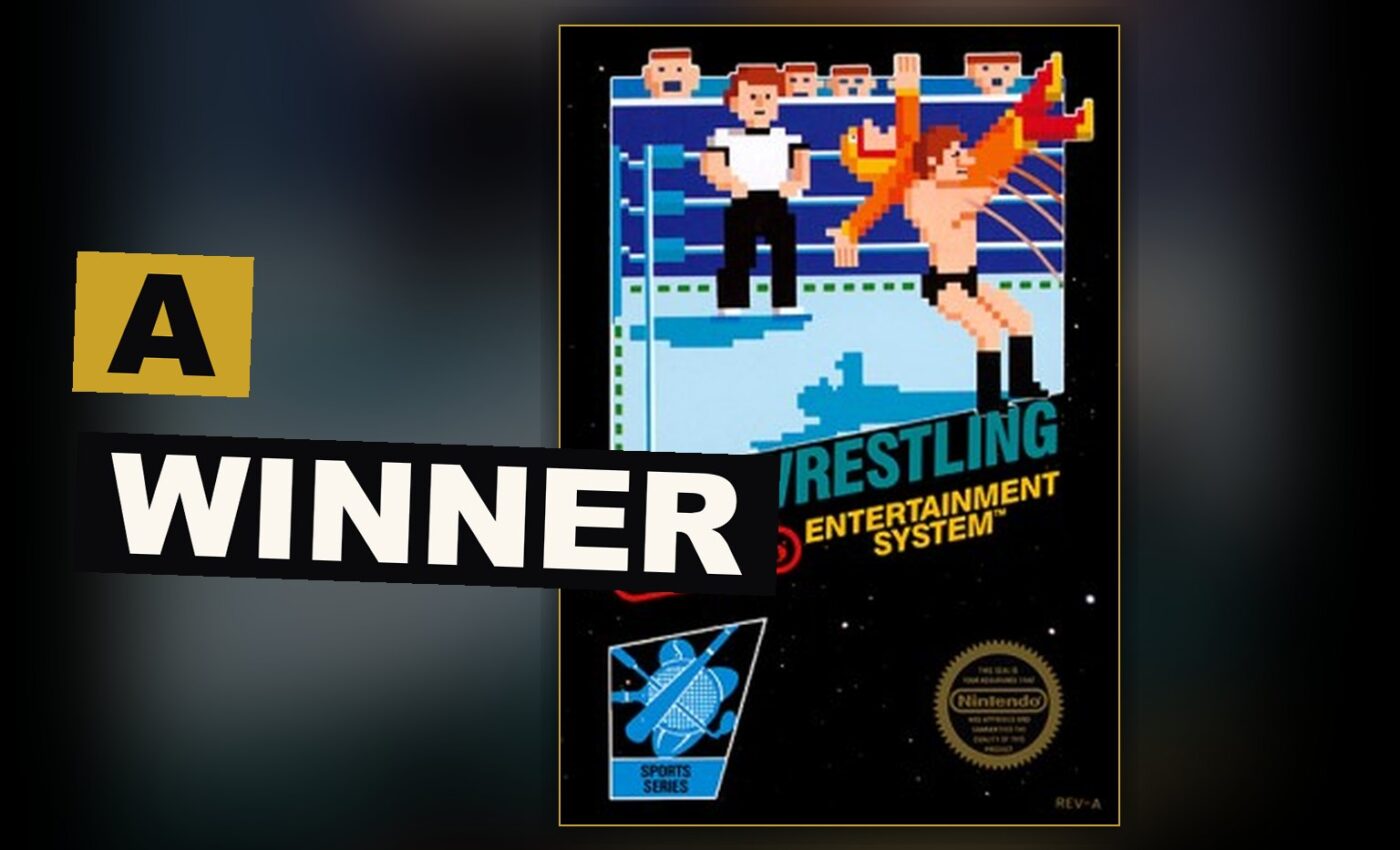
Nintendo’s Pro Wrestling put six wrestlers, a referee, and a twenty-count in a cartridge. It shipped first for the Famicom Disk System in Japan in 1986, then reached North America and Europe on the Nintendo Entertainment System. It was the third wrestling game on the NES, behind Tag Team Match: M.U.S.C.L.E. and Tag Team Wrestling. It is also one of Nintendo’s sports titles for the machine, sitting in the same run as Tennis, Golf, Soccer, Volleyball and Ice Hockey.
That run is the context that matters. Nintendo was building a shelf of clean, legible sports games, and Pro Wrestling is the one where the shelf gets strange. It is not a fighting game with a wrestling skin, and it is not a simulation. It is a small, exact machine with a rulebook, and the rulebook is the best thing about it.
Six Wrestlers, One Ring
The roster is six characters, each with a unique set of wrestling moves. You pick one and fight one-on-one. There is no tag team option, which is a real absence in a genre built on partnerships, and the game never tries to cover for it.
What you get instead is a moveset that separates the six. Punching, kicking and running attacks are the baseline. The interesting layer is the lock-up. Two wrestlers can grab each other and from that hold comes the body slam, the piledriver, and the rest of the professional wrestling vocabulary. Wrestlers can also climb the top two turnbuckles for high-flying attacks.
That is a thin list on paper. In practice it is enough, because every move has a cost. Climbing the ropes takes time. A lock-up can be reversed or escaped. The game is not asking you to memorize a combo tree. It is asking you to pick a moment.
The Referee Counts to Three
The mechanic that gives Pro Wrestling its shape is the pin. A wrestler pinned for a three count loses the match. That is the whole win condition, and it is not instant.
The referee has to run to where the two wrestlers are, lie on his stomach, and begin the three count. If he is on the other side of the ring when a pin starts, the player underneath gets extra time to escape. The game was one of the first wrestling titles to put an in-ring referee on screen, and it is the rare early example of a referee who is not decoration. He is a variable. His position changes the odds of every pin attempt.
Downed opponents can be hauled up from the mat instead of pinned. That opens a window for more attacks, or it wastes the window, depending on how greedy you are. The choice is small and it is constant, and it is the kind of choice that makes a match feel like a match rather than a sequence.
Leaving the Ring Costs You
You can leave the ring. The game lets you, and then it punishes you for it.
A player who goes outside must re-enter before the referee’s twenty-count. Fail and you lose by count-out. If both wrestlers fail to re-enter in time, the result is a double count-out and a draw. The count only breaks after both wrestlers are back inside. As long as one wrestler is outside, the referee keeps counting.
That last rule is the one that produces the game’s strangest moments. A wrestler can be counted out while executing a plancha if he has crossed the ring ropes by the count of twenty. The high-flying move and the disqualification are the same decision, separated by a second.
Five Minutes, Then a Draw
One-player matches are timed. If nobody scores a pinfall inside the five-minute limit, the match is declared a draw.
This is the design decision that will split players, and it is worth being blunt about it. A five-minute cap on a one-player match is short. It turns every bout into a race, and it means the game’s most satisfying outcomes — the long, grinding, back-and-forth match — are structurally impossible in single player. You either finish someone or you get a draw, and a draw is not a loss but it is not a win either.
Multiplayer is where the game holds up. Two players, no clock pressure in the same way, and the full rulebook in play. The referee’s position, the count, the risk of the ropes — all of it becomes a shared negotiation instead of a race against a timer.
What the Game Gets Right
The list of things Pro Wrestling does that its contemporaries did not is short but real:
- An in-ring referee who must physically reach the pin before the count starts
- A twenty-count that continues while either wrestler is outside the ring
- A count-out that can trigger mid-plancha
- Six wrestlers with distinct movesets rather than palette swaps
- Turnbuckle climbing for high-flying attacks
- The option to haul a downed opponent up instead of pinning
None of these are large. Together they are a system. The referee alone changes how a match reads, because his position is information you have to track.
Where the Game Runs Thin
The roster is six. The matches are one-on-one with no tag team bouts. The move list, while distinct per character, is not deep, and the game leans on the lock-up as its one real interaction. Once you understand the lock-up, the punching and the running attacks, you have understood the game.
The five-minute limit on single-player matches is the biggest problem. It caps the drama. A wrestling match is supposed to build, and Pro Wrestling’s clock does not let it. The draw result is a legitimate outcome and it is also an unsatisfying one, and the game produces it often.
Then there is the presentation. The game is a side-view fighter with a small ring and a small crowd of concerns. It is legible and it is clean, and it is not memorable in the way Nintendo’s other sports titles of the era are memorable. Tennis and Golf have a clarity that reads as elegance. Pro Wrestling’s clarity reads as sparseness.
The Third Wrestling Game on the NES
It is worth remembering what Pro Wrestling was up against. It was the third wrestling game on the NES, after Tag Team Match: M.U.S.C.L.E. and Tag Team Wrestling. It was not first. It was not even second.
What it was, was the one Nintendo made. And Nintendo’s version of a wrestling game is a game about rules. The referee, the count, the ropes, the pin — these are the pieces the game cares about. The characters are almost secondary. That is an unusual priority for a wrestling title, and it is the reason Pro Wrestling still has a small, stubborn following.
The published critical score is 5.8 out of 10, and that number is fair. It is not a bad game. It is a game with one genuinely good idea — the referee as a live variable — wrapped in a package that is too small and too clock-limited to let that idea breathe. The multiplayer mode is where the design works, and multiplayer is not what most people remember about a 1986 Nintendo sports title.
Our verdict is that Pro Wrestling is a curiosity with a real mechanic inside it. The in-ring referee and the twenty-count are the parts worth studying. The five-minute draw is the part worth arguing with. If you play it, play it with a second person, and play it for the rules rather than the roster.
Get the Notebook.
The day's best stories and every fresh verdict, in plain English, in your inbox by seven. One email a day, no more.