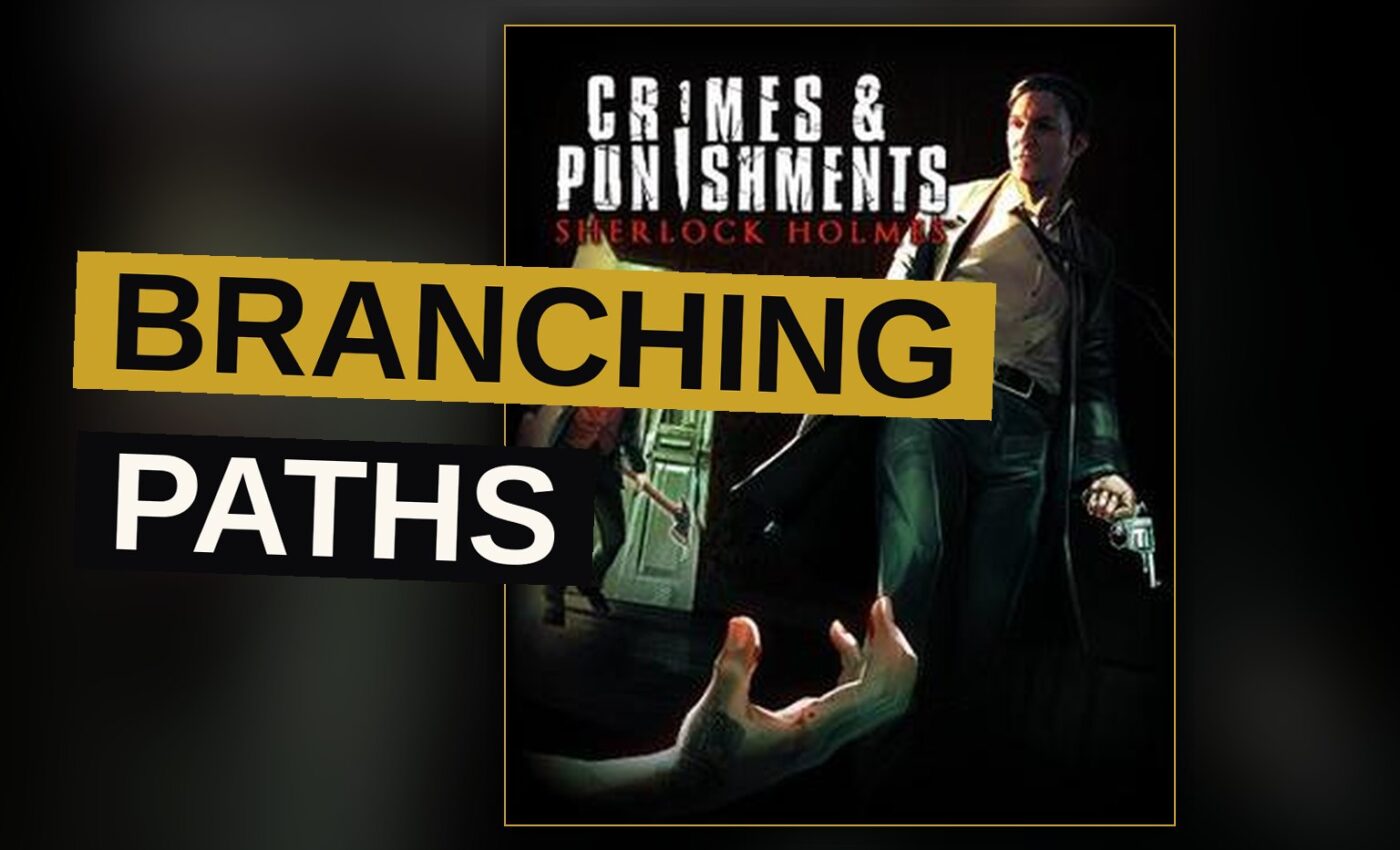
Sherlock Holmes: Crimes & Punishments arrived in 2014 from Frogwares, and it remains the studio’s most complete treatment of the character. Published by Focus Entertainment and Maximum Games, the game shipped on PlayStation 3, PlayStation 4, PC (Microsoft Windows), Xbox 360 and Xbox One, with a Nintendo Switch version following on February 3, 2022.
It is a puzzle-adventure built around six cases, a deduction board, and a moral choice most detective games avoid entirely: what you do with the culprit once you have named them.
Trailer, via IGDBcom.
Six Cases, From Black Peter to the Vanishing Train
The structure is episodic. Holmes works through murders, disappearances and thefts across London and its suburbs in 1894 and 1895, and each case stands alone. “The Fate of Black Peter” opens the set: Inspector Lestrade pulls Holmes into the killing of Peter Carey, an ill-tempered whaling captain found impaled on the wall of his garden cabin with a whaling harpoon. It adapts the Conan Doyle story of the same name.
“Riddle on the Rails” sends Holmes and Watson to rural Staffordshire after Mycroft asks him to look into the Merry Men, a band of anarchists plotting an attack on London. Holmes refuses on the grounds that he does not care for politics. A week later, the train he and Watson take back to London vanishes. That case borrows from “The Lost Special.”
The remaining cases cover the same ground — blood, theft, disappearance — and the game’s title is a deliberate play on Dostoyevsky’s Crime and Punishment, which Sherlock is frequently seen reading.
The Deduction Board Does the Real Work
Most of Crimes & Punishments is spent at crime scenes, examining clues. Every clue found gets pinned to a deduction board, where the player links pieces of information together into a chain. Link enough of them and you build a full tree of deductions.
The clever part is that the tree is not fixed. Depending on how you read the clues, you arrive at different conclusions. You can name the wrong culprit. You can name the right one for the wrong reasons. Each case carries three to five possible solutions, and the game offers six to ten different endings per case depending on what you decide.
Frogwares packed in 14 investigation mechanics. Holmes can deduce a stranger’s life from a glance, or reconstruct a crime scene by studying its key details. He draws evidence from autopsies. He scans the people he meets in a first-person view, reading faces, emotions, clothing and belongings — scars, bruises, the quality of an outfit.
A mechanic called “Sherlock Vision” highlights evidence that would otherwise be missed. Two camera views are available, first person and a static third person, and the player can switch between them at any time.
Absolve or Condemn
Here is where Crimes & Punishments separates itself from the detective games around it. Once Holmes identifies a culprit, the player decides whether to absolve or condemn them. The choice is not cosmetic. It influences how the rest of the game plays out, and it affects the character’s reputation.
The game frames this as a question of moral sense against impartial justice. It hands the player the verdict and then asks what the verdict is worth. Watson is along for all of it, and Toby the Basset Hound and Constable Marrow are playable briefly.
Unreal Engine 3 and a Detailed Victorian London
Crimes & Punishments was the first game in the series built on Unreal Engine 3, and Frogwares used it to render a fully detailed Victorian-era London that the player can explore.
The engine switch matters more than it sounds. Earlier Frogwares entries were stiff, small-scale affairs. This one has room to breathe, and the art team filled it. The London here is not a backdrop; it is a place you walk through, and the period detail holds up better than the case writing in places.
The Switch version landed on February 3, 2022, a strange afterlife for a mid-budget adventure game.
What Works and What Drags
The deduction board is the best idea in the game and the reason to play it. Linking clues and watching a conclusion emerge — then realizing you may have built the wrong one — is a genuine pleasure.
The moral choice is the second-best idea, and it is underused. Six cases, each ending in the same binary prompt, starts to feel like a system rather than a dilemma. The Merry Men thread, a terrorist plot to overthrow the government and free the people of the United Kingdom from debt, is the closest thing to an overarching story, and it never quite carries the weight the game wants it to.
The cases themselves vary. “The Fate of Black Peter” is a strong opener because the image — a whaling captain pinned to his own cabin wall by a harpoon — does a lot of work before you touch a single clue. “Riddle on the Rails” is the most interesting premise and the hardest to sustain, because a vanished train is a puzzle the game has to explain, and the explanation is doing more lifting than the investigation.
Two cases carry the game, and one thread drags it:
- “The Fate of Black Peter” — the strongest hook, and the cleanest Doyle adaptation in the set.
- “Riddle on the Rails” — the best premise, slightly overmatched by its own solution.
- The Merry Men — the connective tissue, and the weakest part.
The Merry Men plot runs underneath all six cases and never resolves into the spine the game needs. That is the honest weak point: the cases are self-contained by design, and the one thread that could tie them together is the one the game handles least.
Where the Series Stands Now
Crimes & Punishments is the high-water mark for Frogwares’ Sherlock Holmes series, and it earns that mostly on the strength of one mechanic. The deduction board is a real design achievement: it trusts the player to build a wrong answer and live with it, and almost nothing else in the genre does that.
The moral choice is a close second, though it is applied too evenly across six cases to keep its edge. The Unreal Engine 3 rebuild gave the series a London worth walking through, and the Conan Doyle adaptations — Black Peter especially — show a studio that understood the source better than most licensed developers bother to.
What holds it back from higher is the connective tissue. The Merry Men plot never becomes the spine the game needs, and the case quality dips in the middle. The Switch release in 2022 gave the game a second life it mostly deserves.
Seven and a half out of ten. The deduction board is the reason to play it, and the reason it still gets talked about.
Get the Notebook.
The day's best stories and every fresh verdict, in plain English, in your inbox by seven. One email a day, no more.