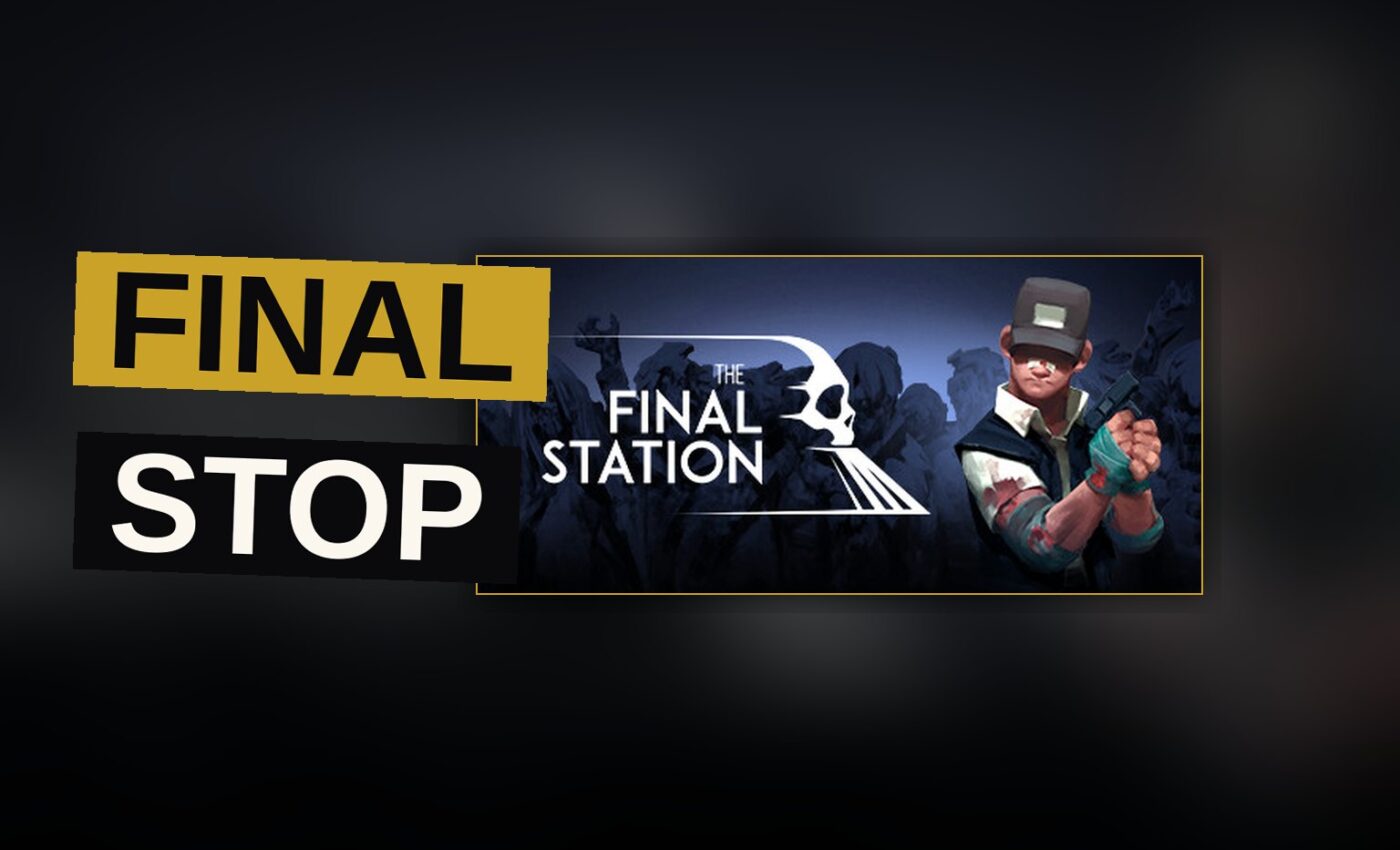
The Final Station asks you to run a train through the end of the world and decide who gets to ride. Do My Best Games built a side-scrolling shooter around a locomotive, a passenger car and a dwindling supply of food, and tinyBuild published it on August 30, 2016 for Windows, OS X, Linux and Xbox One, with the PlayStation 4 version following on September 2. The pitch is grim and specific: keep the engine running, keep the survivors fed, and find the code that opens the next station.
It works more often than it should, and it stumbles exactly where you would expect a small studio to stumble.
Trailer, via tinyBuildGAMES.
Edward Jones and the Second Visitation
You play Edward Jones, a conductor working 106 years after a catastrophe called “The First Visitation.” His assignment is to move an experimental train and collect special cargo. Partway through, he learns he is inside “The Second Visitation” — towns are being attacked by an unknown force, and the people in them are turning into aggressive monsters through an unknown infection.
The cargo turns out to be the power source and central processor for the Guardian, a massive war machine meant to protect humanity. Jones delivers it to the city of Metropole, then heads home. On the return trip he picks up a stranger named Arthur Vane, who speaks in cryptic clues and explains that the infection is not a virus at all. It is a medicine designed to make people stronger. The radiation from the train’s engine is what keeps Jones safe.
That is a clean piece of world-building, and The Final Station is smart to hand it over in fragments rather than a cutscene.
Two Games Sharing One Locomotive
The structure splits in two, and the split is the whole design.
| Section | Where it happens | What you do | What it costs you |
|---|---|---|---|
| Train | Inside the moving locomotive | Feed and heal rescued survivors, run minigames to keep the engine alive | Food, medicine, time |
| Station | Side-scrolling apocalyptic levels | Explore for ammunition, food and survivors, fight or avoid enemies, find the hidden code | Ammunition, health, risk |
The station sections carry the tension. You can swing in melee, spend precious bullets, use the environment, or simply run past whatever is in front of you. Every option is a wager, and the game is honest about the math — ammunition is small, and the enemies are not.
The train sections are quieter and, for a while, better. Survivors you bring aboard need feeding or healing. Sometimes they are more trouble than they are worth, which the game states plainly and then makes you feel.
Where the Tracks Run Out
The Final Station has a linearity problem, and it is not a small one. Stations funnel you toward the same beats, and the exploration that looks open is mostly a corridor with supplies tucked into corners. Once you have learned the rhythm — scavenge, fight or flee, find the code, return — the game rarely surprises you again.
The story carries more weight than the mechanics do. Jones’ final stretch is the strongest material here: the train breaks down, he continues on foot, passes the wreck of the Guardian, and is exposed to poison gas. He reaches his hometown to find that the apparently immune are already rebuilding, while he is showing symptoms. He makes it home but succumbs before he can see his daughter. Vane arrives, promises to look after her, and kills him mercifully.
That ending lands because the game earned it. It is bleak without being cheap, and it reframes every survivor you fed or abandoned along the way.
The Only Traitor, released April 19, 2017, adds a new main character and runs alongside the main story. It is a reasonable excuse to return, though it does not fix the linearity.
The Verdict on The Final Station
The Final Station is a game built on a good idea and executed with real restraint. The train is not a gimmick — it is the entire moral engine of the thing. Who you bring aboard, what you feed them, what you leave behind at the platform: those choices carry more weight than any firefight, and Do My Best Games understands that.
What holds it back is scope. The station levels run out of ideas before the story does, and the side-scrolling combat never develops past the opening hours. It is a game you finish for the ending, not for the systems.
The published critical score sits at 7.2 out of 10, an aggregate drawn from 11 outlets. That number is fair. The originality and the world-building are real, and so is the linearity.
Key facts
– Released: August 30, 2016 (Windows, OS X, Linux, Xbox One); September 2, 2016 (PlayStation 4)
– Developer: Do My Best Games
– Publisher: tinyBuild
– Platforms: PlayStation 4, Linux, PC, Mac, Xbox One, Nintendo Switch
– DLC: The Only Traitor, April 19, 2017
– Modes: Single player
– Published critical score: 7.2/10 (11 outlets)
Get the Notebook.
The day's best stories and every fresh verdict, in plain English, in your inbox by seven. One email a day, no more.