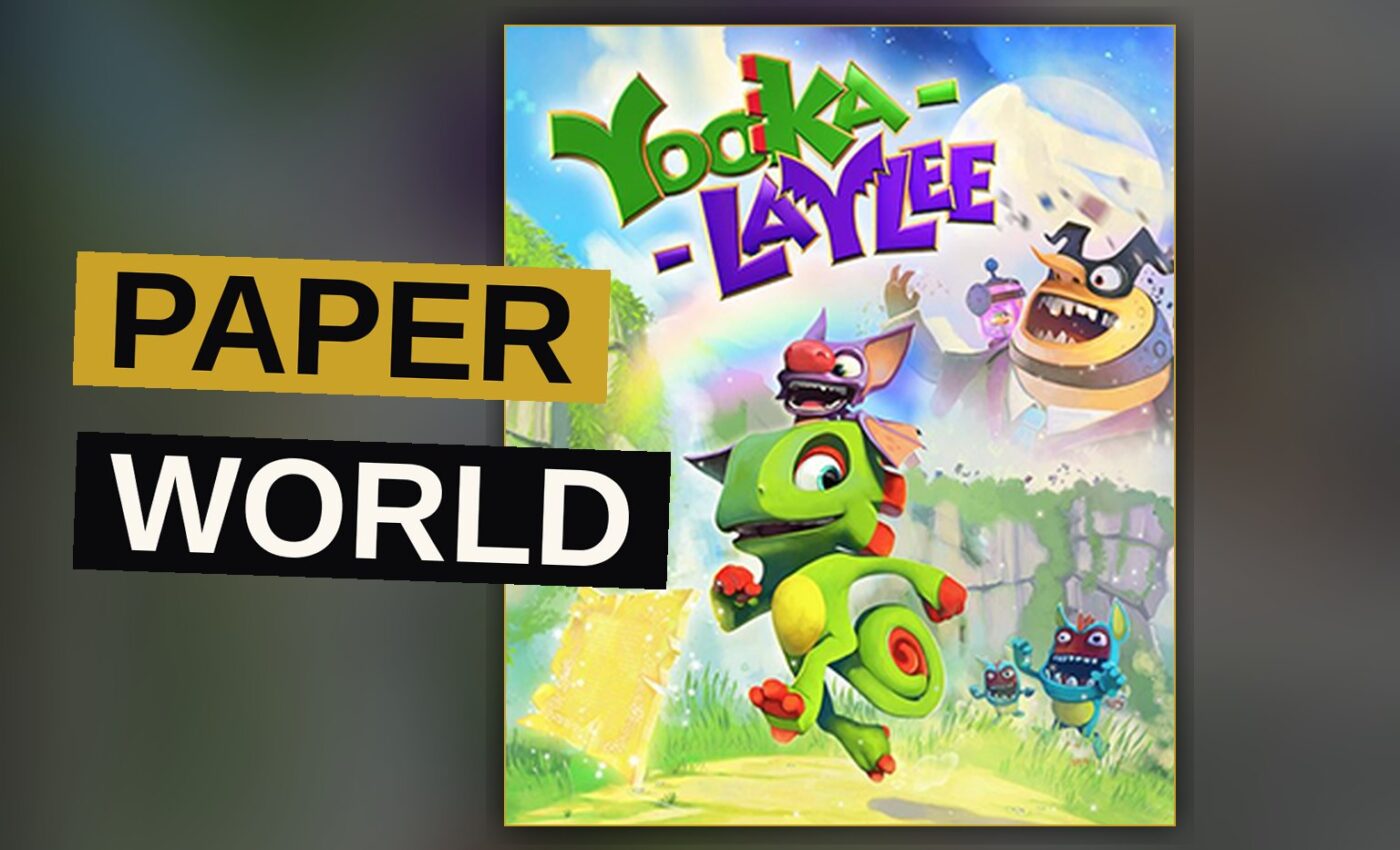
Yooka-Laylee is a game about collecting things, and the first thing it asks you to collect is your patience. Playtonic Games, a British studio staffed by former Rare personnel, built a spiritual successor to Banjo-Kazooie and funded it through a Kickstarter that pulled in more than £2 million. That money bought the game a level of expectation no platformer should have to carry. What shipped in April 2017 for Linux, macOS, PlayStation 4, Windows and Xbox One is a competent, handsome, occasionally sharp tribute act that never quite finds its own voice.
Trailer, via Team17.
A Chameleon, a Bat, and a Snake Named Trowzer
The setup is simple and it works. You control Yooka, a male chameleon, and Laylee, a female bat, from a third-person perspective. They move as a unit. They share a single health meter, which means every mistake belongs to both of them. The pair explore worlds contained inside magical books, hunting “Pagies” — golden pages that serve as the game’s currency. Spend Pagies to unlock a world, or spend them to expand one you have already opened.
Abilities come from a snake named Trowzer, who sells them in exchange for quills. Sonar blasting, tongue whipping, sky soaring, a fart bubble for underwater breathing — the names tell you exactly what kind of game this is. Berries grant temporary powers like fire breath. Butterflies fill a power meter and can be eaten instead to restore health. Play Tonics, bought from Vendi, a living vending machine, modify your stats. Mollycools go to Dr. Puzz, an octopus scientist, who hands back transformations.
The collectible stack is enormous, and that is the point. Ghost Writers appear in levels as characters who offer challenges — catch them or fight them. Play Tokens unlock a secret. It is a game designed to be hoarded.
Capital B and the One Book
The plot is broad corporate satire. At Hivory Towers, CEO Capital B and his assistant Dr. Quack use a machine to suck up every book in the world. They want the “One Book,” a magical volume that can rewrite the universe. Yooka and Laylee happen to have it. They watch it get pulled into Hivory Towers, its pages scattering, and set off to reclaim it.
Five worlds stand between them and that goal. Collect 100 Pagies and you reach Capital B’s office for the confrontation. The ending reveals Hivory Towers is part of a larger association called V.I.L.E., and that Dr. Quack is actually Capital B’s supervisor. Then Blasto, a sentient cannon and friend of the duo, accidentally fires a cannon ball at the two villains, knocking them onto the One Book and trapping them inside it. The heroes celebrate with a party.
It is thin stuff, and it knows it. The writing leans on jokes about profit and corporate greed without ever sharpening them into anything. Capital B is a villain by job title, not by menace.
Where the Nostalgia Holds and Where It Slips
Yooka-Laylee is a Banjo-Kazooie game in all but name, and the source material says as much: it is a spiritual successor to that series, with gameplay similar to Banjo-Kazooie and Chameleon Twist. That inheritance is both the game’s strongest asset and its ceiling.
What works is the texture. The worlds are big and pleasant to move through. The buddy-duo gimmick gives traversal a rhythm a solo platformer cannot match, and the ability list is generous enough that moment-to-moment play stays varied. Unlimited lives, a deliberate break from the spiritual predecessor, keep the game from punishing experimentation. Checkpoints respawn you rather than sending you back. For a game this size, that is the right call.
What does not work is the technical side. The game arrived with shortcomings that reviewers flagged at the time, and they are not cosmetic. The outdated design instincts wear thin across five worlds. Emulating an older structure in 2017 is a choice, and Yooka-Laylee makes it without much interrogation.
Reception split along exactly that line. Reviewers agreed the game captured the essence of earlier platformers. They disagreed on whether capturing an essence was enough. The aggregate sits at 7.0 out of 10 across 22 outlets, and that number is honest about the divide.
What Playtonic Built After This
Playtonic did not stop here. A spin-off, Yooka-Laylee and the Impossible Lair, arrived on 8 October 2019. A remake, Yooka-Replaylee, followed on 9 October 2025. The two follow-ups exist, and that is the fact worth holding onto.
That matters for how you read Yooka-Laylee now. It is not a failure. It is a foundation. The Pagies, the Tonics, the transformations, the fart bubble — all of it is the work of a studio rebuilding a feeling from memory.
The problem is that memory is not the same as invention. Yooka-Laylee is at its best when it stops apologizing for what it is and lets the duo’s odd-couple dynamic carry a level. It is at its worst when it mistakes accumulation for depth. Five worlds, many collectibles, one health bar, and a villain who wants to monetize literature — the satire writes itself, but the game rarely finishes the sentence.
The Numbers
- Release: April 2017 (Linux, macOS, PlayStation 4, Windows, Xbox One); December 2017 (Nintendo Switch); October 2020 (Amazon Luna)
- Developer: Playtonic Games
- Publisher: Team17
- Kickstarter total: Over £2 million
- Critic aggregate: 7.0/10 (22 outlets)
- Spin-off: Yooka-Laylee and the Impossible Lair — 8 October 2019
- Remake: Yooka-Replaylee — 9 October 2025
- Modes: Single player, multiplayer, co-operative, split screen
What This Game Gets Right
Yooka-Laylee earns its 7.0. The score reflects a game that does one thing very well and several things adequately. The Kickstarter raised the money, and what the studio made with it was a Banjo-Kazooie game. The technical shortcomings are a genuine problem. The outdated gameplay is a genuine problem. The lack of a distinctive identity is the largest problem of all, because a spiritual successor that only succeeds at being spiritual has not succeeded at being a successor.
What saves it is the pair at the center. Yooka and Laylee work as a unit in a way that justifies the shared health bar and the co-operative design. The transformations, the Tonics, the Ghost Writers, the snake selling moves for quills — there is real craft in how all of it interlocks. Playtonic built a machine that functions. It just did not build one that surprises.
7.0 of 10.
Get the Notebook.
The day's best stories and every fresh verdict, in plain English, in your inbox by seven. One email a day, no more.