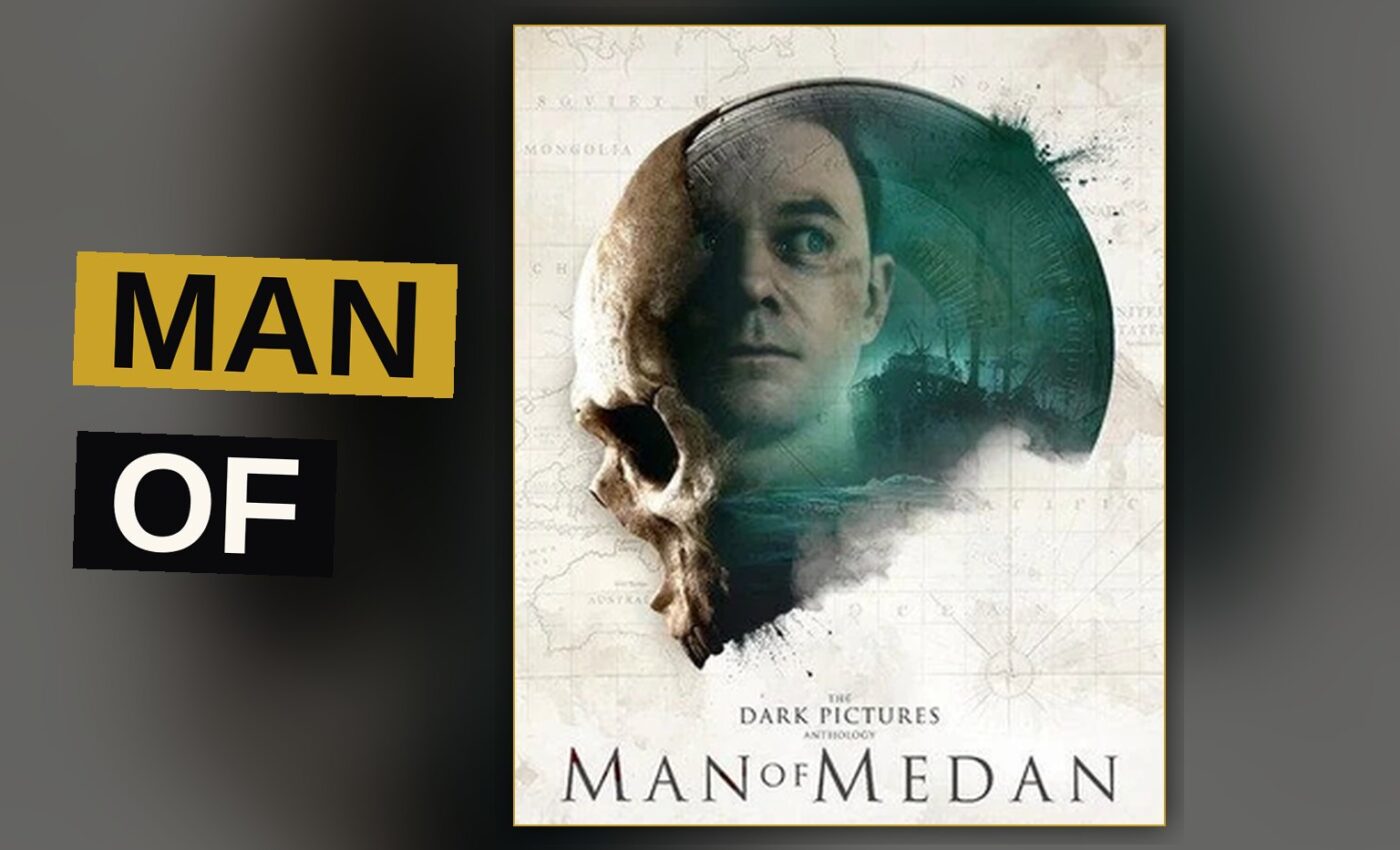
Supermassive Games built its reputation on Until Dawn, a slasher that punished every bad decision with a body. Seven years later it returned with The Dark Pictures Anthology: Man of Medan, the opening chapter of an intended horror series, and swapped the ski lodge for a ghost ship adrift in the South Pacific. The result is a tighter, meaner game that trades some of Until Dawn’s sprawl for a sharper focus — and occasionally mistakes obscurity for dread.
Man of Medan is an interactive drama and survival horror game played from a third-person perspective. It launched in 2019 on PlayStation 4, Xbox One, and PC, and has since come to PlayStation 5, Xbox Series X|S, and Nintendo Switch. Bandai Namco Entertainment published it. The setup is clean: four college students and their boat captain sail out on a diving expedition to find a sunken World War II plane. Pirates hijack the vessel and strand the group aboard a ghost ship, where they must survive visions of ghostly figures.
Trailer, via Bandai Namco Entertainment America.
The Ourang Medan and Manchurian Gold
The premise draws from the urban legend of the SS Ourang Medan, a fabled ghost ship allegedly found adrift in the 1940s. Supermassive leans into that lore hard. The prologue takes place in 1947 aboard the freighter after it departs from Manchuria, carrying Manchurian Gold, a hallucinogenic bioweapon developed during World War II.
When the chemical containers leak, the crew is subjected to hallucinations. Driven mad by apparitions, the sailors inadvertently kill each other or succumb to fear, leaving the vessel to drift. It is a strong cold open, and it plants the game’s real engine: not ghosts, but poisoned minds.
Alex, Julia, Conrad, Brad and Fliss
The five protagonists are brothers Alex (Kareem Alleyne) and Brad (Chris Sandiford); Alex’s girlfriend, Julia (Arielle Palik); Julia’s brother, Conrad (Shawn Ashmore); and Fliss (Ayisha Issa), captain of the Duke of Milan. Supermassive marketed Ashmore as the lead, and he gets the flashiest material, but the game spreads its attention across all five.
Three dynamics carry the story. Alex is considering proposing to Julia during the trip, a decision that colors their interactions. Conrad clashes with Fliss, and depending on the branches their friction either escalates or turns into flirtation. Alex and Brad’s fraternal bond runs on contrast: Alex is outwardly confident but insecure, while Brad struggles with social awkwardness among the group.
A Compass, a Heartbeat, and a Bearings Menu
The choice interface is styled as a compass. It offers two distinct dialogue responses plus an option to remain silent, and it asks the player to approach each decision from either a rational or an emotional perspective. Those choices shape the characters’ personality traits and their relationships.
Action sequences rely on quick time events: pressing specific buttons within a short time limit to dodge obstacles or perform physical tasks. There are also rhythm-based minigames where the player presses buttons in time with a character’s heartbeat to remain hidden. Fail, and the consequences can be immediate, including the permanent death of a protagonist.
A menu system called Bearings tracks the narrative branches and lets the player look back at the consequences of their actions. The narrative adapts to losses so the game continues to its conclusion regardless of how many characters survive.
The Curator Breaks the Fourth Wall
Interspersed throughout the story are scenes featuring the Curator, a character who breaks the fourth wall to discuss the narrative. Supermassive created him as connective tissue across the anthology.
The anthology’s games share a universe but are designed as standalone stories, playable in any order. That is a smart structural bet. It means Man of Medan has to stand on its own, and mostly it does.
Where the Branching Actually Bites
The developers expanded the branching narrative scope relative to Until Dawn to emphasize replayability. Supermassive programmed 69 unique death scenes. The design intent was to remind the player that every decision carries permanent consequences.
The choice interface is deliberately prominent and obtrusive. That is a psychological cue, forcing the player to pause and weigh emotional instinct against tactical calculation. It works. Man of Medan is at its best when you are staring at the compass, knowing that silence is itself a choice, and that someone will pay for it.
The pieces that carry the game:
- The compass and Bearings systems — the mechanical heart of the whole thing.
- The Curator — a device that could have been a gimmick and instead gives the anthology a spine.
- The five-protagonist relationship web — ambitious, uneven, occasionally flat.
- The hallucination sequences — explained, grounded, and less frightening than the choices around them.
That last point is the problem. Man of Medan is a horror game whose monsters are the weakest element. The hallucinations are explained, grounded, and chemically rationalized, which is thematically coherent and dramatically deflating. Once you understand Manchurian Gold, the apparitions stop being frightening and start being symptoms. The dread has to come from the group instead — from Conrad goading Fliss, from Alex’s insecurity, from Brad’s awkwardness — and those scenes are well-written but not always well-staged.
Jason Graves composed the soundtrack, and the audio design does real work in the claustrophobic stretches. The fixed camera angles force you to navigate cramped corridors with limited sightlines, and that constraint is the game’s most reliable scare tool. Supermassive built the whole thing on Unreal Engine 4 to facilitate a multi-platform release.
What the Ghost Ship Never Earns
Where Man of Medan falls short is in the gap between its systems and its scares. The branching is genuinely ambitious. The consequences land. But the horror set pieces rarely match the tension of the decisions that lead into them, and the ghost ship itself — the selling point — is the least convincing character in the cast. The game is better at making you afraid of your own choices than of anything on screen.
It is also short, and the brevity cuts both ways. There is little fat, but there is also little room for the quieter character work that would make the deaths hurt more. When a protagonist dies, the loss registers as a mechanical outcome more than a dramatic one.
Still, the ambition is real, and the execution is mostly there. Man of Medan set out to prove that a horror anthology could work as a series of standalone, choice-driven stories with a shared host and a shared universe. It proved it. The Curator, the compass, the Bearings menu — these are the bones of something durable.
The verdict: Man of Medan is a confident, clever, occasionally frustrating opener. Its branching narrative and consequence design are the real attraction, and they hold up. Its horror is more explained than felt, and the ghost ship never quite earns its own legend. It is worth playing for the decisions, not the ghosts.
The score sits at 7.1/10, an IGDB critic aggregate drawn from 13 outlets. That number is fair. It captures a game whose systems outclass its scares — and whose best ideas are the ones you argue with, not the ones that make you jump.
Get the Notebook.
The day's best stories and every fresh verdict, in plain English, in your inbox by seven. One email a day, no more.