
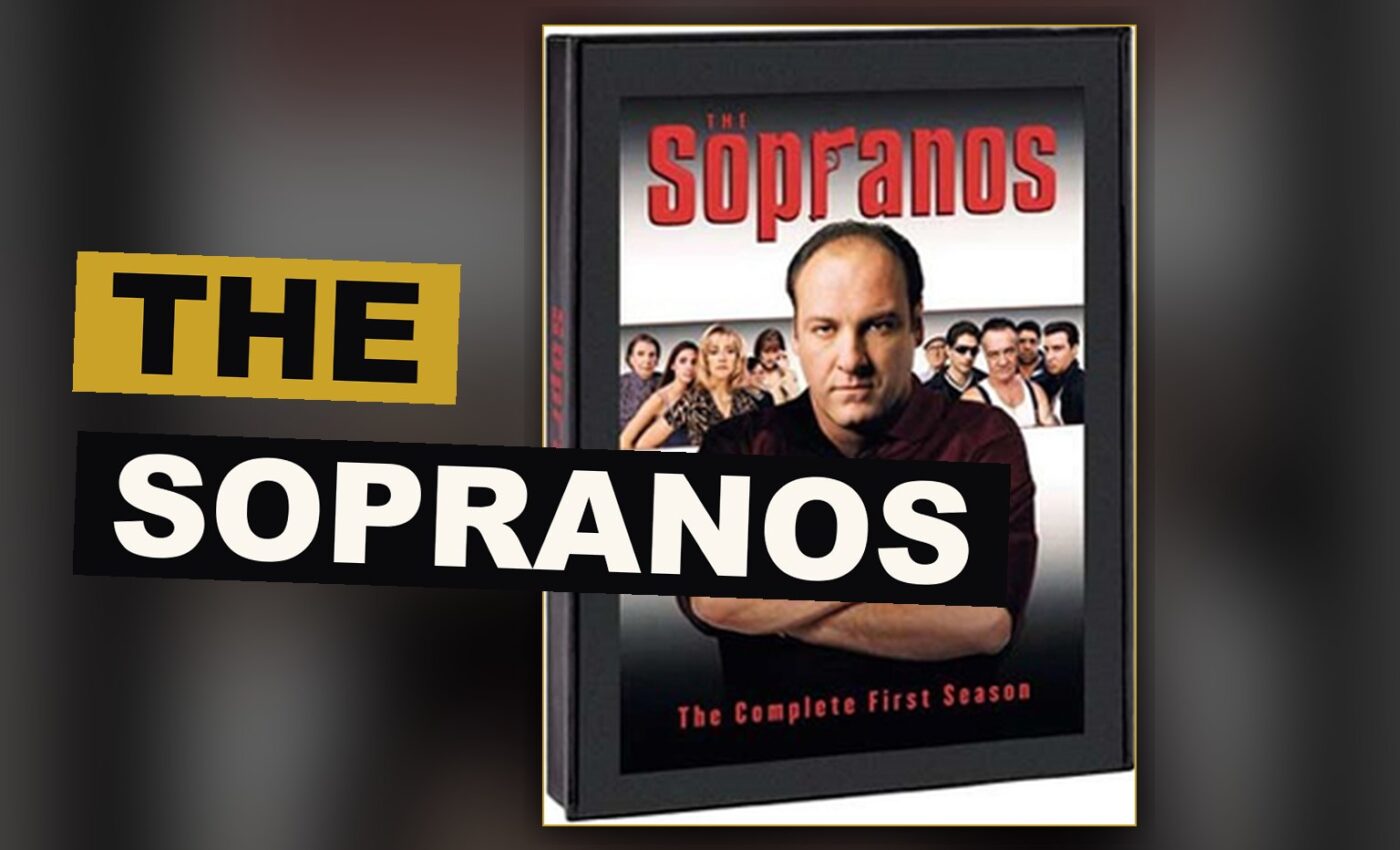
Tony Soprano is a New Jersey mobster who has panic attacks. That is the whole engine of The Sopranos, and it is enough to carry 86 episodes. David Chase created the series for HBO, and it ran from January 10, 1999, to June 10, 2007. Six seasons. James Gandolfini plays Tony. Lorraine Bracco plays Dr. Jennifer Melfi, the psychiatrist who treats him. The show is a crime drama, but the crime is the least interesting thing in it.
A Mob Boss on the Couch
The premise is simple and strange. Tony is a capo in the DiMeo crime family at the start. He becomes its undisputed boss. He is also a husband and a father in North Jersey. After a fainting spell triggered by a panic attack, his physician sends him to Dr. Melfi. Tony does not want to be there. He goes anyway. In her office he talks about his mother, his work, his rage. Melfi listens. She is thoughtful, rational, humane. Tony is none of those things. The contrast is the show.
Chase does not play the therapy as a gimmick. It is a central narrative thread, and it changes how we see Tony. A man who orders violence can also weep in a chair. The show never asks us to forgive him. It asks us to watch him.
Gandolfini, Falco, and the Family
Gandolfini is the reason this works. Tony is prone to bouts of clinical depression and reflex syncope. He is a serial womanizer. He is violent. He is also, at times, tender. Gandolfini holds all of it without flinching.
Edie Falco plays Carmela Soprano, Tony’s wife. Her problem is not ignorance. She knows what her husband does. She publicly denies it. She reconciles her misgivings with the affluent lifestyle and higher social status it brings her. That is the trap, and Falco plays it with a straight back and a tight mouth.
The kids are Meadow and A.J., played by Jamie-Lynn Sigler and Robert Iler. Meadow is intelligent and rebellious. A.J. is an underachiever. Tony and Carmela parent with anger, criticism and yelling. The children’s teenage problems get worse once they learn what their father is.
Christopher, Junior, and the DiMeo Crew
Michael Imperioli plays Christopher Moltisanti, Tony’s nephew and protégé. Dominic Chianese plays Corrado “Junior” Soprano, Tony’s uncle. Junior is a rival inside the family. The Lupertazzi crime family of New York is a rival outside it.
The supporting cast is deep. Steven Van Zandt plays Silvio Dante. Tony Sirico plays Paulie Gualtieri. Aida Turturro plays Janice Soprano. Steve Schirripa plays Bobby Baccalieri. None of these are filler roles. Each one has a story arc that pays off.
The Casting Was Not an Accident
Many of the actors on The Sopranos are Italian American. Many come from the New York metropolitan area, like the characters they portray. The series shares 27 actors with Martin Scorsese’s 1990 gangster film Goodfellas. That includes main cast members Lorraine Bracco, Michael Imperioli and Tony Sirico.
The casting directors were Georgianne Walken and Sheila Jaffe. Chase put the main cast together through auditions and readings. Actors often did not know whether Chase liked their performances.
Imperioli beat out several actors for the part of Christopher. He said Chase had “a poker face, so I thought he wasn’t into me, and he kept giving me notes and having me try it again, which often is a sign that you’re not doing it right.” Chase wanted Imperioli because of his performance in Goodfellas.
Gandolfini was invited to audition after casting director Susan Fitzgerald saw a short clip of his performance in the 1993 film True Romance.
Bracco played mob wife Karen Hill in Goodfellas. She was originally asked to play Carmela Soprano. She took Dr. Melfi instead. She wanted to try something different, and she felt the part of the highly educated Dr. Melfi would be more of a challenge.
Sirico had a criminal history. He signed on to play Paulie Walnuts so long as his character was not to be a “rat.” He had originally auditioned for the role of Uncle Junior with Frank Vincent. Chianese landed the role instead.
Filmed at Silvercup, Greenlit in 1997
HBO greenlit the series in 1997. It was broadcast as part of HBO’s newly launched Sunday night programming block. The series was produced by HBO in association with Chase Films and Brad Grey Television. It was primarily filmed at Silvercup Studios in New York City, with some on-location filming in New Jersey. After its original HBO run, it entered broadcast and cable syndication in the United States and other territories.
The executive producers throughout the run were Chase, Brad Grey, Robin Green, Mitchell Burgess, Ilene S. Landress, Terence Winter and Matthew Weiner. That is a writers’ room that went on to shape a decade of television. The Sopranos is where they learned.
Why the Therapy Still Holds
The show has been credited by media commentators with ushering in a new era of television. That claim is easy to make and hard to prove. What is provable is the craft. The Sopranos treats a mob boss as a patient. It treats a psychiatrist as a person with her own weaknesses. Melfi harbors some degree of attraction to Tony. She rarely admits it and never acts on it. She is drawn to the challenge of helping such an unusual client. She naively assumes their doctor-patient relationship will not affect her personal life. It does.
That is the show’s real subject. Not whether Tony gets caught. Whether anyone can help him, and whether helping him is even the right thing to do. Melfi asks herself that question across six seasons. The show does not answer it for her.
Tony’s career causes him frequent rage and anxiety. His work continually leads him into dangerous and life-threatening scenarios. He finds himself at odds with Carmela, with Junior, with ambitious family members, with New York. The therapy is the one room where he cannot solve a problem with a threat. That is why it matters.
The Score
The Sopranos is not flawless. Six seasons means some arcs drag. The New York storyline takes up more room than it earns in places. But the show’s best passages are as good as television gets. The writing is plain and exact. The performances are unshowy. The show trusts the audience to sit with a bad man and think about him.
It is widely regarded as one of the greatest and most influential television series of all time. That reputation is deserved. The Sopranos made it possible to build a drama around a character who is neither redeemed nor condemned. It ended in 2007. Nothing since has quite matched the nerve of it.
Key facts
- Created by: David Chase
- Network: HBO
- Run: January 10, 1999 – June 10, 2007
- Seasons: 6
- Episodes: 86
- Genres: Crime, Drama
- Main cast: James Gandolfini, Edie Falco, Lorraine Bracco, Michael Imperioli
- Filmed at: Silvercup Studios, New York City
- Published critical score: 9.2/10 (IMDb)
Get the Notebook.
The day's best stories and every fresh verdict, in plain English, in your inbox by seven. One email a day, no more.