
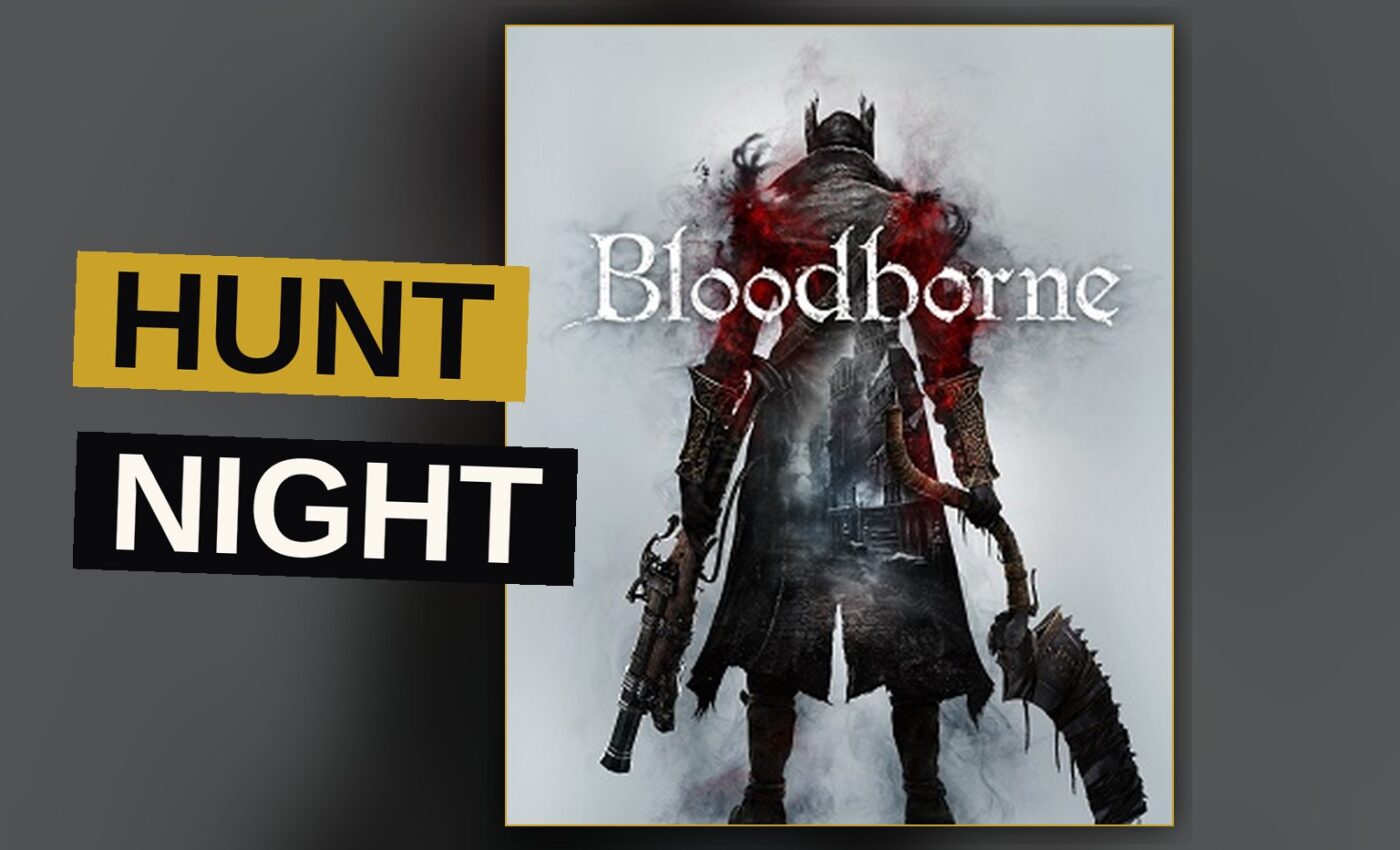
Bloodborne opens with a transfusion and ends, depending on what you do, with a sunrise or a birth. In between, FromSoftware builds the densest, strangest world the studio has made — a decaying Gothic city called Yharnam where medicine is blood and blood is a plague. The game came to PlayStation 4 in 2015, published by Sony Computer Entertainment, and it remains the sharpest argument that a hard game can also be a beautiful one. It scores 9.1 out of 10.
Trailer, via IGDBcom.
Yharnam and the night of the Hunt
You play a Hunter, a customizable character who arrives in Yharnam seeking a mysterious cure known as Paleblood. After a blood transfusion, you wake in a spectral realm called the Hunter’s Dream, bound to forces you do not yet understand. The night of the Hunt has begun, and the city’s inhabitants have been transformed by a blood-borne plague into beasts.
The Healing Church, once the city’s salvation, guards secrets tied to ancient eldritch beings called the Great Ones. Tracing the plague to its source means pulling apart the connections between the Church, the College of Byrgenwerth and those beings at the edges of reality.
That is the plot, but it is also the mood. Yharnam is Victorian-era inspired, decrepit, and structured as a series of interconnected areas. Shortcuts unlock through exploration. Lamps act as checkpoints and let you return to the Dream, where you buy items, level up, upgrade weapons and travel to other areas. Nothing here is a menu screen you forget. The hub is a place, and it has a keeper — Gehrman, an elderly Hunter who oversees the Dream.
Trick weapons, firearms and the Rally system
Combat emphasizes dodging, counterattacking and close-range aggression. The Rally system lets you regain a portion of recently lost health by quickly striking an enemy after taking damage. That single mechanic rewires how you play. Retreating is punished. Standing your ground, bleeding, and hitting back is rewarded.
Many melee weapons are trick weapons, transforming between two forms with different attacks. Firearms are generally used to interrupt or parry enemy attacks, creating openings for powerful visceral attacks. Defeating enemies grants Blood Echoes, used as currency and for character progression. Die, and your Blood Echoes drop at the site of death or sit with a nearby enemy. Return and you can recover them. Die again before you do, and they are gone.
Insight is a secondary currency, earned through events such as encountering or defeating bosses. You spend it on items and multiplayer actions, and accumulating it changes some aspects of the game world. That last detail is the one that lingers. The game tracks how much you know, and then it alters itself in response.
The Old Hunters and the post-launch fixes
Bloodborne began development in 2012 under the working title Project Beast. It was inspired by the literary works of H. P. Lovecraft and Bram Stoker, and by the architectural design of real-world locations in countries such as Romania and the Czech Republic. The downloadable content The Old Hunters followed.
At launch, some criticism landed on the game’s technical performance. Post-release updates improved it. That is the honest shape of this release: a game whose frame rate and load times were a real complaint, and a game whose fixes arrived and mostly settled the matter.
Attempting to find the source of the plague, the player’s character unravels the city’s mysteries while fighting beasts and eldritch beings.
Byrgenwerth, Rom and the blood moon
The back half of Bloodborne is where it stops being a monster hunt and becomes something else. Guided to the Healing Church’s grand cathedral, you receive a vision pointing toward Byrgenwerth. There you defeat Rom, a spider-like being whose death reveals the blood moon and the influence of the Great Ones.
From there: signs of Queen Yharnam, her child Mergo, and the Nightmare of Mensis. In the hidden village of Yahar’gul you defeat the One Reborn and enter the Nightmare. Inside, you kill Micolash, leader of the School of Mensis, and Mergo’s Wet Nurse, ending the nightmare.
Then the game hands you a choice. Back in the Hunter’s Dream, Gehrman offers to release you. Accept, and he kills you; you awaken in Yharnam at sunrise. Refuse, and you defeat him — but the Dream’s master, the Moon Presence, binds you to the Hunter’s Dream as his replacement.
Three umbilical cords and the real ending
There is a third path. If the Hunter has consumed three umbilical cords associated with the Great Ones before refusing Gehrman, they resist the Moon Presence, kill it, and are reborn as an infant Great One.
This is not a secret ending bolted on for completionists. It is the thesis. The whole game has been about what the Church did with the old blood, what Byrgenwerth found, and what happens to a person who keeps pulling that thread. The Hunter who ascends is the Hunter who refused to stop asking.
Multiplayer, co-operation and the Dream
The game includes online multiplayer features. Players can summon help, and the modes cover single player, multiplayer and co-operative play. The system is woven into the fiction rather than stapled beside it — Insight, that secondary currency, is spent on multiplayer actions, so even calling a friend costs you something and changes the world.
It is a small thing. It is also the kind of decision that separates Bloodborne from its imitators. Every system here is pointed at the same idea: knowledge has a price, and the price is usually paid in blood or in sanity.
What Bloodborne gets right, and where it stumbles
The interconnected world design is the achievement. Yharnam folds back on itself, and the shortcuts you unlock are not conveniences — they are the map teaching you the city. The sound design and the Lovecraftian themes have been cited as reasons the game is counted among the greatest ever made, and that reputation holds up. The atmosphere is not decoration. It is the argument.
The criticism at launch was fair. Technical performance was the weak point, and it was improved with post-release updates rather than fixed on day one.
The deeper point is that Bloodborne is a game about institutions that found something they should not have touched and then built a city on top of it. The Healing Church split from Byrgenwerth’s research and spread blood ministration throughout Yharnam. The practice is connected to the plague. The Church then deployed Hunters to kill the infected, and its upper echelons fell into infighting. Every horror in the game is downstream of a decision made by people who thought they were helping.
That is why the game still reads as more than a hard action RPG. The combat is punishing, the Rally system is elegant, and the trick weapons are the best version of a weapon system FromSoftware has built. But the reason to play Bloodborne in 2026 is the same as it was in 2015. It is one of the few games that trusts you to assemble the story yourself, then rewards you for having done it.
The technical complaints at launch were real, and they were addressed. Everything else about this game has aged into place. Bloodborne is a 9.1 out of 10.
Get the Notebook.
The day's best stories and every fresh verdict, in plain English, in your inbox by seven. One email a day, no more.


