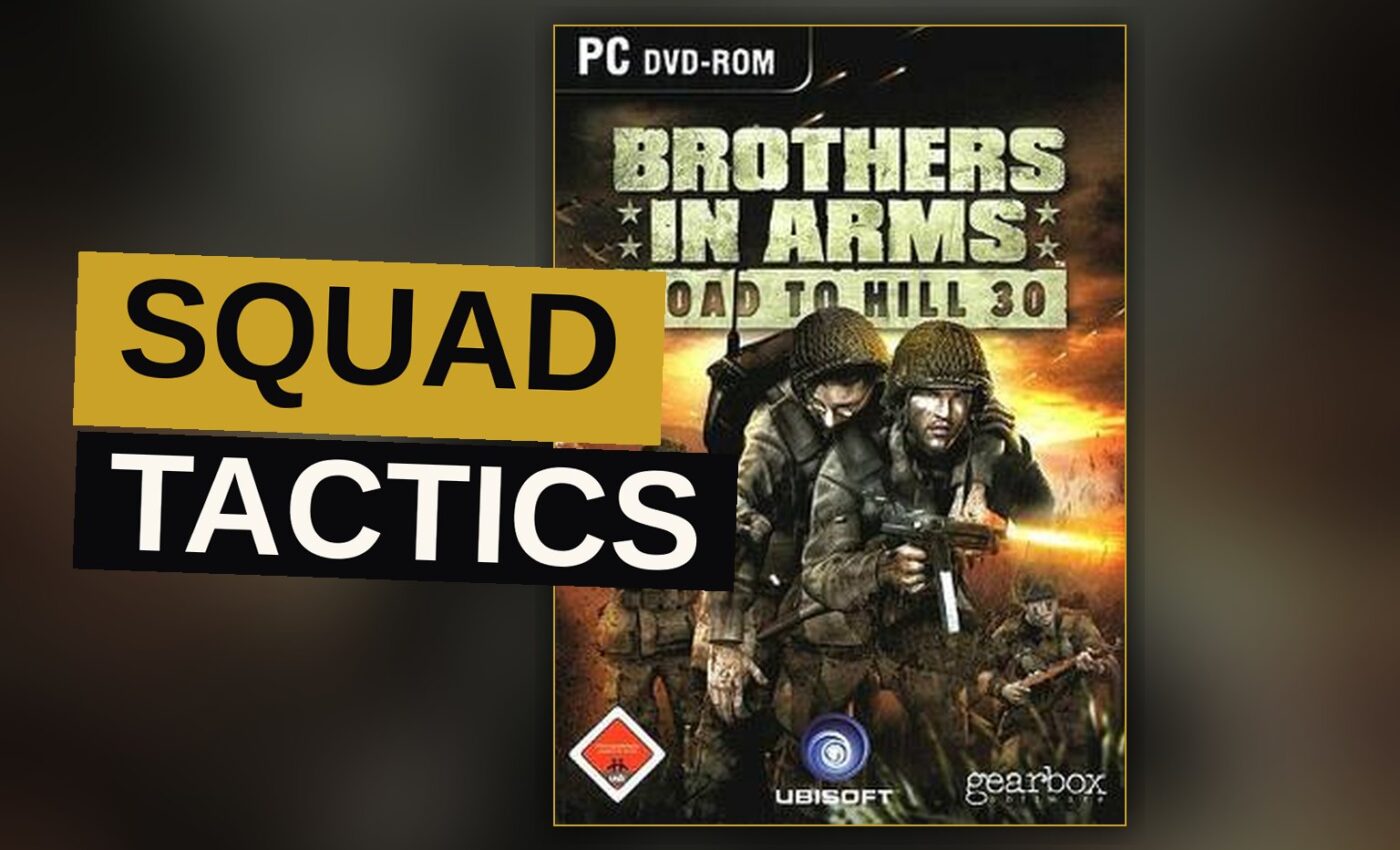
Brothers in Arms: Road to Hill 30 is a war game that refuses to let you be a hero. It wants you to be a sergeant, and the difference is the whole game.
Released in 2005 for Xbox, PC and Mac, with a later Wii port, the game puts you in the boots of Staff Sergeant Matt Baker of the 101st Airborne Division. It tells the story of the 502nd Parachute Infantry Regiment in the days after D-Day, from the chaotic night drops of June 6 to the bloody push toward Carentan. This is not a game about sprinting through gunfire with a shotgun. It is about angles, suppression, and the terrible cost of every yard gained.
Trailer, via GameTrailersMedia.
Baker and the Men of the 502nd
The narrative frame is a memory. Baker, wounded and waiting for evacuation, recounts the previous weeks to a medic. The game shifts between the present — a battered farmhouse, the sound of artillery — and the past, where you fight through the hedgerows of Normandy. The structure gives every firefight a weight of consequence, because you know where Baker ends up, but not who he lost to get there.
The squad members are not interchangeable grunts:
- Kevin Leggett, the steady radioman.
- Joe Hartsock, Baker’s fire-team leader and second-in-command, confident and sometimes reckless.
- Michael Garnett, whose fear is visible in his voice.
The game takes time to let you know these men. When one of them falls, it is not a statistic. It is a name you have heard say something human.
The dialogue is plain and believable. Men talk about food, about home, about the sergeant who got them killed. They do not deliver speeches. The game understands that soldiers in combat do not think in grand themes. They think in the next field, the next wall, the next burst of machine-gun fire.
Squad Command and the Art of Suppression
The core mechanic is simple to state and hard to master. You have two fire teams, and you direct them with a cursor and a button press. You can order them to move, to suppress, or to assault. The game is built on a single tactical truth: a German machine gunner in a covered position will kill you if you try to run at him. You will not outgun him. You will outmaneuver him.
The flow of combat is a rhythm. You locate the enemy position. You order one team to lay down suppressive fire, keeping the Germans’ heads down. You move the other team to a flank, an angle where they can fire on the exposed enemy. You watch the tracer rounds cross, and you advance. There is no snap-to-cover mechanic. You use the terrain — walls, hedgerows, ditches — as real soldiers would.
The suppression mechanic is the heart of it. When bullets are cracking past a German position, the enemy soldiers stop firing and hunker down. They are not dead, but they are neutralized. The game rewards patience and planning over reflexes. A rushed assault will get your squad killed. A careful flank will win the field.
Defending Bloody Gulch
The game builds to a set piece that is still discussed today: the defense of the Bloody Gulch, a sunken road near Carentan. On June 13, 1944, a German counterattack threatened to push the 101st back to the beaches. The game recreates this with a mission that feels genuinely desperate.
You have limited men. The enemy comes in waves — infantry, then tanks, then more infantry. The game does not give you infinite ammunition or a magic checkpoint that resets your squad. You have to allocate your fire teams, watch your ammunition count, and make hard choices about who lives and who dies.
The tanks are a particular terror. You do not have a reliable anti-tank weapon in the early game. You have a bazooka, but it is slow to load and the tanks are armored. The solution is to wait for the tank to get close, to hit it in the side or the rear, and to hope the crew does not see you first. The tension is unbearable, and the payoff is a deep, physical relief.
Normandy’s Look and Sound
For 2005, the game looked impressive. The Unreal Engine 2.0 was pushed hard, and the result is a Normandy that feels muddy, wet, and dangerous. The hedgerows are dense. The fields are open and deadly. The sky is often gray. The game does not glamorize the setting. It looks like a place where men died.
The sound design is the stronger element. The crack of a sniper round is distinct. The thud of a mortar is heavy. The chatter of your squad is constant and useful — they call out enemy positions, they warn you of grenades, they tell you when they are reloading. The music is sparse, which is correct. The silence between firefights is more frightening than any score.
The character models are dated now. Faces are stiff, animations are clunky. But the game’s art direction — the way it uses light and shadow, the way it frames a burning farmhouse against a dark sky — holds up better than the technology.
The Wii Port and Platform Notes
The Wii version arrived later, and it is a different experience. The motion controls were used for aiming, and they are not precise. The game’s tactical core — placing a cursor and issuing orders — becomes fiddly with a remote. The Wii port is a curiosity, not the definitive version.
The PC version has its own issues. The controls are fine, but the game was designed for a controller, and the keyboard and mouse setup can feel awkward for squad commands. The graphics settings are limited. It is a game of its era, and it shows. But the gameplay holds. The tactical loop is strong enough to survive the technical rough edges.
If you have a choice, play the Xbox or PC release. The Wii version is for completionists only.
History Treated With Respect
The game takes its history seriously. It was developed with input from veterans, and it shows in the details. The weapons are accurate. The tactics are accurate. The geography is based on real maps. The game also includes documentary-style unlockable content, with interviews with actual veterans of the 502nd. This is not a cynical add-on. It is the game’s thesis: these men were real, and this is what they did.
The game does not moralize. It does not tell you that war is hell in a caption. It shows you. You see a man die because you misjudged an angle. You see a squad mate break down after a close call. The game trusts you to draw the conclusion. That restraint is rare in the genre, and it is powerful.
Flaws That Frustrate
The game is not perfect. The friendly AI can be infuriating. Squad members will sometimes stand in the open, ignore an order, or get stuck on a piece of terrain. The pathfinding is a constant problem.
The checkpoints are also stingy. A single mistake can send you back ten minutes, and the game does not offer a quick save. On higher difficulties, this is punishing. The lack of modern quality-of-life features is a real barrier for new players.
The difficulty curve is also uneven. Some missions are straightforward, and others spike sharply. The mission in the town of Carentan is a particular wall. The enemy is numerous, the cover is sparse, and the AI is aggressive. You will die. You will restart. You will learn the angles. It is not unfair, but it is unforgiving.
Lasting Influence
Brothers in Arms: Road to Hill 30 spawned a series. The sequel, Earned in Blood, told the same campaign from the perspective of a different soldier. Hell’s Highway followed on the next generation of consoles. The series was praised for its tactics and its seriousness, but it never reached the mainstream heights of Call of Duty.
It also influenced the genre. The idea of suppression as a core mechanic, the focus on squad command, the refusal to make the player a one-man army — these ideas found their way into later games. The direct descendants are visible in later tactical shooters, including the Rainbow Six and Ghost Recon titles that followed in the years after its release.
The game asks more of its players, and it rewards them with a deeper experience.
It is a masterpiece of tactics, and it is a solemn memorial. On IGDB, the game holds a critic aggregate of 9.2 out of 10 across six outlets.
Get the Notebook.
The day's best stories and every fresh verdict, in plain English, in your inbox by seven. One email a day, no more.