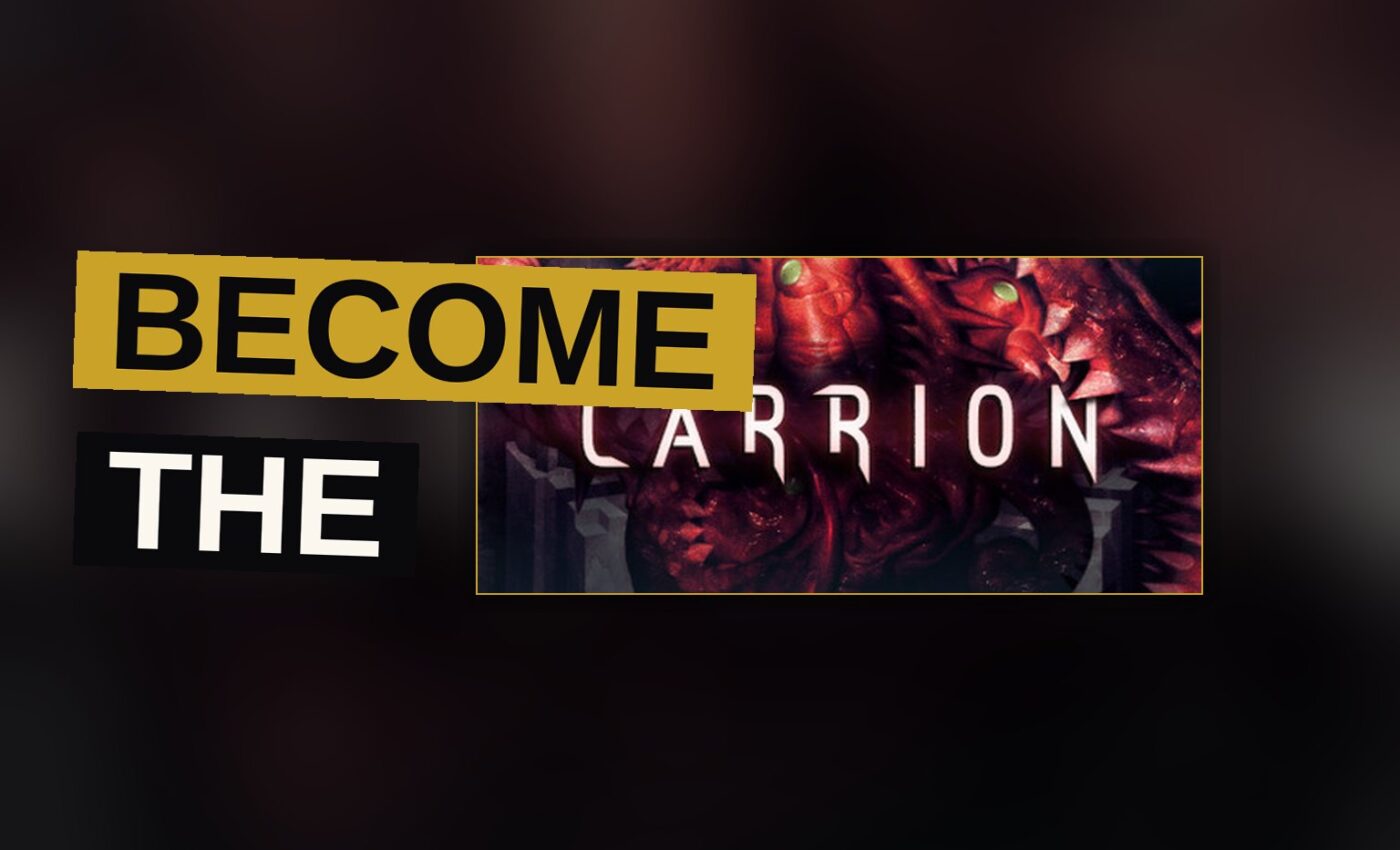
Carrion is a reverse-horror game from Phobia Game Studio, published by Devolver Digital. You do not play the scientist. You play the thing in the vent.
The red, amorphous, tentacled creature wakes inside a containment unit at a Relith Science research facility. It breaks out. It hunts. That is the whole pitch, and it is a good one.
Trailer, via DevolverDigital.
Relith Science and the Creature
The setup inverts the standard horror arrangement. Players control the monster of unknown origin, crawling through vents and corridors, stalking and killing the scientists and soldiers in its path. The facility is the maze. The staff are the prey.
Carrion released on July 23, 2020, for Linux, macOS, Nintendo Switch, Windows, and Xbox One. It later came to PlayStation 4, PlayStation 5, Android, iOS, and Mac. It is a single-player side-view platformer with adventure and indie bones, wearing action, science fiction and horror on its sleeve.
The Creature’s Genetic Code
The upgrade loop gives the killing a shape. As the creature moves through the complex, it reclaims pieces of its own genetic code that Relith scientists removed for study and containment. Each fragment lets it evolve: greater size, a dash that breaks through wooden barricades and opens otherwise unreachable areas, more means of both defense and offense.
That structure matters more than the gore. Carrion is not a game about being scary. It is a game about being hungry and getting bigger, and the code fragments are the meter running underneath it.
Material Analyzers and the Flashbacks
The story arrives in fragments. Material analyzers sit in the facility; entering one triggers a flashback revealing the creature’s origins. The Creature was found inside an egg-like sack by three scientists. On waking, it killed two and possessed the third. Relith security forces arrived and executed the remaining scientist, forcing the creature into the open and allowing Relith to capture and contain it.
The ending lands the idea. The creature returns to its initial containment area and absorbs the last piece of its stolen genetic code, reconstituting a human form that takes the appearance of the scientist it originally infected. It escapes into a partially quarantined city as the sun sets.
That is a strong final image. It is also the moment the game’s cleanest idea gets a little muddled.
What Carrion Does Well
The perspective is the point. Side view, single player, no victim’s-eye camera to hide behind. You are always looking at the monster, and the monster is always looking at the next corridor. The dash upgrade earns its place because it changes how you read a room, not just how fast you cross it. Barricades stop being walls and start being doors.
The flashbacks are the weakest link. They explain a creature that did not need explaining. A red thing in a vent is scarier before you know it was found in an egg-like sack by three named men.
| Element | What Carrion does |
|---|---|
| Player role | The monster, not the victim |
| Objective | Escape the Relith Science facility |
| Upgrades | Genetic code fragments; dash; increased size |
| Story delivery | Material analyzers trigger flashbacks |
| Perspective | Side view, single player |
The Verdict on Carrion
Carrion is a smart, well-built reversal that runs out of new ideas before it runs out of corridors. The core loop — hunt, devour, evolve, repeat — is satisfying for the length of the game, and the dash upgrade is the single best decision Phobia made. But the material analyzers keep interrupting the fantasy to explain it, and explanation is the one thing a monster movie should never stop to do.
The human-form ending is ambitious and lands as a shrug. It wants to say something about what the creature actually is. It mostly says the game ran out of monster.
Still, this is a game worth playing for what it gets right. The vent-crawling, the growing, the moment a barricade stops mattering — that is the good stuff. Carrion is not a horror classic. It is a sharp, strange, short idea executed with real confidence, and that counts for something.
7.5 of 10.
Get the Notebook.
The day's best stories and every fresh verdict, in plain English, in your inbox by seven. One email a day, no more.