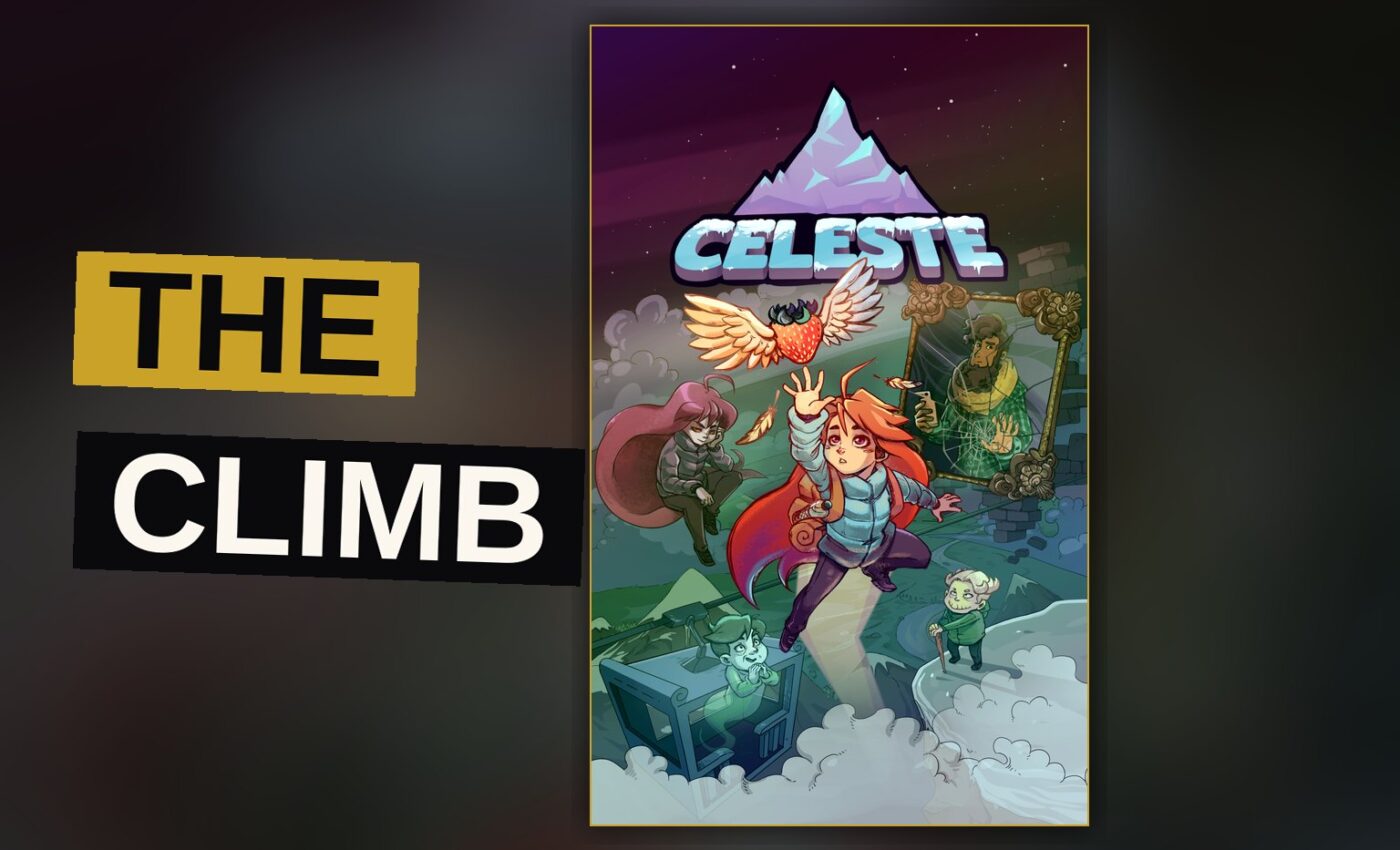
Celeste opens with a simple instruction: climb the mountain. Madeline, a young woman dealing with anxiety and depression, sets out for the summit of a fictional version of Mount Celeste. What follows is one of the tightest, most humane platformers ever made.
Maddy Thorson and Noel Berry built Celeste around a small set of moves. Madeline can run, jump, wall jump, cling to walls for a limited time, and dash in mid-air in any of eight directions. That is the whole vocabulary. The game spends eight chapters finding new sentences with it.
Trailer, via Maddy Thorson.
Madeline’s Dash and the Eight Chapters
The base game runs eight chapters, plus a free expansion, each chopped into single-screen challenges with checkpoints between screens. Levels branch, and the branches hide optional trials and collectibles: strawberries, cassette tapes, crystal hearts that open gates.
Objects around the mountain extend the moveset. Green gems refill a dash without a landing. Dream blocks carry Madeline across a gap when she dashes into them. Moving blocks pass their momentum to her when she jumps off. Bubbles push her. Some platforms only shift after a dash.
Thorson and Berry wanted the moveset to mirror bouldering, which is where the limited climbing stamina comes from. The stamina system also took shape around the vertical space the mountain theme demanded.
That restraint is the point. Every screen is a small, legible problem, and the game never adds a mechanic it cannot justify.
Badeline, Oshiro, and Theo
Mount Celeste is a fictional peak with several distinct areas. It seems haunted, and strange things happen there. Madeline climbs it to confront her anxiety, pushing on until she reaches the summit.
At the base she meets Granny, an elderly woman who tells her to turn back. Madeline ignores her and moves on to an abandoned city, where she meets Theo, a social media-obsessed traveler from Seattle.
The next area is a nightmare. Madeline sees part of herself in a mirror — a personification of her anxiety and depression called Badeline — and Badeline drives her out. Badeline doubts Madeline can reach the summit and says she will stop her to keep her from climbing unprepared, calling herself Madeline’s pragmatic part.
Madeline then reaches the Celestial Resort, an abandoned hotel run by Oshiro, a ghost who cannot let go of his past and lives in denial. He asks her to stay and help fix the place’s poor condition. She agrees. Badeline then taunts Oshiro, telling him Madeline helped only to feed her own ego. He believes it, turns furious, and chases her out of the resort.
After a windy ridge, Madeline finds Theo at a gondola lift. Badeline stops the gondola, and Madeline has a panic attack. Theo calms her down. The two reach an ancient temple, where Theo is trapped inside a crystal until Madeline frees him. Their talk gives Madeline the confidence to confront Badeline.
This is the part of Celeste that people remember. Badeline is not a monster to be destroyed. She is Madeline, and the game knows it.
Assist Mode and the Question of Difficulty
Celeste was built to be accessible. An Assist Mode makes the game more forgiving: players can slow the game down, dash without limits, or make Madeline invincible.
That decision matters more than any single level. A game this precise could have locked its hardest content behind raw execution. Instead, Celeste lets players choose how much friction they want.
Thorson and Berry added themes of self-forgiveness to the story to make the game more introspective, and those themes became tangled up with the mechanics. The design and the story are the same argument.
B-Sides, C-Sides, and Farewell
Every one of the eight chapters has a B-side, a harder version that reuses the chapter’s mechanics. A hidden cassette tape unlocks each one. Finish all eight B-sides and the C-side levels open — shorter levels, harder still.
The Farewell expansion adds a ninth chapter. It has no B-side, no C-side, and no ordinary strawberries. It does add grabbable jellyfish that work like parachutes, exploding pufferfish that launch Madeline, and double-dash gems that grant two dashes when collected.
The table below sets the main progression against the optional content:
| Content | Unlock | Structure | Difficulty |
|---|---|---|---|
| Eight base chapters | Available from the start | Single-screen challenges, checkpoints, branching paths | Standard |
| B-side levels | Hidden cassette tape in the corresponding chapter | Reuses main-level mechanics | Higher |
| C-side levels | Complete all eight B-sides | Shorter in length | Highest |
| Farewell | Free DLC | Ninth chapter, no B-side or C-side, no ordinary strawberries | Adds jellyfish, pufferfish, double-dash gems |
Thorson, Berry, and Where Celeste Came From
Celeste started as a weekend project. In August 2015, Thorson and Berry made a version for the PICO-8, then decided to turn it into a full game. Thorson produced; Berry led programming.
The pair named Metroid (1986), Donkey Kong Country 2 (1995), and Kero Blaster (2014) as influences. Thorson called Super Mario Bros. 3 (1988) the biggest one, mainly for how it handles problem-solving. Shacknews and Kill Screen both compared Celeste’s level design to Thorson’s Super Mario Maker (2015) levels.
Precision pushed two other decisions. The team skipped an off-the-shelf physics engine so it could fix outcomes in specific situations. It also chose pixel art, partly because the team knew the style and partly because it reads clearly to a player under pressure.
Lena Raine composed the soundtrack. Celeste launched on January 25, 2018, for Linux, macOS, Nintendo Switch, PlayStation 4, and Windows, with Xbox One the next day. Google Stadia got it in July 2020. The game was developed and published by indie studio Maddy Makes Games, with Thorson and Berry as its developers.
What Celeste Gets Right
Celeste earns its reputation. The moveset is tiny, the chapters are built from single screens, and the whole thing rests on one young woman deciding to keep going up. That should not be enough for a game this long, and yet it is, because the mountain and the anxiety are the same problem.
The accessibility work is the part the industry should have copied harder. Assist Mode does not dilute Celeste; it widens who gets to finish it. The B-sides and C-sides give the hardest players somewhere to go without making the main path a toll booth.
Where Celeste is weakest is where it always was: the back half of the optional content leans on the same mechanics with less room to breathe. That is a complaint about a bonus, not about the game.
Farewell is the best argument that the team understood what it had built. Jellyfish that act as parachutes and pufferfish that launch Madeline are new verbs in a game that had already said everything with eight directions and a dash.
Celeste is a 2018 platformer developed and published by Maddy Makes Games, and it remains one of the clearest statements a game has made about self-forgiveness — not as a theme bolted onto a challenge, but as the challenge itself. Madeline climbs. Badeline follows. The player learns both are necessary.
Score: 9.2 of 10.
Get the Notebook.
The day's best stories and every fresh verdict, in plain English, in your inbox by seven. One email a day, no more.