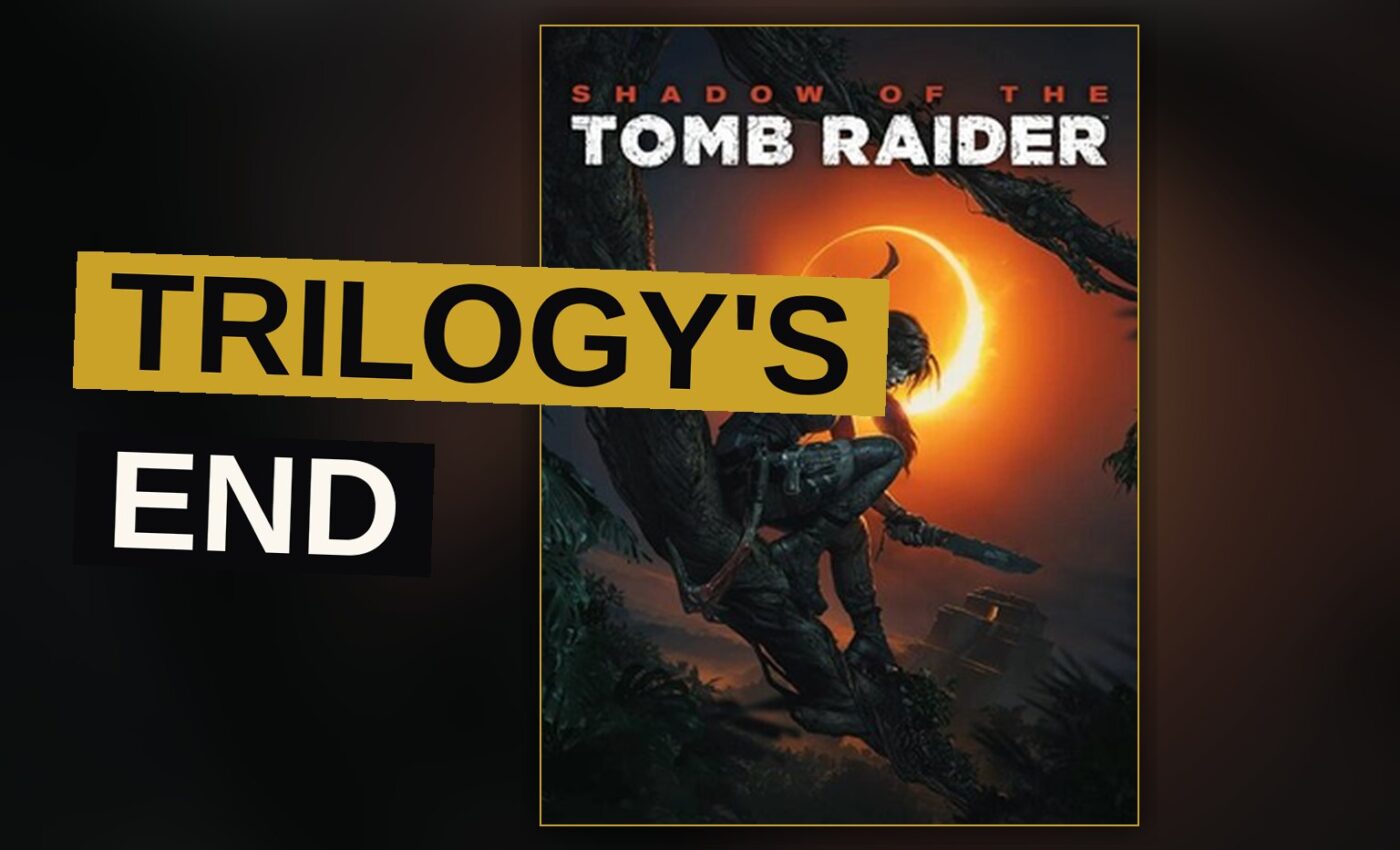
Shadow of the Tomb Raider closes Lara Croft’s origin trilogy with a story about the cost of obsession. The game, released in 2018 for PC, PS4, and Xbox One, picks up immediately after the events of Rise of the Tomb Raider. Lara has become a force of nature, but her relentless pursuit of ancient artifacts has consequences she cannot control.
The opening hours make that clear. Lara triggers a catastrophic event in Cozumel, Mexico, unleashing a tsunami that drowns an entire city. The game does not let her, or the player, look away from the wreckage. This is a Lara who has stopped being a survivor and started being a cause. The narrative asks a simple question: how far can she go before she becomes the villain of her own story?
Paititi and the Living Jungle
The story moves from Cozumel into the dense, rain-soaked wilds of the Peruvian Amazon. The centerpiece is the hidden city of Paititi, a sprawling Incan settlement that feels alive in a way the hubs of previous games never did. Where the 2013 game gave you a beach and Rise gave you a snowy mountain, Paititi offers a full community. NPCs have daily routines, markets bustle, and the architecture tells its own story. It is the most ambitious setting the trilogy has attempted.
But Paititi is also where the pacing stumbles. The game forces Lara into stealth sections within the city, where she must move unseen through streets full of enemies. These segments clash with the open exploration that defines the rest of the experience. The city is a marvel to look at, but it often fights against the player’s desire to simply explore it. The tension between narrative and gameplay is at its most visible here.
The tombs themselves are the real triumph. Shadow of the Tomb Raider features some of the best puzzle challenges in the series. Each tomb is a self-contained mechanical puzzle, often requiring the manipulation of water, fire, and light. The optional Challenge Tombs are particularly strong, offering complex spatial reasoning tests that reward patience. These are the moments when the game feels most confident, letting the environment do the talking.
Mud, Fear, and the Stealth Overhaul
Combat has been pushed to the background, and that is a deliberate choice. The game gives Lara a full arsenal, including a bow, pistols, and rifles, but it encourages avoiding direct confrontation. The stealth system has been expanded with a new mechanic: mud. Lara can cover herself in mud to blend into walls and foliage, making her nearly invisible to enemies. It is a simple addition, but it changes how encounters play out.
The game also introduces “Fear” as a tool. Lara can use her skills to terrify enemies, making them flee or become easier to take down. You can string up bodies, sabotage equipment, or simply execute a brutal takedown in front of a patrolling guard. The AI reacts believably to these events, and the emergent chaos is often more satisfying than a straight firefight. When combat does break out, it is fast and brutal, but the game clearly wants you to avoid it when possible.
The skill tree has been streamlined, but it still offers meaningful choices. You can specialize in stealth, combat, or survival, and each path changes how you approach the world. The gear upgrades, including a grappling hook and a climbing axe, unlock new paths through the environment. There is a satisfying loop of exploration, resource gathering, and upgrading that keeps the momentum going between story beats.
Technical Performance Across Platforms
On PC, Shadow of the Tomb Raider is a technical showcase. The game supports high frame rates and offers a wealth of graphical options. The jungle environments are dense with foliage, and the lighting effects are some of the best seen in the genre. The water effects, particularly during the opening tsunami sequence, are stunning. On PS4 and Xbox One, the game holds up well, though the frame rate can dip during the busiest scenes.
The game’s sound design deserves specific praise. The jungle is a living thing, filled with the calls of birds, insects, and unseen predators. The soundtrack, composed by Brian D’Oliveira, uses native instruments and choral elements to build an atmosphere that is both beautiful and threatening. The voice acting is solid across the board, with Camilla Luddington delivering a performance that captures Lara’s growing ruthlessness.
| Feature | Shadow of the Tomb Raider | Rise of the Tomb Raider |
|---|---|---|
| Setting | Paititi and the Amazon | Siberia and the Soviet installation |
| Core mechanic | Mud stealth and fear tactics | Improvised weapons and stealth |
| Tombs | Best in the trilogy, puzzle-heavy | Strong, but more combat-focused |
| Hub world | Living city with NPC routines | Large but mostly empty wilderness |
| Combat emphasis | Avoided, stealth-first | Balanced between stealth and action |
Where the Narrative Stumbles
The story has strong bones, but it fumbles the execution. The villain, a cult leader named Dr. Dominguez, is underwritten and never feels like a genuine threat. He has a connection to the ancient Maya and a goal that is vaguely apocalyptic, but the game never gives him enough screen time to make his menace land. He is a placeholder for a conflict the narrative is not fully interested in.
The supporting cast is similarly thin. Jonah, Lara’s constant companion, gets a few moments of development, but he remains a sidekick rather than a full character. The game introduces a new character, an indigenous leader named Unuratu, who has the potential to be compelling, but her arc is rushed. The game is so focused on Lara’s internal struggle that it forgets to give the people around her real stakes.
The ending is the biggest disappointment. The game builds toward a confrontation that should feel personal and earned, but it resolves in a way that feels rushed. Lara makes a choice that is meant to be profound, but the game does not give the player enough time to sit with it. The epilogue tries to tie the trilogy together with a neat bow, but it feels more like a checklist than a conclusion.
A Fitting Farewell or a Missed Mark?
Shadow of the Tomb Raider is the most mechanically polished entry in the trilogy. The controls are tight, the platforming is fluid, and the puzzles are excellent. It is also the most inconsistent. The game cannot decide if it wants to be a survival story, a stealth action game, or an open-world exploration title. It tries to be all three, and the seams show.
The 2013 reboot had a clear identity: a young woman fighting to survive on a hostile island. Rise of the Tomb Raider expanded that into a larger adventure with a clearer villain. Shadow of the Tomb Raider aims for something more ambitious, a story about consequence and obsession, but it loses focus along the way. The pieces are all there, but they do not always fit together.
The game is at its best when it trusts its strengths. The tombs, the exploration, and the atmosphere are top-tier. The stealth mechanics are a genuine improvement. When the game lets Lara be a tomb raider, it is exceptional. When it forces her into a narrative role she has not fully earned, it drags.
It is a fitting end to a trilogy that has always been about growth. Lara has grown from a frightened survivor into a ruthless hunter. Whether that growth is a good thing is the question the game leaves unanswered. It is a bold choice for a blockbuster title, and it deserves credit for trying.
Shadow of the Tomb Raider is a flawed, beautiful, and ambitious game. It does not reach the heights of its best moments consistently, but it delivers enough excellence to justify the journey. For fans of the series, it is a worthy farewell to this version of Lara Croft. For newcomers, it is a dense and sometimes frustrating entry point.
The game holds a Metacritic PC score of 8.1/10.
Get the Notebook.
The day's best stories and every fresh verdict, in plain English, in your inbox by seven. One email a day, no more.