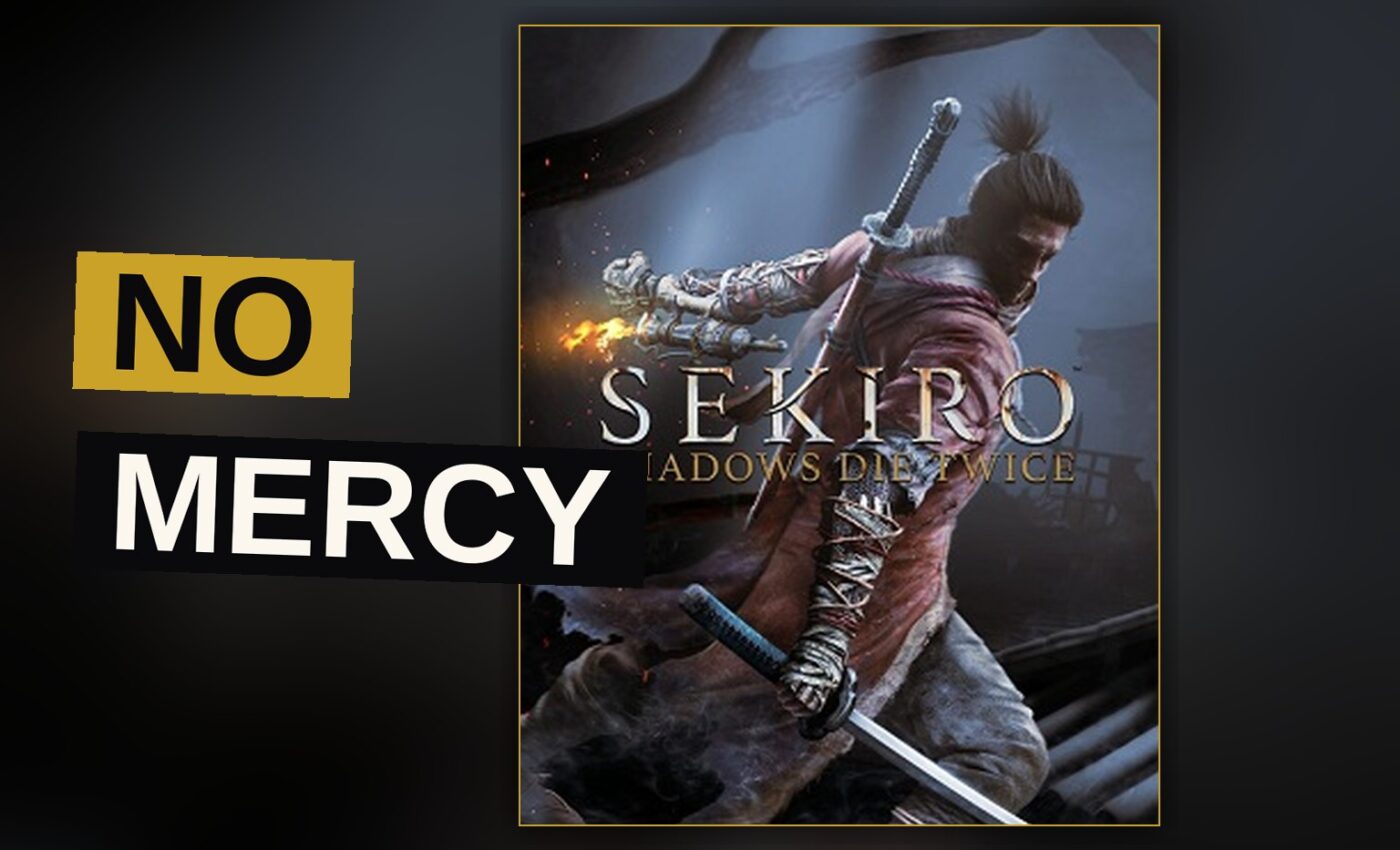
Sekiro: Shadows Die Twice is not a game of quiet moments. It is a game of blades, of breath held in the chest, of one mistake ending everything. FromSoftware’s 2019 action title for PS4, Xbox One, and PC trades the sprawling role-playing freedom of its earlier work for a tight, violent duel. The result is a masterpiece of tension, and one of the most demanding games ever made.
The game asks for a specific kind of patience. If you can meet it on its own terms, there is nothing else like it.
Trailer, via sekirothegame.
The One-Armed Wolf
You play the Wolf, a shinobi bound to a young lord named Kuro. Early in the game, the Wolf loses his left arm in a fight and gains a prosthetic tool in its place. The setup is simple: the Wolf must rescue Kuro from the Ashina clan, a warlord family holding the last of a fading era. That mission takes him across a ruined Japan, through castles, caves, and a sunken valley.
The story is thinner than the lore-heavy sagas of Dark Souls. Sekiro: Shadows Die Twice tells its tale through short cutscenes and sparse dialogue. But the narrative holds. The Wolf’s loyalty to Kuro is the engine, and the game’s ending depends on choices you make near the final hour. It is not a story of epic scope. It is a story of one man’s oath.
The prosthetic arm is the game’s signature tool. It holds a grappling hook, a loaded axe, a flame vent, and more. Each tool has a use in combat and in exploration. The grappling hook opens vertical paths that Sekiro: Shadows Die Twice uses constantly. You are not climbing ladders or finding keys. You are swinging from rooftops and tree branches, moving like the shinobi the game says you are.
Posture and the Deathblow
The core of Sekiro: Shadows Die Twice is its combat. There is no stamina bar, no weight limit, no stat allocation. You have one sword and a set of skills. The fight is built around two health bars: the enemy’s health and their posture. Posture breaks when you block, deflect, or land hits at the right moment. A broken posture leaves an enemy open for a deathblow, a single strike that ends the fight.
Deflection is the key. Pressing block at the exact moment an attack lands parries it, building the enemy’s posture while keeping yours safe. Miss the timing and you take damage. The game punishes panic. Spamming the block button reduces the window for a perfect deflect, so you must read each enemy’s attacks and respond with precision. It is a rhythm game disguised as a sword fight, and it is brutal.
Bosses in Sekiro: Shadows Die Twice are extended duels. A single boss fight can last ten minutes, with two or three phases and a new move set each time. The game expects you to die, to learn, to try again. Death is not a failure state; it is the lesson. The game’s famous “Resurrection” mechanic lets you rise from death once per fight, but the cost is real. Overuse it and the game’s rot mechanic spreads, weakening NPCs and closing side paths.
This is not a game you can out-level. You cannot grind for better gear or higher stats. The only progress is skill, both the Wolf’s and yours. That purity is the game’s greatest strength and its sharpest edge. If you cannot learn the pattern, you do not advance.
Exploring the Ashina Countryside
The world of Sekiro: Shadows Die Twice is smaller than Dark Souls, but denser. The game is not an open world. It is a series of connected zones, each with a clear path and a handful of secrets. The Ashina Outskirts lead to the castle, which leads to the sunken valley, which leads to a frozen temple. Each area has its own enemies, its own traps, and its own visual identity.
The art direction is superb. The game runs on a modified engine and looks stunning on all three platforms. The PS4 and Xbox One versions hold a steady frame rate in most areas, though the PC version offers higher resolutions and smoother performance. The lighting is the star. Sunsets bleed orange across castle walls. Fog rolls through bamboo forests.
Exploration rewards the cautious. Hidden paths lead to new prosthetic tools, prayer beads that increase your health, and gourd seeds that refill your healing flask. The game does not mark these on a map. You find them by looking, by checking every ledge, by using the grappling hook on every branch. The reward for curiosity is real power, and the game respects that.
Facing the Difficulty Wall
Sekiro: Shadows Die Twice is hard. This is not a warning; it is a fact. The game expects you to die dozens of times on the first major boss, the Lady Butterfly. It expects you to learn her moves, to deflect her kicks, to punish her openings. The game’s difficulty is not cheap. Every death is your fault. But the margin for error is thin, and the game does not ease you in.
The game has no difficulty settings. There is no easy mode. FromSoftware has defended this choice, and the design is consistent: the difficulty is the point. The tension of a fight is what makes the victory land. When you finally break a boss’s posture and land the deathblow, the release is immense. It is a feeling few games can match.
For some players, that wall is too high. The game’s combat demands reflexes and pattern recognition. If you cannot deflect consistently, you will not finish it. This is a limitation, not a flaw. Sekiro: Shadows Die Twice knows exactly what it is, and it does not apologize.
Tools, Skills, and Stealth
The prosthetic arm is more than a grappling hook. Each tool has a use against specific enemies. The loaded axe breaks shields. The flame vent sets enemies on fire, leaving them open to attacks. The shuriken stops fleeing enemies and damages airborne foes. The game encourages experimentation, and each tool has upgrades found through exploration.
The skill tree is simpler than Dark Souls. You earn skill points from combat, and you spend them on a small set of abilities. Some are passive, like increased posture damage. Others are active, like the Whirlwind Slash or the Ichimonji. The skills are useful, but they are not the center of the game. The sword is the center. The skills are seasoning.
The game also includes a stealth system. You can crouch, hide in grass, and take enemies out with a single backstab. Stealth is not mandatory, but it is effective. Clearing a group of soldiers before a boss fight makes the fight easier. The game rewards patience, and it does not punish you for using every tool at your disposal.
The Bosses Worth Remembering
The boss fights in Sekiro: Shadows Die Twice are the reason to play. Each one is a distinct puzzle. The Guardian Ape is a wild, unpredictable beast that throws its own body at you. The Owl is a mirror match, a shinobi who fights exactly like you. The Sword Saint Isshin is a four-phase marathon that tests everything you have learned. These fights are the game’s highlights, and they are unforgettable.
The game’s midpoint twist is a genuine surprise. Without spoiling it, the game changes the world and the objectives halfway through. The second half introduces new enemies and new challenges. The pacing is excellent. Just when you think you have mastered the game, it introduces a new mechanic or a new enemy type that forces you to adapt.
The final boss is the hardest fight in the game. It is a test of every skill the game has taught you. It will take hours. It will feel impossible. And when you win, you will feel like a master.
What Sekiro: Shadows Die Twice Does Best
Sekiro: Shadows Die Twice succeeds on three fronts. The order matters, because each builds on the last.
-
Combat precision. The deflect system is unmatched. No other game makes a single button press feel this meaningful.
-
Boss design. Each fight is a lesson. The game teaches you a skill, then tests it in a duel.
-
World density. Every corner hides something useful. Exploration always pays off.
The game is a focused vision. It cuts away the clutter of role-playing games and leaves only the fight. That focus is its identity. It is a game that respects your time by demanding your full attention. It is a game that tells you exactly what it is, and then makes you prove you are worthy of it.
Sekiro: Shadows Die Twice is a masterpiece of action design. It is hard, but it is fair. It is demanding, but it is rewarding. If you have the patience, it will give you one of the greatest experiences in modern gaming.