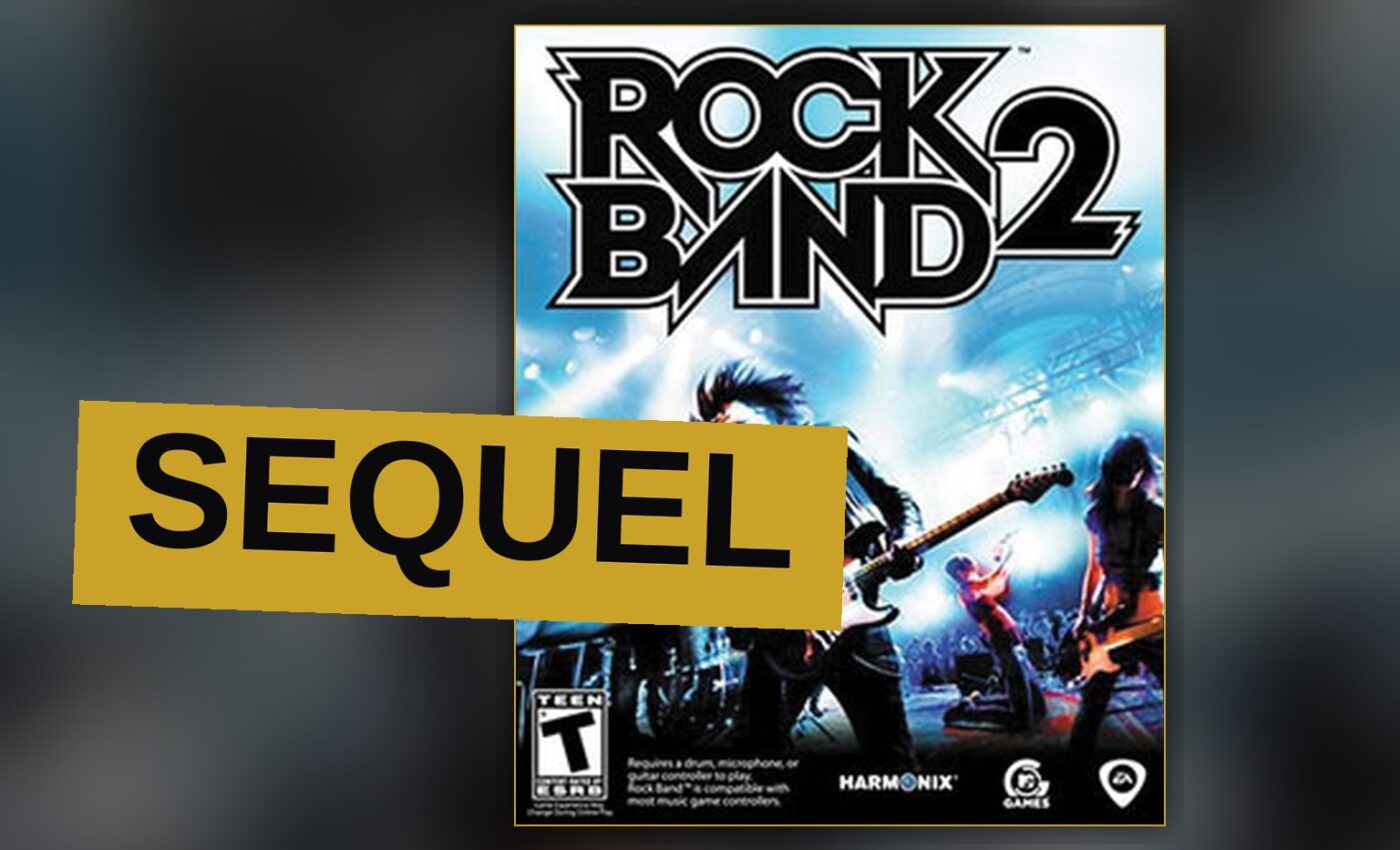
Rock Band 2 does not fix what was broken. It takes what worked, sharpens it, and hands you a bigger stage.
The 2008 rhythm game for PS3, Wii, Xbox 360, and PS2 arrives as the sequel to the phenomenon that turned living rooms into arenas. Harmonix knew the formula. They did not reinvent it. They refined it, expanded it, and made it harder to put down.
This is the rare sequel that respects your time and your shelves. The plastic guitar, drums, and microphone return, but the song list does the heavy lifting. Rock Band 2 is a masterclass in track selection, a 84-song base set that runs from AC/DC to Bob Dylan, from the Replacements to the Grateful Dead.
Trailer, via Electronic Arts.
Setlist Depth Drives the Disc
The base game disc holds 84 songs. That number matters because it is nearly double the first game’s 58. The range is the story. You get the punk fury of the Dead Kennedys’ “Police Truck” and the prog sprawl of Dream Theater’s “Panic Attack.” You get the pop hook of “Buddy Holly” by Weezer and the metal crunch of “Battery” by Metallica.
The DLC library from the first game carries over. Every track you bought in Rock Band 1 plays here. That continuity is a quiet gift. Your library does not reset. Your progress does not vanish.
The setlist is not just long. It is smart. Songs are grouped by difficulty and era, so a party can move from the Ramones to Fleetwood Mac without whiplash. The game knows when to let you breathe and when to push.
Hardware Upgrades, With Caveats
The new guitar is quieter. The strum bar clicks less, and the buttons sit closer to the neck. It feels faster in the hand, which matters when you are chasing five stars on “Prequel to the Sequel” by Between the Buried and Me.
The drums get the bigger change. The kick pedal is sturdier. The pads are more forgiving. For the first time, a drum fill feels like drumming, not button-mashing.
The microphone stays simple. You sing, the game scores you. The new harmonies in the vocal track add depth, but the core remains: hit the notes, keep the pitch, do not embarrass yourself in front of friends.
The instruments are not perfect. The wireless guitar still eats batteries at an alarming rate. The drum kit still rattles on hard floors. But compared to the first game’s hardware, this is a clear step up.
World Tour and Challenge Mode
The career mode, now called World Tour, fixes the biggest complaint from the first game. In Rock Band 1, you dragged a band through a string of venues and hoped the setlist matched your skill. Rock Band 2 gives you a clearer structure.
You move your band through cities and venues, unlocking new challenges as you go. The game tracks your band’s progression across a map. You unlock new cities, new venues, and new challenges. The goals are visible. You always know what you are working toward.
The band management is deeper. You can hire AI members, fire them, and recruit friends. The game tracks your band’s fame, your cash, and your equipment. It is a light simulation, but it gives the career mode a spine.
The biggest addition is the setlist creator. You can build a custom setlist from any song you own, including DLC. You can save it, name it, and play it anytime. For party hosts, this is the feature that sells the game.
For solo players, the new Challenge mode is the draw. It takes a specific band, like the Who or the Police, and runs you through their songs in sequence. You earn stars, you unlock modifiers, and you chase leaderboard placement.
The difficulty curve is brutal in the right way. The early challenges are warm-ups. The later ones, like the full run of Megadeth’s “Peace Sells,” are gauntlets. You will fail. You will retry. You will feel the click when you finally clear it.
The game also adds a practice mode that lets you slow down any section. You can isolate the guitar solo in “Painkiller” and grind it at half speed. This is the tool that turns a casual player into a competent one.
Online Play Expands the Party
Rock Band 2’s online suite is more than a lobby. It has a full band mode where four players can join from different consoles. You can form a band, pick a setlist, and play a full show together. The lag issues that plagued the first game are mostly gone.
The game also adds a Battle of the Bands mode. This is a rotating set of challenges, updated weekly. One week it is a score attack on a single song. The next it is a marathon of five songs with no breaks. The leaderboards are global, so there is always a reason to come back.
The online community is the secret weapon. Rock Band 2 launched into a world where the first game had already built a player base. The sequel inherits that crowd. Finding a band is never hard. The matchmaking is fast, and the voice chat is clear.
The Wii version brings online play to that console for the first time in the series. The PS3 and Xbox 360 versions offer the full online package. The PS2 version is a stripped-down port with no online at all.
Cleaner Presentation, Sharper Sound
The graphics are not a leap. The character models are sharper, and the venues have more detail, but the game still looks like a rhythm game from 2008. The stage lighting is better. The crowd animations are livelier. The core loop is the same: notes fly down the highway, you hit them, the crowd roars.
The menus are faster. The load times are shorter. The song selection screen sorts by artist, title, decade, or difficulty. The interface is not glamorous, but it is efficient.
The sound mix is the real upgrade. Each instrument gets its own audio channel. If you fail a guitar part, the guitar drops out of the mix. The remaining instruments carry the song. This is a small detail, but it makes failure feel musical rather than jarring.
Standout Tracks and the Difficulty Curve
A quick rundown of the standouts:
- “Shooting Star” by Bad Company — a slow-burn anthem that tests your sustain.
- “Alive” by Pearl Jam — the guitar solo is a rite of passage.
- “Give It Away” by Red Hot Chili Peppers — the bass line is the star.
- “Livin’ on a Prayer” by Bon Jovi — the crowd knows every word.
- “Let There Be Rock” by AC/DC — the live version, with the full solo.
These are not the only good songs. They are the ones you will replay. The full list has no filler, but it has peaks.
Here is how the game’s challenge progression roughly scales across a typical play session:
| Stage | Song Example | Challenge Level |
|---|---|---|
| Warm-up | “Buddy Holly” by Weezer | Easy |
| Steady | “Shooting Star” by Bad Company | Medium |
| Stretch | “Alive” by Pearl Jam | Hard |
| Gauntlet | “Peace Sells” by Megadeth | Very Hard |
| Endurance | “Painkiller” full solo grind | Expert |
The curve is deliberate. Early songs teach you the mechanics. Later ones demand mastery. The practice mode bridges that gap.
Rock Band 2 is the best rhythm game of its generation. It is not a revolution. It is a consolidation. Everything the first game did well, this one does better. The setlist is deeper, the instruments are sturdier, the career mode is smarter, and the online modes are richer.
It has flaws. The PS2 version is incomplete. The battery drain is real. The difficulty spikes will frustrate casual players. But the core experience, the feeling of four people locking into a song and nailing it, is unmatched.
The game respects your skill. It respects your library. It respects your time. In a genre full of gimmicks, Rock Band 2 is the real thing.