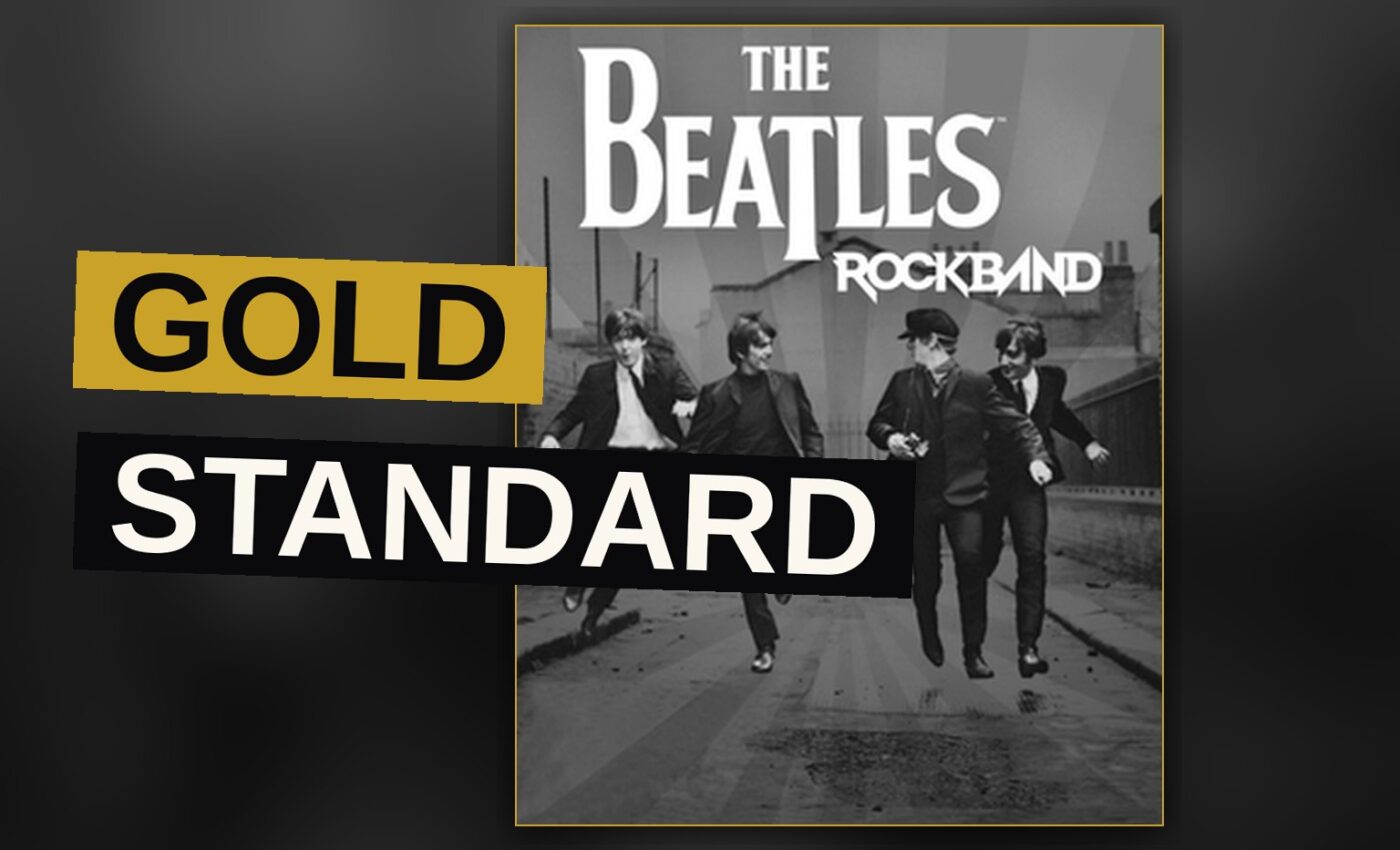
The Beatles: Rock Band is not a game about notes. It is a game about a feeling, and the feeling is the sound of four people who changed the world by locking into the same groove. Harmonix, the studio behind the genre-defining Rock Band series, built this 2009 release for the PlayStation 3, the Wii, and the Xbox 360. It is a tribute, a history lesson, and a party game all at once. The result is something that still holds up as the most emotionally resonant music game ever made.
Trailer, via Gamehelper.
Abbey Road Sets the Stage
The game opens in the studio. You start in the cramped, cluttered space of Abbey Road, where the band recorded most of its catalogue. The visual style is not photorealistic. It is a warm, stylized cartoon that feels like a pop-art dream. You see the lads in their moptop days, then the bearded, suited figures of the later years. The transitions between eras are seamless, and the attention to detail is staggering. From the tea cups on the piano to the cigarette smoke in the air, every frame feels researched and loved.
The song list is the spine of the experience. It draws from the entire career, from the early scream of “I Saw Her Standing There” to the late, strange beauty of “I Want You (She’s So Heavy).” There are 45 songs on the disc, with more added later as downloadable content. The tracklist is not just a greatest hits package. It is a curated arc that tells the story of the band’s evolution. You play the simple, joyful pop of the early years, then the psychedelic swirl of the middle period, and finally the stripped-down, raw sessions of the Let It Be era.
Dreamscape Visuals Carry the Story
The game’s most famous feature is the Dreamscape. This is the name for the visual journey that plays behind the songs. It is not a static venue. It is a surreal, ever-changing landscape of imagery drawn from the band’s lyrics and iconography. For “Lucy in the Sky with Diamonds,” you float through a kaleidoscope of colors and giant flowers. For “A Day in the Life,” you watch a surreal circus of clocks and mirrors.
The Dreamscape is where Harmonix proved that a rhythm game could be art. It is not just a background. It is a narrative device. The visuals shift with the music, and they often reflect the specific mood of the recording. The early songs are shot in bright, sunny black-and-white, like a television broadcast from 1964. The later songs are darker, more textured, and more abstract. The transition from the first to the last is a visual biography of the band itself.
Plastic Instruments, Real Feel
The core gameplay is the same as the regular Rock Band series. You hit colored notes as they scroll down the screen, matching the rhythm of the guitar, bass, drums, or vocals. The instruments are the same plastic peripherals from the earlier games. The guitar is a five-button fret board, the drums are four pads and a kick pedal, and the microphone tracks your pitch. The hardware is not new, but the software makes it feel new.
The key difference is the calibration of the charts. The note patterns are designed to mimic the actual performances. The bass lines on the early songs are simple and driving, matching Paul McCartney’s style. The later songs feature more complex, melodic bass work. The drum parts are similarly faithful to Ringo Starr’s unique, off-center playing. The guitar parts capture George Harrison’s clean, economical solos. The vocal parts are the most demanding, often requiring you to hold long, sustained notes or hit precise harmonies.
There is a moment in “Paperback Writer” where the bass line is so funky and propulsive that you feel like you are actually playing it. There is a moment in “Within You Without You” where the odd time signature makes you stumble, and you realize how strange and brilliant the original recording was. The game does not just ask you to hit notes. It asks you to inhabit the music.
Studio Tape Reveals the Band
The game includes archival audio of the band talking in the studio. These are not scripted lines. They are snippets from the recording sessions, captured on tape. You hear John Lennon cracking jokes. You hear Paul McCartney directing the band. You hear George Harrison complaining about the volume of his guitar. You hear Ringo Starr offering a dry comment about a take.
These audio clips are placed between songs and in the loading screens. They add a layer of intimacy that no other music game has achieved. You are not just playing the music. You are sitting in the room with the band. You hear the frustration and the laughter. You hear the creative process in real time. It is a gift to any fan of the band, and it makes the game feel like a documentary as much as a game.
| Era | Opening Track | Closing Track |
|---|---|---|
| Early Years | “I Saw Her Standing There” | “Twist and Shout” |
| Psychedelic Period | “Lucy in the Sky with Diamonds” | “Strawberry Fields Forever” |
| Late Period | “While My Guitar Gently Weeps” | “I Want You (She’s So Heavy)” |
Harmony Demands Real Skill
The difficulty curve is steep at the top. The early songs are easy enough for a child to play. The later songs, like “Revolution” or “Helter Skelter,” demand serious skill. The drum part for “Helter Skelter” is a frantic, pounding workout. The guitar part for “While My Guitar Gently Weeps” requires fast, precise finger work. The vocal harmonies are the real challenge.
The game supports up to three vocalists, each singing a different harmony line. This is a unique feature. When you get three people singing the correct harmonies on “Because” or “Nowhere Man,” the sound is transcendent. When you fail, it is a mess. The harmony system is a bold design choice, and it works more often than it fails. It rewards the kind of patience and listening that the Beatles themselves practiced in the studio.
Gaps in the Setlist
The game is not perfect. The setlist omits some major hits, like “Hey Jude” and “Let It Be,” which were released later as downloadable content. The absence of those songs on the disc feels like a gap. The game also lacks the full narrative structure of a career mode. There is no story of a struggling band rising to fame. Instead, the game presents the band as already legendary, which is accurate but less dramatic.
The biggest limitation is the hardware. The plastic instruments are flimsy by modern standards. The drum pads can be loud and unresponsive. The guitar strum bar can break with heavy use. Playing the game in 2009 required a significant investment in plastic junk. That is a real cost, and it was a barrier for many players. But for those who made the investment, the payoff was enormous.
The game also suffers from a lack of free play options. The main modes are the career tour and the quick play. There is no robust sandbox mode where you can just jam. The game is tightly scripted, which is part of its charm, but it limits replayability for some players. You are following a path, not creating your own.
Final Score and Lasting Legacy
The Beatles: Rock Band is a love letter. It is a meticulously crafted tribute to a band that needs no introduction. It succeeds because it treats the source material with reverence without ever becoming a museum piece. The game is fun. It is challenging. It is beautiful. It is the rare music game that makes you feel like you are part of the music, not just a button-presser.
Critics praised the game, and it made a strong impression on the public. It remains a benchmark for how to adapt a legacy act into an interactive medium. No other band has received this level of care in a video game. The Beatles: Rock Band is the gold standard.
The game is a snapshot of a moment in time. It captures the band at the height of their powers and presents them to a new generation. It is a game that rewards patience, listening, and a willingness to sing badly with your friends. It is a game that understands that the Beatles were not just a band. They were a phenomenon.
For the PS3, the Wii, and the Xbox 360, this is a must-own. It is a piece of history that you can play. It is a document of genius that you can hold in your hands. It is a game that makes you smile, makes you sweat, and makes you sing.
The score is 8.8/10.
Get the Notebook.
The day's best stories and every fresh verdict, in plain English, in your inbox by seven. One email a day, no more.