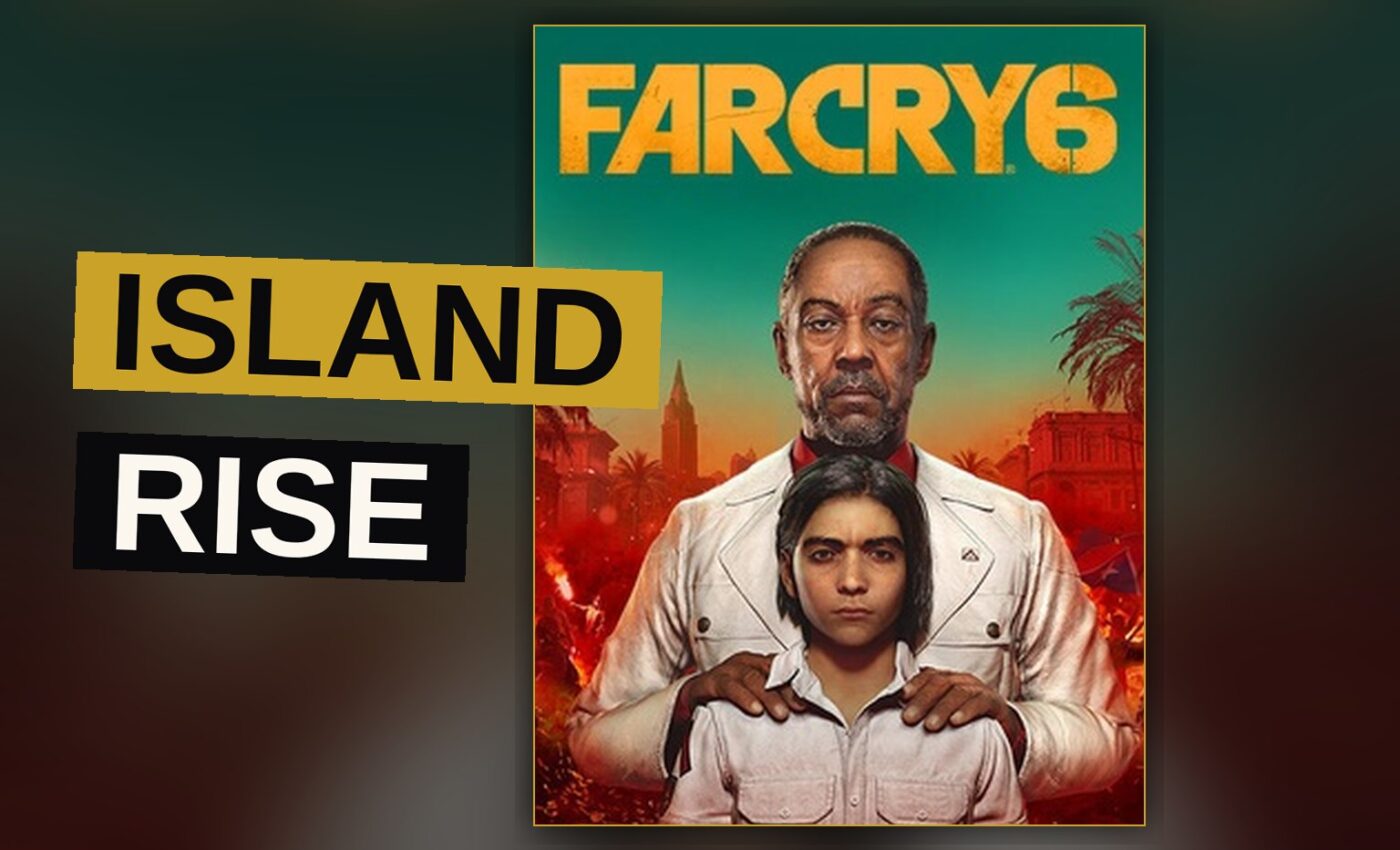
Ubisoft Toronto built Far Cry 6 around a dictator, a teenager, and an island that time forgot. It is the sixth main entry in the Far Cry series and the follow-up to 2018’s Far Cry 5. It came out five years ago, in 2021, on Google Stadia, Xbox Series X|S, Xbox One, PlayStation 4, PlayStation 5, and PC. It is a first-person shooter in an open world, and it is the most interesting thing Ubisoft has done with this series in years.
Trailer, via Ubisoft.
Antón Castillo and the boy he is grooming
The game takes place in 2021 on Yara, a fictional Caribbean nation. Giancarlo Esposito plays Antón Castillo, the president. Anthony Gonzalez, who played Miguel in “Coco,” plays Diego, his 13-year-old son. Castillo is raising the boy to succeed him.
The backstory the game hands you is specific. In 1967, a guerrilla revolution toppled the regime of Antón’s father, and Yara went dark to the rest of the world. Antón became a political prisoner. In 2019 he was elected president. He now pushes Viviro, a cancer treatment made from Yara’s tobacco, and promises it will steady the economy.
Two years later he announces a draft lottery. Citizens get conscripted as farm workers in the tobacco fields. That is the spark.
Dani Rojas and the boat that never leaves
You play Dani Rojas, a former conscript turned guerrilla. You pick the character’s gender at the start. Nisa Gunduz and Sean Rey voice the two versions.
The opening is the best sequence in Far Cry 6. Dani plans to flee to Miami by fishing boat with friends Lita Torres and Alejo Ruiz. Alejo is shot and killed after provoking troops in the street. Dani and Lita reach the boat and escape — until Antón stops it. Diego was trying to run with them. Antón takes his son back and orders the boat sunk.
Dani washes up on a beach with a dying Lita. Her last act is to send Dani to Clara Garcia, who leads the guerrilla movement Libertad. Clara’s first jobs are to bring back Juan Cortez, an ex-spymaster and weapons maker, to break the FND forces on the island, and to clear the blockade. Finish, and Clara offers a boat out of Yara. Staying is the game.
Resolver weapons, Supremos, and a wiener dog
The shooting is familiar Far Cry, which is to say competent and a little loose. You fight on foot or in land, water, and air vehicles. The map splits into seven regions, from jungle to the streets of the capital, Esperanza, to mountains and open ocean. You get sidearms, assault rifles, submachine guns, shotguns, light machine guns, sniper rifles, and grenade launchers, and you customize them with materials you find.
The new toys are the reason to care. Resolver weapons are prototypes built from junk, each with a perk:
- A silent close-range nailgun
- A sling-shot weapon that fires CDs
Supremo backpacks stack more perks on your loadout. One fires homing missiles. One lets you see enemies through solid objects. You can also holster your weapon now, so enemy NPCs won’t shoot on sight unless you’re inside a restricted area. Small change, large effect on how the island feels.
Fangs for Hire return. Chorizo is a wiener dog, and he is dangerously distracting.
A political game, by design
Development started around 2016 and ran long. The team studied recent revolutions, mostly the Cuban Revolution of 1953–1959. Castillo is based on Fulgencio Batista. The designers said outright they wanted Far Cry 6 to be “political,” and they named the themes: the rise of fascism in a nation, the cost of imperialism, and the need for free and fair elections.
That last part is a reaction to the fight over Far Cry 5. The team also went back for the things people liked: a tropical setting and a protagonist who actually talks. Narrative director Navid Khavari said of the voiced lead, “It was essential for us to ensure that the protagonist has a personal investment in that revolution.” In Far Cry 5 you were mute. Here Dani argues, jokes, and grieves.
The design goal was choice. Players can approach the campaign in whatever order they like. Alongside the main path, Far Cry 6 carries the role-playing furniture the series has picked up: a leveling system, side quests, and a Rank Level that marks your standing and the difficulty of each region. Push into new ground and enemy forces get better gear, and the places you’re attacking get more heavily fortified.
Cooperative multiplayer is in. So is single-player and standard multiplayer.
Where Yara wears thin
Yara is enormous and the game knows it. The seven regions give you room, and they also give you repetition. Outposts, checkpoints, the same fight with a different backdrop. The Rank Level system is the worst offender: it turns exploration into a math problem, and it punishes you for wandering into the wrong part of a map that was sold on wandering.
The story is the counterweight. Esposito plays Castillo with a calm that makes him hard to look away from, and the father-son thread gives the game a spine that most open worlds don’t have. Diego is not a prop. He is a kid being shaped into something awful, and the game keeps that in view. Gonzalez is the reason it lands.
The supporting cast is thinner. Clara, Juan, and the Libertad crew do their jobs, but the game’s best writing is reserved for the Castillo family, and you spend most of your time away from them.
What Far Cry 6 gets right
Far Cry 6 is the series finally taking its own premise seriously. The Cuban Revolution source material isn’t decoration — it’s the engine. A dictator selling a cancer drug made from tobacco, a draft lottery that feeds the fields, a boy groomed to inherit it all. That is a real idea, and Ubisoft Toronto commits to it.
The game around that idea is uneven. The Resolver weapons and Supremos are the most fun the combat has been in years, and holstering your weapon quietly fixes a problem the series never admitted it had. But the Rank Level grind and the outpost loop drag against the story every time you leave the main path. The result is a game that is better when you’re watching it than when you’re clearing your fourth checkpoint.
Still, the highs are high. The opening boat sequence, the Castillo scenes, Chorizo. Far Cry 6 is worth your time, and it is worth arguing about, which is more than most entries in this series can claim.
8.2 of 10.
Get the Notebook.
The day's best stories and every fresh verdict, in plain English, in your inbox by seven. One email a day, no more.