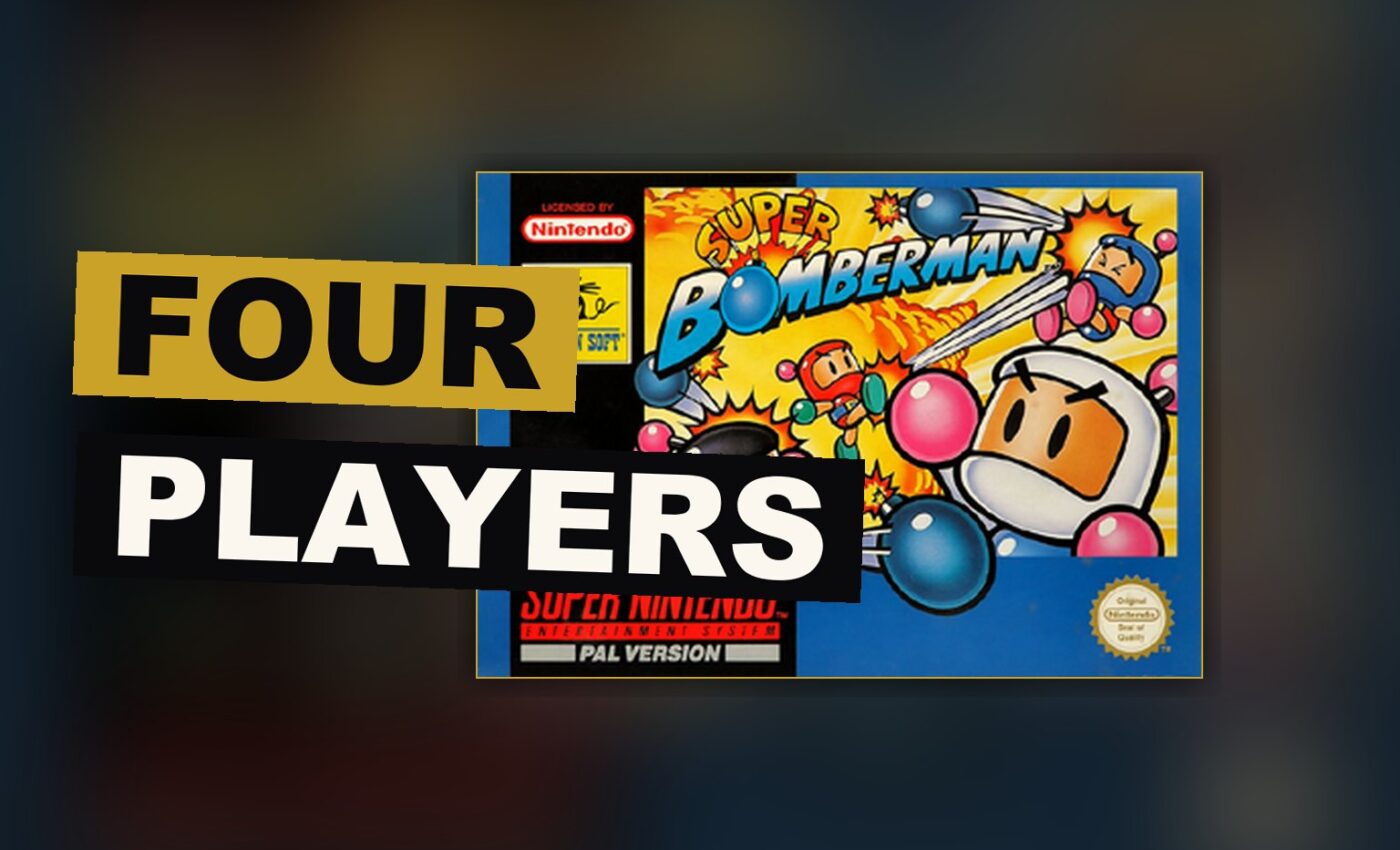
Super Bomberman arrived on the Super Nintendo Entertainment System in 1993, developed by Produce! and published by Hudson Soft. It is the first game in the Bomberman series to keep the Bomberman name in Europe, rather than being renamed Dynablaster or Eric and the Floaters. That small fact tells you a lot about what this game is: a series finally confident enough to travel under its own name.
A Grid of 143 Squares
The whole game takes place on a single non-scrolling screen. That screen shows a top-down view of a grid of 143 squares, arranged 13 by 11. The grid restricts movement, so characters can only move horizontally or vertically. There is no diagonal dodge, no free aim, no camera to fight. You are locked into the geometry, and the geometry is the game.
Pressing a button makes Bomberman drop a bomb at his feet. The bomb pulses for a few seconds, giving the player time to run, then explodes, shooting flames horizontally and vertically. The game revolves around using those blasts to destroy walls and enemies. If a flame hits another bomb, that second bomb detonates early. Chain reactions follow, and they can be enormous.
That single rule — bombs set off bombs — is the engine behind everything Super Bomberman does well. It turns a simple screen into a puzzle with a timer attached.
Trapping Enemies, and Yourself
Once a bomb is laid, it is usually impossible to walk past until it has detonated. That one limitation creates the game’s central tactic: trapping enemies with bombs and forcing them into the blasts. It also creates the game’s central failure. The same wall that pens in an enemy pens in the player.
Most levels start with the grid partly filled with destructible soft walls. A blast that hits one disintegrates it, opening space to move through. Special items appear by walking over icons on the screen, normally revealed when destroying walls or killing enemies. There are many different items, and they grant different abilities. They change a player’s tactics and the way the game is played.
The items are where Super Bomberman finds its variety. The core loop never changes. What changes is what you can do inside it.
Diamond City, Carat Diamond, and Dr. Mook
The story takes place in Diamond City, far to the north of Bomberman’s home city, Peace Town. There, the evil Carat Diamond and his cohort, scientist Dr. Mook, are holding a Robot Tournament with robots built for combat and offensive capabilities. They want Bomberman’s advanced combat capabilities.
Diamond builds a fake Bomberman and sends it to Peace Town to kidnap the real one. Black Bomberman knows the plot and heads out alone to face the fake. Black Bomberman is defeated and his castle is taken. He escapes, seeks refuge with White Bomberman, and warns him of Diamond’s plan. Then hordes of enemy robots begin their advance toward Peace Town. The two heroes must join forces to defeat Diamond.
It is thin stuff, and it is delivered with a straight face. But it does the job a 1993 arcade game needed done: it gives the player a reason to be on that screen.
What the Series Kept
Super Bomberman spawned a sub-series. Seven more entries have followed:
- Super Bomberman 2 (1994)
- Super Bomberman 3 (1995)
- Super Bomberman 4 (1996)
- Super Bomberman 5 (1997)
- Super Bomberman R (2017)
- Super Bomberman R Online (2017)
- Super Bomberman R 2 (2023)
That is a long run for a game built on one screen and one button. It is also the clearest evidence of how well the original’s rules were built. The series did not survive because of its story. It survived because dropping a bomb and running is a good idea, and because the chain reaction makes every placement a small gamble.
The game was re-released in 2026 as part of the Super Bomberman Collection compilation. That re-release is the reason to look back at it now, and it holds up better than most of its contemporaries.
The Case Against the Single Screen
The single non-scrolling screen is the game’s identity, and it is also its ceiling. Everything happens inside 143 squares. There is no scrolling, no exploration, no sense that the world extends past the frame. What you see on the first screen is what you get on the last one.
The plot is the weakest part of the package. Diamond City, Carat Diamond, Dr. Mook, the Robot Tournament, the fake Bomberman, the taken castle — none of it changes how the game plays. It is set dressing bolted onto a maze. The characters are named and then never developed. Black Bomberman gets defeated and then exists mainly to explain why White Bomberman has a partner.
Single player is the only mode listed here, which matters. Bomberman has always been a game people remember playing against other people, and this entry is built around one player working through a grid alone. The chain reaction is still satisfying. It is just a lonelier satisfaction than the series would later be known for.
7.2 of 10
Super Bomberman earns a 7.2 out of 10.
The score is not a knock on the mechanics. The bomb-pulse timing, the soft walls, the item drops, the chain reactions — these are clean, readable systems that a player can learn in a minute and still be mastering an hour later. The game does exactly what it sets out to do, and it does it without clutter.
What holds it at 7.2 rather than higher is scope. The single screen limits how much the game can grow, and the story adds nothing you will remember. The 2026 re-release in the Super Bomberman Collection is the right way to meet this one: as a well-built foundation for a series that spent the next three decades building on it. Play it for the bombs. The rest is noise.
Get the Notebook.
The day's best stories and every fresh verdict, in plain English, in your inbox by seven. One email a day, no more.