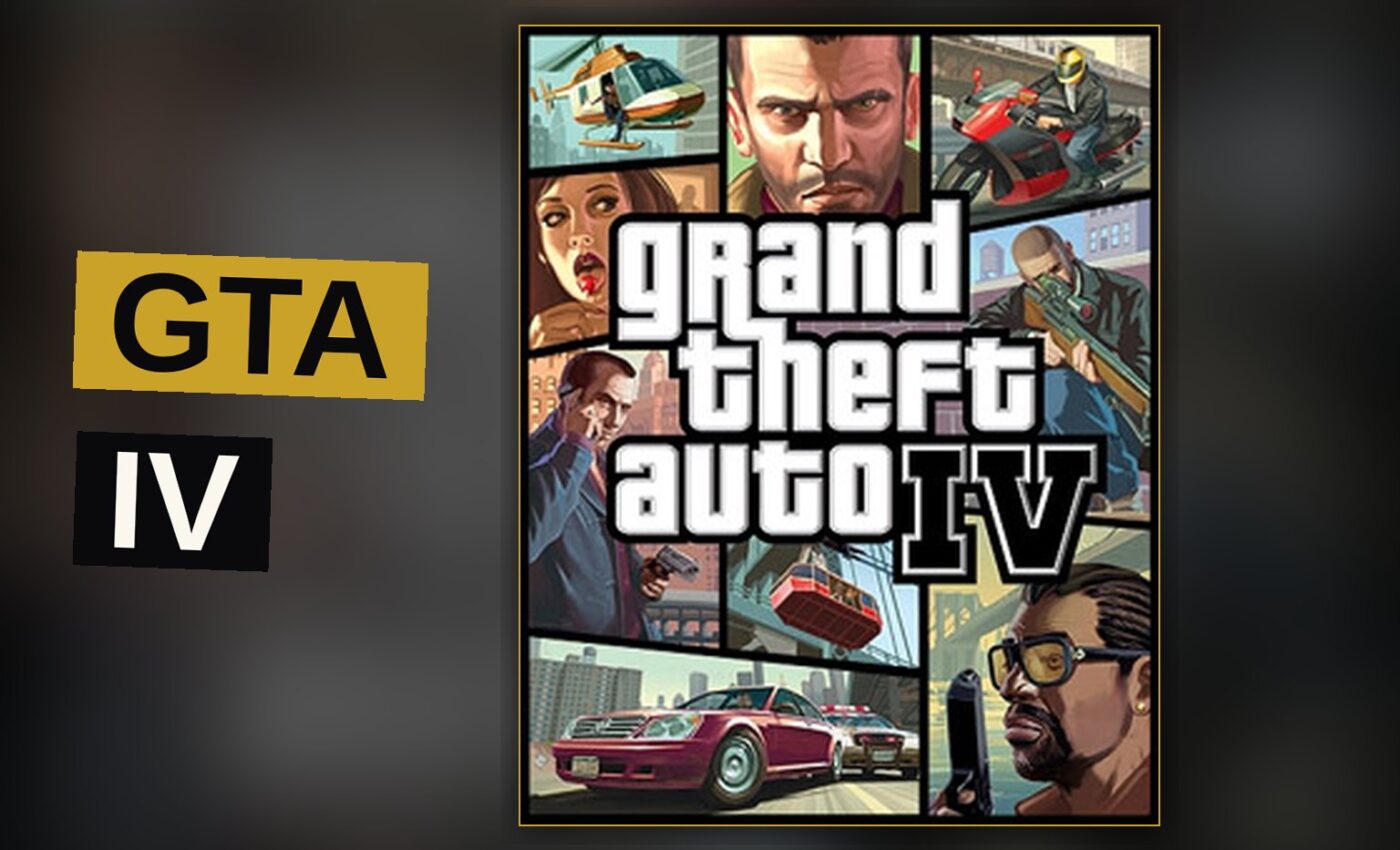
Liberty City is a machine built to be broken. Rockstar North’s Grand Theft Auto IV, released in 2008 for PS3, PC, and Xbox 360, does not simply place you in a city. It drops you into a sprawling, grimy simulation of New York, then asks you to survive it. Niko Bellic arrives on a cargo ship with a cousin’s promise of a golden life, and the game spends its next forty hours dismantling that lie.
The opening is a masterclass in tonal control. Niko steps off the boat, and the first thing he sees is the Statue of Happiness, a Liberty City twist on the Statue of Liberty, holding a coffee cup. The sky is gray. The streets are wet. The promise of America is present, but it looks exhausted. That mood never lifts. Grand Theft Auto IV is a sad game dressed in the clothes of a blockbuster, and that tension is its greatest strength.
Trailer, via Rockstar Games.
Niko Bellic Carries the Weight
Niko is not a cartoon. He is a former soldier from an unnamed Eastern European country, haunted by a betrayal that killed his unit. He talks about it in a flat, tired voice. When he kills a man, he does not joke. He sometimes comments on the waste of it. This is a stark departure from the series’ earlier protagonists, who were mostly vehicles for mayhem. Niko has a moral compass, even if he routinely ignores it.
The performance by Michael Hollick carries the entire game. Niko’s accent slips occasionally, but the weariness is consistent. He is a man who has seen the worst of humanity and is now being paid to see it again. His cousin Roman is the opposite: a loud, optimistic gambler who believes every scheme will finally pay off. Together they form the emotional core of the story. Roman’s constant calls for bowling or darts are annoying, but they are also the only warmth Niko has.
The game’s writing is sharp and specific. Missions are not random violence. They are favors, debts, and betrayals. The characters Niko meets—the corrupt cop, the drug-addled rich kid, the aging mobster—all have clear motivations. The dialogue is often funny, but the humor is dry and bitter. You laugh, then you feel bad for laughing.
Driving Through a Living City
The city itself is the real protagonist. Liberty City is dense, vertical, and filthy. It is divided into four boroughs: Broker, Dukes, Bohan, and Algonquin. The geography mimics New York closely enough that locals will recognize landmarks, but it is an interpretation, not a copy. The streets are packed with traffic. Pedestrians have routines. The weather changes from bright sun to sudden rain to thick fog.
The driving model is the most controversial part of Grand Theft Auto IV. Cars have weight. They bounce over curbs. They fishtail when you brake hard. This is not the arcade handling of earlier games. It is closer to a simulation, and it takes time to master. Early on, you will crash constantly. But once you learn the rhythm, the driving becomes satisfying. A high-speed chase through Algonquin at night, with rain on the windshield, is one of the best experiences in the game.
The physics engine deserves credit. When you crash, the car crumples realistically. Bodies react to bullets with a heavy stagger. The Euphoria engine, which drives character animation, means that NPCs do not fall in canned poses. They stumble, grab railings, and sometimes crawl. This makes violence feel consequential. It is ugly, and it should be.
Five Missions That Define the Game
The mission design is a slow burn. Early missions are simple: drive here, kill that man, escape the police. But the game layers complexity over time. You will tail targets, hack computers, and plant bugs. One memorable mission has you chasing a motorcycle through a construction site. Another forces you to choose between killing two targets, and the game remembers your choice.
A numbered list of the game’s most essential missions:
- “Three Leaf Clover” — A bank heist that plays like a movie. It is loud, chaotic, and unforgiving.
- “The Snow Storm” — A raid on a drug deal that ends in a brutal firefight in the snow.
- “Out of the Closet” — A hostage rescue that goes wrong in every possible way.
- “Paper Trail” — A mission involving a corrupt politician that shows the game’s satirical edge.
- “A Revenger’s Tragedy” — The final mission, which forces a choice that defines the ending.
The mission variety is strong, but the pacing is uneven. The middle third of the game drags. You will run errands for characters you do not care about, and some missions are pure filler.
Side Attractions and Distractions
Grand Theft Auto IV is not just the main story. The game is stuffed with side content. You can watch television shows, including a parody of reality TV and a news network that is clearly Fox News. You can browse the internet on in-game computers, reading satirical articles and dating profiles. You can play pool, darts, and bowling.
The dating system is a highlight. Niko can pursue several women, each with her own personality and schedule. These dates are not just cutscenes. You have to pick them up, take them somewhere, and behave well. If you fail, the relationship suffers. It is a small RPG layer that adds texture.
The vigilante missions, where you hunt criminals as a makeshift cop, are fun but shallow. The taxi missions are a good way to earn money. The game also includes a hidden package hunt, but the reward is underwhelming. The side content is broad, but it lacks the depth of the main story.
Technical Price of Ambition
Grand Theft Auto IV was a technical marvel in 2008, but it was also a technical mess. The frame rate on the PS3 and Xbox 360 versions frequently dips, especially in busy areas. The draw distance is short, causing pop-in. The PC version, released later, fixed some issues but introduced others, including a notorious Games for Windows Live requirement.
The game is also a memory hog. On PC, it was infamous for using only 2GB of RAM at launch, which caused stuttering on systems with more. Mods later fixed this, but the out-of-box experience was poor. The console versions are more stable, but they still show their age. The textures are muddy, and the character models are stiff by modern standards.
The sound design, however, holds up. The radio stations are excellent. You have rock, pop, hip-hop, jazz, and talk radio. The licensed soundtrack is a time capsule of late-2000s music, and the original score by Michael Hunter is moody and electronic. The voice acting is uniformly strong, with standout performances from the supporting cast.
Satire That Stings
Grand Theft Auto IV is a satire of American life, and it is often vicious. The game mocks consumerism, celebrity, politics, and the media. The in-game internet is full of absurd products and news stories. The radio ads are pitch-perfect parodies of real commercials. The talk radio hosts are bigoted and stupid, and the game lets you listen to them for as long as you want.
The satire is blunt and repetitive, but effective. The game’s America is a place where everyone is selling something, and everyone is lying about it.
This is where Grand Theft Auto IV differs from its successors. Grand Theft Auto V was a satire of Los Angeles, but it was a celebration of excess. Grand Theft Auto IV is a tragedy. The story ends with Niko getting what he wanted—money, safety, a chance at peace—but he does not look happy. He looks tired.
A City That Demands Patience
The game is not for everyone. Its pacing is slow. Its controls are heavy. Its story is depressing. If you want a power fantasy, this is the wrong game. Grand Theft Auto IV asks you to invest in a character who is not a hero. He is a killer with a conscience, and the game does not let him off the hook.
The mission design punishes failure harshly. A single mistake can restart a long mission. The checkpoints are rare, and the older missions have none. This can be frustrating, especially in the late game. The difficulty curve is steep, and some missions feel unfair.
But the rewards are real. When you finally master the driving, when you learn the streets, when you survive a five-star wanted level, you feel a sense of accomplishment. The game respects your time by giving you a world that is worth learning.
Legacy of a Sad Masterpiece
Grand Theft Auto IV is a landmark. It showed that blockbuster games could have a soul. It proved that a violent open world could be melancholic. It influenced a generation of games, from Red Dead Redemption to The Last of Us. Its influence is still visible in modern titles, even as the industry has moved toward live services and microtransactions.
The game’s expansions, “The Lost and Damned” and “The Ballad of Gay Tony,” added new perspectives and refined the mechanics. They are worth playing, but they do not change the core experience. The base game remains the definitive statement.
Grand Theft Auto IV is not a perfect game, but its strengths are overwhelming.
It is a game about the American dream, and it concludes that the dream is a lie.
Grand Theft Auto IV is a flawed, beautiful, and deeply sad game. It is not a game you play for a weekend. It is a game you live in for a month.