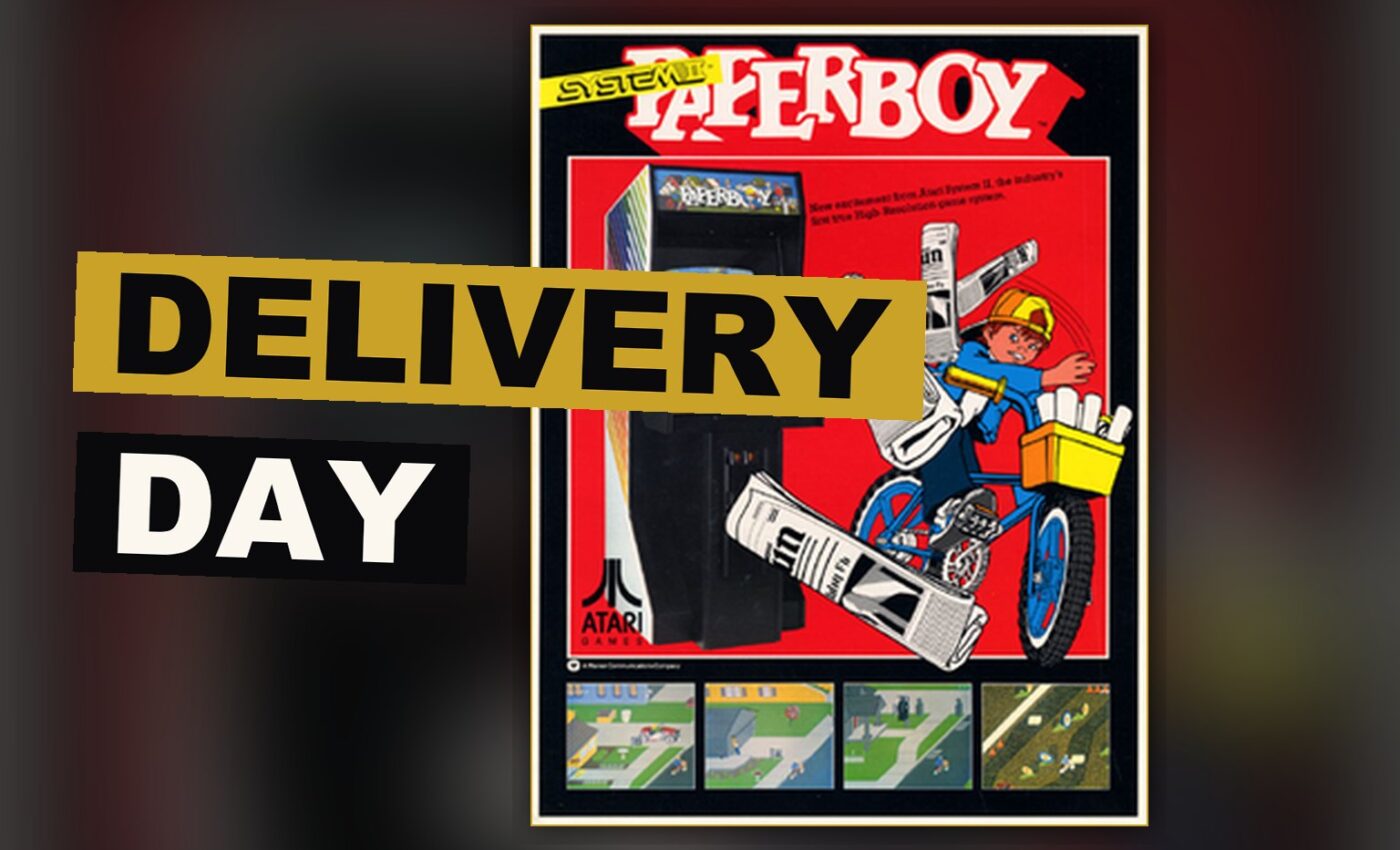
Paperboy puts you on a bicycle, hands you a pile of newspapers, and sends you down a suburban street full of danger. The NES version of the arcade hit asks players to deliver papers to subscribers while avoiding dogs, cars, board riders, and other hazards along the way. It sounds simple. It rarely plays simple.
The Delivery Path
Each level covers one street, run left to right, with the houses that take papers lined up along one side. Subscribers want a paper thrown on their porch. Houses without a subscription do not want one, and hitting their windows costs points instead of earning them. The bicycle moves forward on its own, so most of the challenge sits in aiming throws and guiding the bicycle around trouble at the same time.
That double demand is the game’s core trick. A player who focuses only on throwing will end up in an accident. A player who focuses only on avoiding hazards will miss deliveries and lose subscribers. Balancing both is the whole job.
The street fills with trouble fast. Cars move out without warning. Dogs chase the bicycle. Board riders cut across the path. Water hoses turn on and off. Some hazards can be avoided with quick turning, others only with good timing.
Control on the NES controller is adequate but less quick than the arcade cabinet’s rolling ball control. The original setup gave players fine control over small movements. The NES controller here asks for more careful timing to hit the same lines, and that changes the feel of close calls with cars and dogs. Players who know the arcade version may notice the difference right away; new players likely will not.
Throwing papers uses a separate button, and the two actions — guiding the bicycle and throwing — need to happen in close order for an accurate delivery. Missed throws are common early on, and the learning process is steady rather than harsh.
Days, Windows, and Subscribers
The game runs across a set week, Monday through Sunday, with the subscriber list carrying over from one day to the next based on how well the previous day’s deliveries went. Break enough windows on a subscriber’s house and they cancel their paper. Deliver well and the customer list grows. That design gives the whole affair some weight beyond the immediate hazards.
Still, the core action does not change much from level to level. The scenery changes, the arrangement of hazards changes, but the core task stays the same throughout. Players looking for variety in the actions available will not find much of it. Players looking for a tight, steady arcade process will find exactly that.
Graphics and Sound
The graphics do the job without much flourish. Houses, lawns, and hazards are easy to read at a glance, which matters given how fast the action moves. Character sprites are small but distinct enough to tell a dog from a board rider in the short window available to react.
The music plays constantly through each run and will tire some players well before the session ends. Sound effects for accidents and successful deliveries are clear and useful, giving players feedback without needing to check a display.
The table below lays out the plain shape of the week as the game gives it.
| Day | Subscriber Status |
|---|---|
| Monday | Starting list for the week |
| Tuesday–Saturday | Carries over from the prior day’s deliveries |
| Sunday | Final subscriber count for the week |
This shape repeats across further weeks with added difficulty, though the arrangement of houses stays the same.
What separates a good week from a poor one, in practice, is a small run of choices a player makes without much room to think them over.
In this reviewer’s judgment, that narrow space between control and consequence is the real measure of the game, more than any single hazard or level. Paperboy for NES earns a 7.1 of 10.