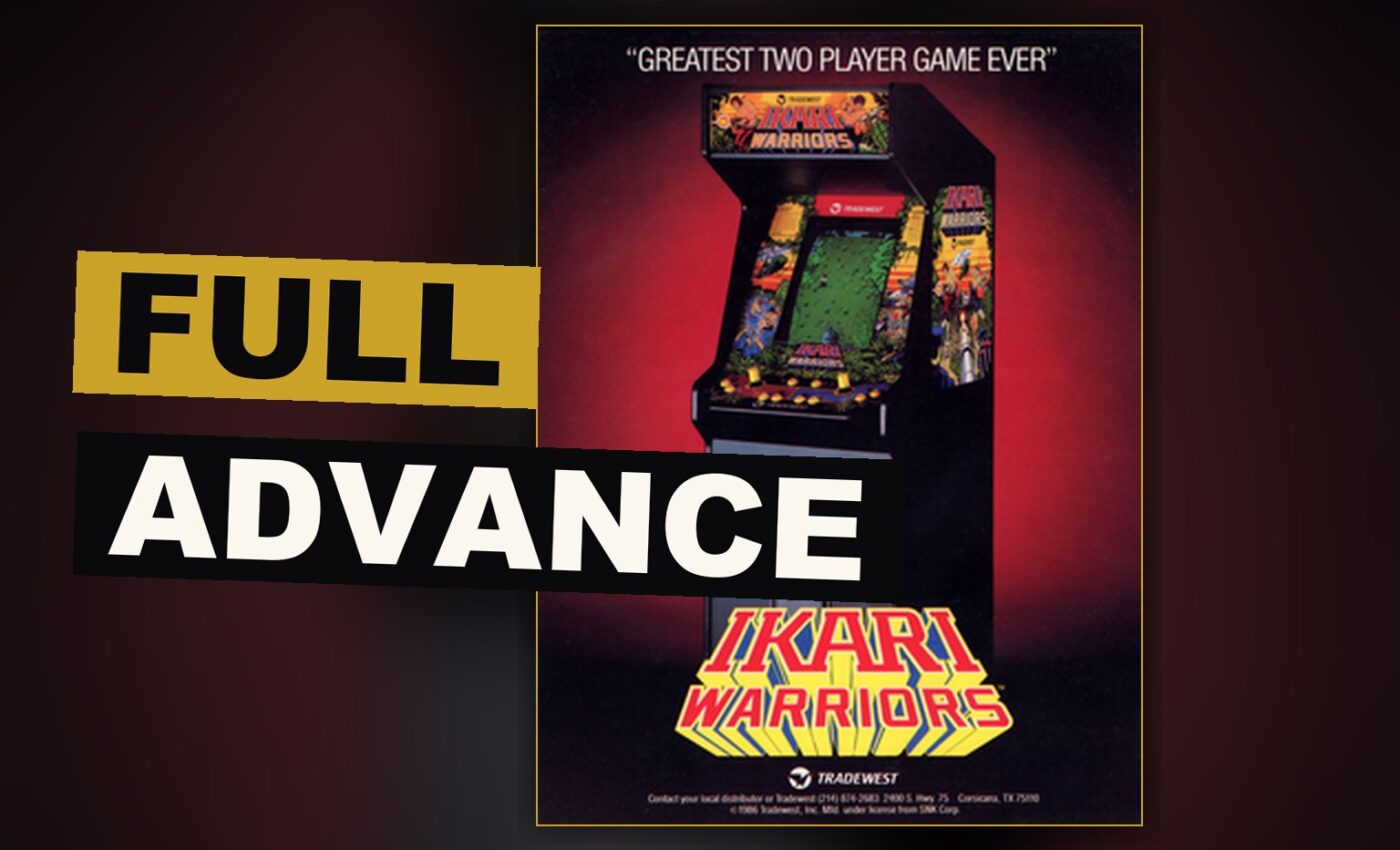
Ikari Warriors brought SNK its first real American arcade hit in 1986, and the NES port asks players to make the same trip from the bottom of the screen to the village of Ikari. The premise is simple: one or two players fight upward through jungles, rivers and ruins, pick up machine guns, grenades and rocket launchers, and try to free a captured officer. What the home version cannot carry over is the thing that made the arcade cabinet worth standing at.
Colonel Ralf Jones and Second Lieutenant Clark Still
The player controls Colonel Ralf Jones, in red, and Second Lieutenant Clark Still, in blue. Their goal is the village of Ikari, where a high-ranking officer named Colonel Cook is held captive. Enemy soldiers, tanks and helicopters stand in the way.
Ikari Warriors is a vertically scrolling run and gun game. Players move from the bottom of the screen upward. The terrain shifts among jungles, rivers and ruins, and the weapons scattered along the route include machine guns, grenades and rocket launchers.
The arcade original, developed and published by SNK, was released in North America by Tradewest. In Japan it was called Ikari. It was a major commercial success: Japan’s second highest-grossing table arcade in 1986 and London’s third highest-grossing arcade game that year. It ranked among America’s top five highest-grossing dedicated arcade games in both 1986 and 1987.
The Rotary Joystick That Did Not Make the Trip
What set Ikari Warriors apart from the many Commando clones on the market was its control style. The arcade cabinet used rotary joysticks, a scheme SNK had based on its earlier TNK III from 1985. Rotating the stick changed which direction the character faced, independent of the direction he was moving, which was set by pushing the stick. That gave the player eight directions to attack or walk in.
The design has a strange consequence. No shot is fired from directly in front of the player. The warrior fires the machine gun in his right hand and throws grenades with his left, so the aim always sits slightly off-center from the body.
On the NES, that rotary stick is gone. What remains is a two-player cooperative mode and a game built around a mechanic the hardware cannot reproduce.
Tanks With Limited Fuel
Players can commandeer enemy tanks and helicopters. The tanks are immune to enemy bullets, but they run on a limited supply of fuel and take damage when it runs out or when the tank is caught in an explosion. The player goes up with the tank unless he can exit and get clear before it blows.
The helicopters carry two weapons, a spread gun and a cannon, and can fly over water. That is the NES version’s addition, and it is the port’s best argument for existing.
“Call for Fire”
Ikari Warriors has an answer for players who stall. Linger too long moving up the screen and the computer starts using what the source calls “call for fire.” A red spot appears below the player, tracking fire meant to speed the game along.
If a player character takes too long moving up screen, the computer starts using “call for fire”.
It is a blunt fix, and it tells you what the arcade game was built to do: keep you moving, keep you feeding quarters, keep the cabinet turning over. On a home console, with no quarters and no crowd, the pressure reads differently. The mechanic punishes hesitation that the NES controller makes hard to avoid.
A Licensed Rambo That Never Was
Ikari Warriors was originally intended to be an official licensed adaptation of Rambo: First Blood Part II, the 1985 film. SNK could not initially acquire the rights, so the game became its own thing. The jungle, the rescue mission and the one-man army premise stayed.
The NES version keeps the shape of that idea and loses the feel of it. Two players working upward together is still the point, and the cooperative mode is where the port earns its keep.
A Famous Name and a Missing Stick
The rotary joystick was not a gimmick. It was the reason Ikari Warriors stood out from the Commando clones crowding the market, and without it the game is a competent vertical shooter with a famous name and a control scheme that no longer explains itself.
The tanks and helicopters add texture. The fuel limit and the tracking fire add pressure. Neither replaces the thing that made the arcade original worth watching someone else play.
Ikari Warriors on NES is a port of a landmark that left its landmark at the door. Play it with a second player and it holds up as a decent afternoon. Play it alone and you are playing the outline of a better game.
Get the Notebook.
The day's best stories and every fresh verdict, in plain English, in your inbox by seven. One email a day, no more.