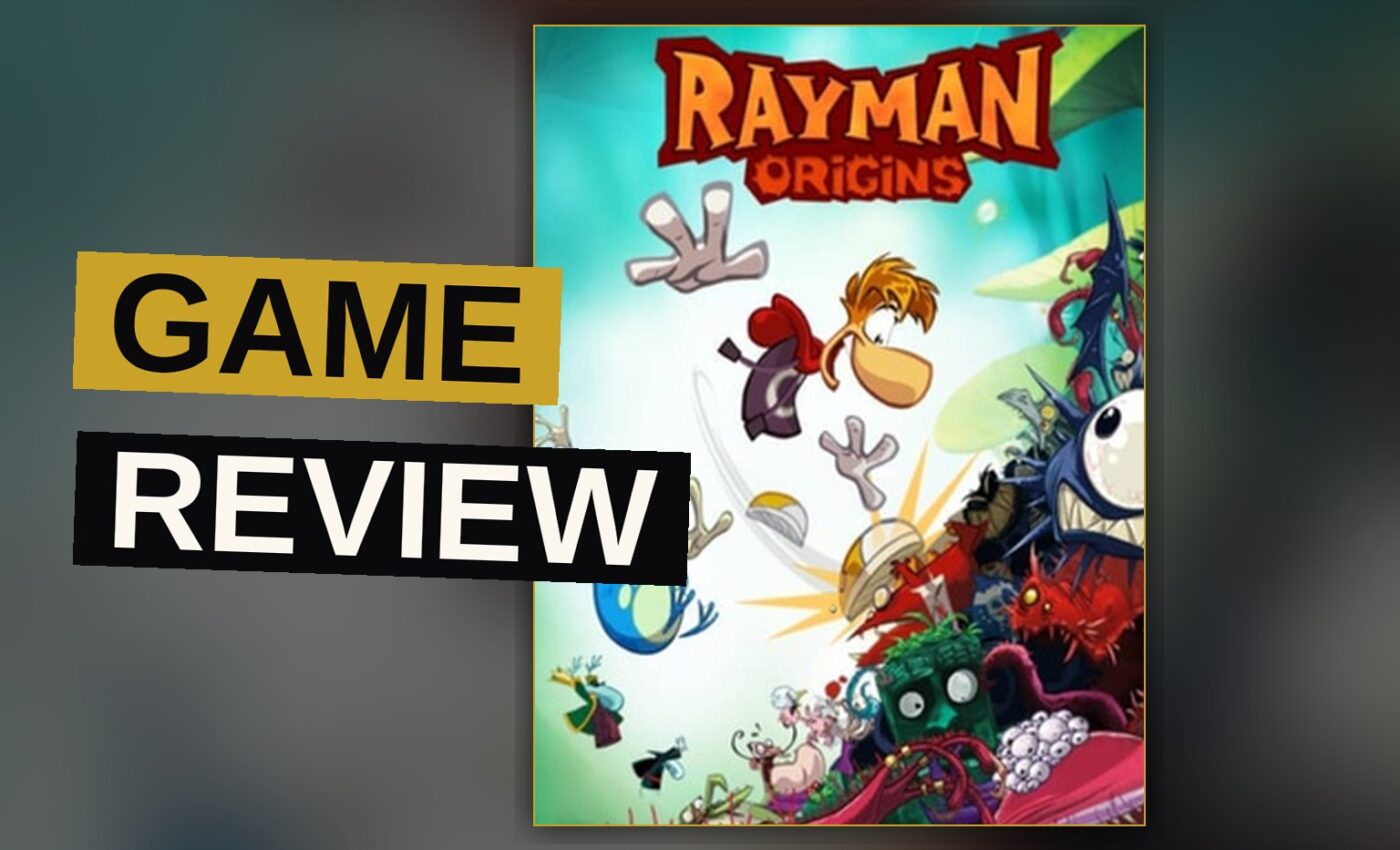
Rayman Origins is a game that moves like a dream and hits like a fist. It came out in 2011 for PS3, 3DS, Wii, and PC, and it remains one of the purest platformers ever made. The game does not waste a single second of your time. Every level is a tight, handcrafted burst of running, jumping, and punching that rewards precision and punishes hesitation.
The plot is almost nonexistent. The evil Lums have been freed from a magical cage, and they have turned the world’s creatures into monsters. Rayman and his friends Globox and the Teensies have to fix the mess.
That is it. The story is a frame for the action, and the action is the whole point.
Trailer, via Ubisoft.
Jumping Into the Jungle
The opening level, the Jibberish Jungle, is a masterclass in teaching by doing. You learn to run, jump, and hit enemies without a single tutorial box. The game just puts you in motion and lets you figure it out. This is the right way to start a platformer. It trusts the player.
The controls are tight. Rayman runs at a brisk pace, jumps with a satisfying arc, and attacks with a simple punch. You can also hover with his helicopter hair, which gives you a little extra airtime. The game adds new moves as you go, but the core feel never changes. It is fast, responsive, and fair.
The level design is the real star. Each screen is a small puzzle box filled with coins, hidden rooms, and enemies. The game wants you to explore, but it also wants you to move fast. There is a constant tension between grabbing everything and rushing ahead. That tension is what makes Rayman Origins so good.
Colors and Cartoons
Visually, Rayman Origins is a riot of color. The backgrounds are hand-painted, the characters are expressive, and the animations are full of life. Every frame looks like a cartoon that jumped off the page. The game runs at a smooth 60 frames per second on most platforms, and that fluidity is essential to the feel.
The sound is just as good. The music is a mix of jazzy, tribal, and orchestral tracks that change with the environment. The sound effects are punchy and clear. The characters do not speak in words, but they make noises that say everything. It is a game that understands that sound and image work together.
The art style is not just decoration. It is part of the design. The game uses color to signal danger, light to show the path, and animation to communicate enemy behavior. You can read the screen at a glance, and that clarity is what makes the action work.
Lums and Electoons
The main collectible is the Lum, a small glowing creature. You grab them to fill a jar at the end of each level. Fill the jar and you unlock a new area. It is a simple loop, but it is deeply satisfying. The game also hides Electoons, which are bigger collectibles that open doors to bonus levels.
The bonus levels are some of the best in the game. They are short, intense challenges that test your timing and your nerve. Some of them are chase sequences where you have to run from a giant creature. Others are precision jumps over bottomless pits. They are hard, but they are always fair.
The game does not hold your hand. If you miss a jump, you fall. If you hit a spike, you die. The checkpoints are generous, though, so you never lose too much progress. The difficulty curve is steep but steady. It starts easy, and it ends with some of the toughest platforming in the genre.
Four Players, One Screen
Rayman Origins supports up to four players in local co-op. This is not a tacked-on mode. The game is built around it. When you play with friends, you can bounce off each other, hit each other, and accidentally kill each other. It is chaos, and it is wonderful.
The co-op makes the game easier and harder at the same time. You have more hands to grab Lums, but you also have more bodies to knock into pits. The game does not punish friendly fire, so you can smack a friend into a spike just for fun. That freedom is part of the charm.
Playing alone is a different experience. It is more focused and more precise. The game is still great solo, but it is a different beast. If you have friends, play with them. If you are alone, do not worry. You are still in for a great time.
The Desert of Dijiridoos
The game is divided into five worlds, each with its own theme. The Desert of Dijiridoos is a sandy wasteland with a jazzy beat. The Gourmand Land is a food-filled paradise with giant forks and knives. The Sea of Serendipity is an underwater adventure with bubbles and currents.
Here is the running order of the worlds:
| Order | World | Theme |
|---|---|---|
| 1 | Jibberish Jungle | The opening jungle that teaches by doing |
| 2 | Desert of Dijiridoos | A sandy wasteland with a jazzy beat |
| 3 | Gourmand Land | A food-filled paradise with giant forks and knives |
| 4 | Sea of Serendipity | An underwater adventure with bubbles and currents |
| 5 | Land of the Livid Dead | A gauntlet of pain |
Each world has its own set of enemies and its own tricks. The desert has rolling boulders and wind gusts. The food world has sliding surfaces and swinging hooks. The sea has currents that push you around and enemies that swim in patterns. The variety keeps the game fresh from start to finish.
The final world, the Land of the Livid Dead, is a gauntlet of pain. It is a series of short, brutal levels that test everything you have learned. It is hard, but it is not unfair. Every death is your fault, and every victory feels earned.
The Speedrun and the Replay
Rayman Origins is built for replay. The game tracks your time for each level, and it gives you a medal if you finish fast enough. This is not just a vanity metric. The game wants you to find the fastest route, and it rewards you for it.
The speedrun is a joy because the game is so fluid. Once you know the levels, you can string together jumps and punches into a smooth flow. It is like a dance. The game also has a time attack mode where you race against a ghost. That mode is a pure test of skill.
The game is not long. You can finish it in about ten hours if you are good. But the replay value is huge. You will want to go back and find every hidden room, grab every Lum, and beat your best times. It is a game that respects your time and rewards your effort.
The Score
Rayman Origins is a game that delivers on every level. It has beautiful art, tight controls, a great soundtrack, and a perfect difficulty curve. It is a game that is easy to pick up and hard to put down. It is a game that respects the player and rewards the committed.
It is not a game that will change your life. It is not a game that will make you think deeply about the human condition. It is a game that is pure, unadulterated fun. And that is exactly what it should be.
It earns its place among the best platformers of its generation. It is a game that is greater than the sum of its parts. It is a game that you will finish and immediately want to start again.
It is a game that is worth every penny and every minute. It is a game that is a joy to play and a joy to talk about. It is a game that is, in every way that matters, a triumph.
Rayman Origins scores an 8.9 out of 10. That is a great score, and it is a deserved one. It is a game that is almost perfect, and it is a game that you should not miss. It is a game that is a bright, bold, and beautiful piece of art. It is a game that is, quite simply, excellent.
Get the Notebook.
The day's best stories and every fresh verdict, in plain English, in your inbox by seven. One email a day, no more.