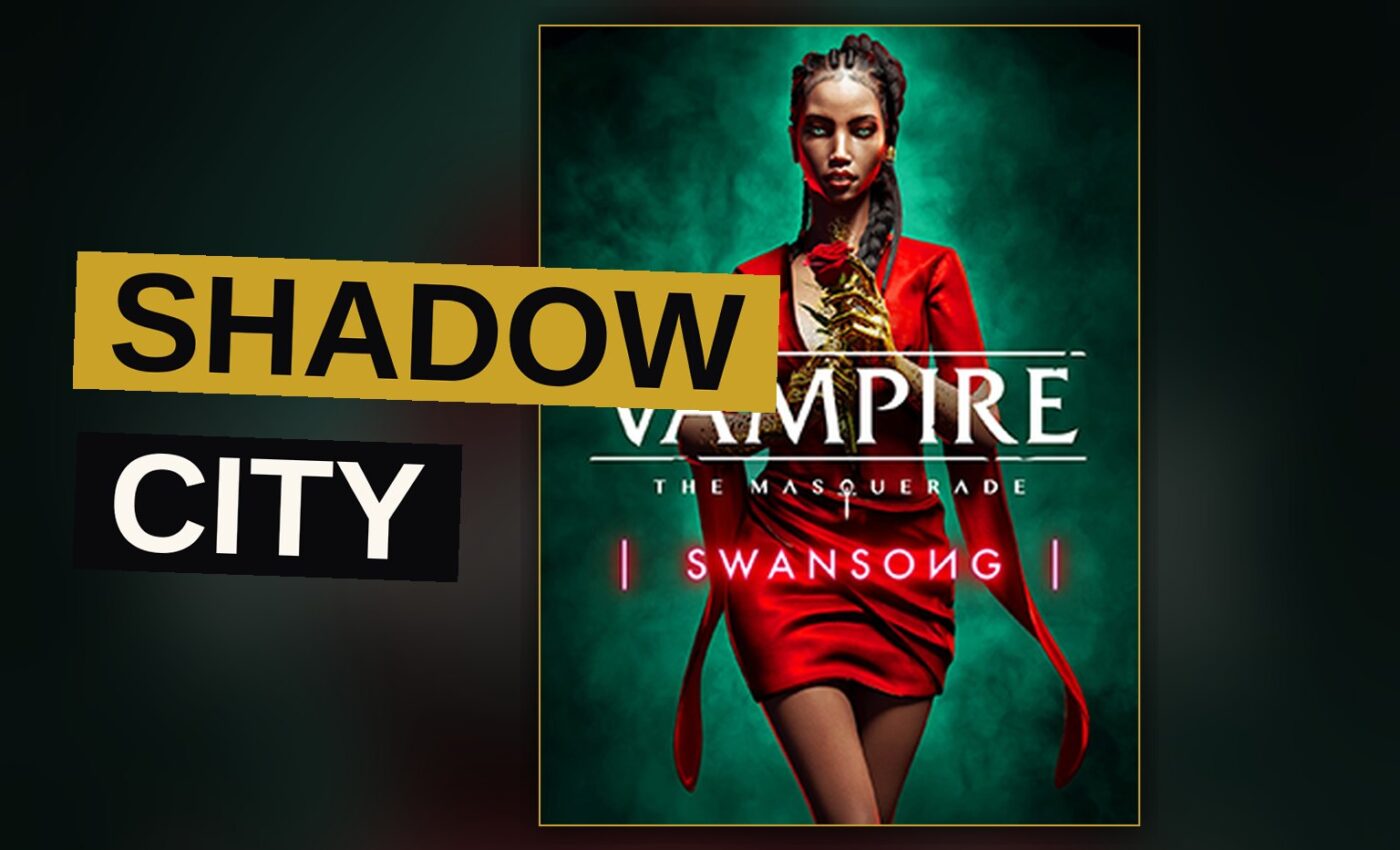
Vampire: The Masquerade – Swansong asks you to keep a secret for thirty hours. The secret is that you are a monster. Three monsters, actually, and the game hands you all three in rotation, switching control between a Ventrue enforcer, a Toreador socialite and a Malkavian seer as they pick through the wreckage of a vampire summit that went wrong in Boston.
Big Bad Wolf developed it. Nacon published it. It came out in May 2022 for Microsoft Windows, PlayStation 4, PlayStation 5, Xbox One and Xbox Series X/S, with a Nintendo Switch version following in September 2023. It is a single-player narrative RPG built on White Wolf Publishing’s tabletop game Vampire: The Masquerade, part of the larger World of Darkness line. And it is a game that understands its source material better than it understands how to make a video game out of it.
Trailer, via Nacon.
Hazel Iversen and the Boston Camarilla
The premise is strong. Hazel Iversen, called the Swan, has taken over as Prince of the Boston Camarilla. She wants to strengthen the sect’s presence by bringing Boston and Hartford together, merging two domains into one bloc. The Masquerade — the law that keeps humans from learning vampires exist — is hers to enforce, and she intends to enforce it with what the game’s own summary calls an iron hand in a velvet glove.
Then the reunification goes violent. Influential Camarilla members are destroyed or captured by a group that knows exactly where to hit them. The investigation that follows is the spine of Swansong, and it points toward the Society of St Leopold, a sect of vampire hunters funded and supported by the Holy See, working alongside the Special Affairs Division, a government agency with a similar brief.
That is a good conspiracy. It has institutional weight, it has a reason to exist, and it gives the three leads something to actually do.
Galeb, Emem and Leysha
You play three vampires, each roughly a hundred years old, each from a different clan, each with a different opinion about Camarilla rule. Galeb is Ventrue, an intimidating man. Emem is Toreador, described in the source material as a seductive Amazon. Leysha is Malkavian, leaning on supernatural insight and the spreading of madness.
They have separate missions. Galeb is tasked with an assassination. The others have their own assignments, and the game cuts between them as the affair comes to a close. The clan differences are not cosmetic. Each character has vampiric disciplines — abilities — and you upgrade them along with character statistics to suit how you want to play. Those choices feed back into how characters interact with you and which skills you can bring to bear.
You will pick locks. You will hack computer terminals. You will talk your way past people who would rather you did not.
The Masquerade as a mechanic
Here is the best idea in Swansong. Your characters spend most of their time surrounded by humans, and using a supernatural ability in front of one risks exposing what you are. So the game makes you hesitate. A discipline is not a cooldown; it is a decision about whether this room is safe.
That tension is real, and it is the reason to play the game at all. Big Bad Wolf built a system where the most powerful thing you can do is also the most dangerous, and it mostly holds up.
The moral choices land in the same place. The game puts characters in difficult situations where there is no obviously correct choice, and it means it. You will not find a paragon path and a renegade path here. You will find two bad options and a clock.
An iron hand in a velvet glove, she intends to assert her power and reinforce the Masquerade, the vampiric law designed to ensure humans never learn about her kind.
Where the investigation stalls
The problem is pacing. Swansong is a narrative RPG in which your every choice determines the fate of the three main characters and of the Boston Camarilla, and that is a lot of weight to put on a conversation. When the writing is sharp, the weight feels earned. When it is not, you are reading a lot of text to unlock a skill check.
The game also asks you to care about a power struggle inside a sect you have just met. The fall of London as a vampire home is mentioned as context for why the Camarilla has stopped fighting itself and started trying to survive, and it is the most interesting piece of backstory in the game. It is also background. Boston’s vampires want to make sure everyone in the Northeastern United States is safe, which is a fine goal and a dull one.
The three leads carry it as far as they can. Galeb is the most legible of them, because intimidation is a mechanic the game can actually express. Emem’s seduction is harder to render in a menu. Leysha’s madness is the hardest of all, and the game’s answer is to let her see things the others cannot, which is a solution that works better in a tabletop session than on a screen.
A cult game with a cult audience
Swansong is not trying to be a sequel to anything. It is trying to be a detective story with fangs, told in three voices, set in a city where the supernatural is a liability rather than a weapon. That is a legitimate ambition and the game gets closer to it than its reputation suggests.
But the reputation is not unfair. A critic aggregate of 6.3 out of 10 across eight outlets is the score of a game that a specific player will love and most players will respect without finishing. The Masquerade mechanic is the reason. The disciplines, the lockpicking, the hacking, the careful arithmetic of when to be a monster — that is a real design idea, and it is buried under a plot that keeps explaining itself.
The World of Darkness has always been a setting about consequences. Swansong understands that intellectually. It struggles to make you feel it in your hands.
What the score reflects
Vampire: The Masquerade – Swansong is a competent narrative RPG with one genuinely excellent system and a story that never quite justifies its length. Big Bad Wolf knows the tabletop game. The clan politics are right, the Masquerade is treated as law rather than flavor, and the Society of St Leopold and the Special Affairs Division are antagonists with actual institutional backing — which is more than most vampire fiction bothers to build.
What holds it back is that the investigation is more interesting to read about than to play. You switch between Galeb, Emem and Leysha, you upgrade disciplines, you avoid using them near humans, and you make choices with no clearly correct answer. That loop is solid. It is also thin, and thirty hours is a long time to run a thin loop through a conspiracy that keeps its best material — London, the hunters, the Holy See — at arm’s length.
Worth playing if you want a vampire game that takes the Masquerade seriously as a rule you can break. Worth skipping if you want the rule to break you back.
Reference card
- Title: Vampire: The Masquerade – Swansong
- Developer: Big Bad Wolf
- Publisher: Nacon
- Release: May 2022 (Microsoft Windows, PlayStation 4, PlayStation 5, Xbox One, Xbox Series X/S); September 2023 (Nintendo Switch)
- Genre: Narrative RPG, single-player
- Setting: Boston, World of Darkness
- Protagonists: Galeb (Ventrue), Emem (Toreador), Leysha (Malkavian)
- Antagonists: Society of St Leopold, Special Affairs Division
- Critic aggregate: 6.3/10 across eight outlets
- Score: 6.3 of 10
Get the Notebook.
The day's best stories and every fresh verdict, in plain English, in your inbox by seven. One email a day, no more.