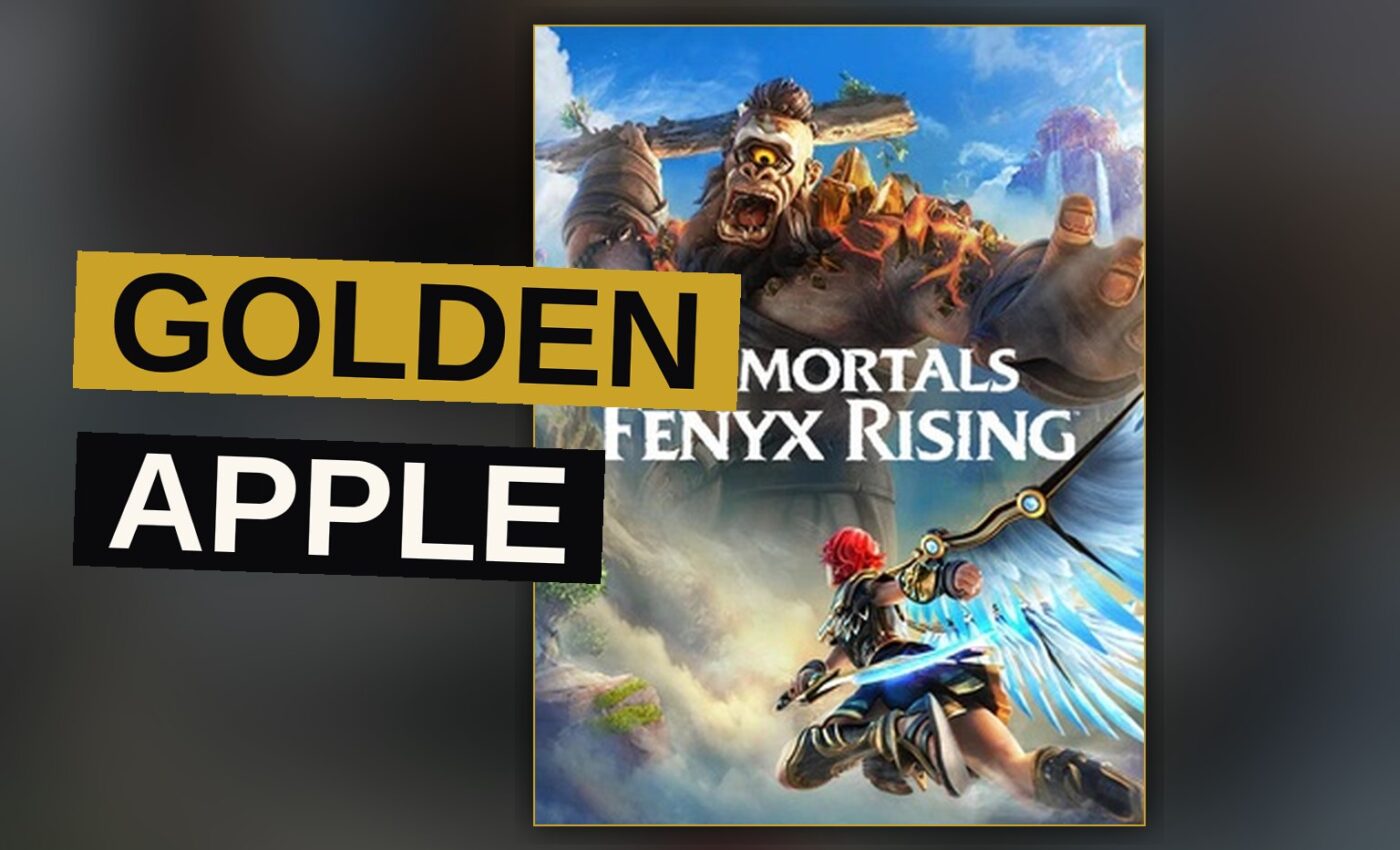
Ubisoft Québec built Immortals Fenyx Rising on a bet that Greek myth, told as a storybook, could carry an open world. The bet mostly pays. Released in 2020 for Nintendo Switch, PlayStation 4, PlayStation 5, Stadia, Windows, Xbox One and Xbox Series X/S, the game hands you a shield-bearer named Fenyx and seven regions of the Golden Isle to cross. It is bright, funny where it wants to be, and long enough to wear thin before the last god stands up.
Trailer, via Ubisoft.
Typhon Escapes and the Gods Fall
The setup is the strongest thing here. Typhon, a Titan imprisoned under a mountain for eons, breaks free, severs the Olympian gods from their godly essences and turns much of humanity to stone.
Fenyx, a young Greek shield-bearer of the Delian League, survives a shipwreck and washes up on the Golden Isle to find the crew and islanders petrified. A prophecy points the way. A fledgling firebird, Phosphor, comes along.
The framing device is the game’s best idea. Prometheus tells the whole story to a chastened Zeus and wagers that a mortal can beat Typhon, which would free Prometheus from his own imprisonment. It gives the campaign a narrator with a stake in the outcome, and it lets the game laugh at its own gods.
A Custom Hero Who Is Canonically Female
You can set Fenyx’s gender, voice and appearance. The character is canonically female, and the Hall of Gods later lets you change the look again at Aphrodite’s Beauty Chair.
That flexibility is welcome. It also means Fenyx arrives with less fixed personality than the gods around them, and the game leans on the Olympians to do the emotional work.
Seven Regions and a Bird That Points the Way
The Golden Isle is one large open world split into seven regions drawn from Greek myth, and the whole map is open from the start. Fenyx climbs cliffs, rides a mount and flies on the wings of Daedalus.
Phosphor marks points of interest on the map. Rifts scattered across the island pull you into the Vaults of Tartaros, platforming trials that test combat and traversal together.
The enemies come from the same well: minotaurs, cyclopes and worse. Combat runs on two melee modes — fast, weak light attacks with a sword, slow, strong heavy attacks with an axe — plus a bow. Stamina drains as you swing, and an exhausted Fenyx is a dead Fenyx.
Aphrodite as a Tree, Ares as a Rooster
The restoration quests are where the writing earns its keep. Each fallen god is a joke with a point:
- Aphrodite, who became a tree without her passion.
- Ares, transformed into a rooster without his pride.
- Hephaestus, reduced to one of his own automatons without suffering.
- Athena, turned into a child without the ability to make clear judgments.
Fenyx also puts down the corrupted spirits of Achilles, Atalanta, Heracles and Odysseus. Then the gods, restored, fall straight back into bickering and infighting, unable to agree on how to stop Typhon. That refusal to let the Olympians be noble is the sharpest thing the story does.
Godlike Abilities and a Crafting Treadmill
Progression unlocks abilities such as Ares’ Wrath, a group of spears that thrust enemies into the air. Armor and weapons upgrade by collecting crafting resources.
This is the part that sags. The Vaults of Tartaros repeat their tricks, and the resource grind stretches the middle of the game well past what the puzzles can support. Exploration stays pleasant; the checklist underneath it does not.
Where the Story Stops
One caveat sits over the whole package. The plot as documented trails off mid-thought at Fenyx’s older brother Ligyron, the sibling the quest is meant to rescue. The source material does not resolve what happens there, and this review will not pretend otherwise.
What is clear is the structure: a mortal, a wager, a captured loved one, and a Titan who wants to remake the world. The game commits to that shape and delivers it.
The Verdict on Immortals Fenyx Rising
Immortals Fenyx Rising is a good game with a great frame. The Prometheus-and-Zeus narration does more for the material than any single dungeon, because it gives the campaign a teller, a listener and a bet. The god-restoration set pieces — Aphrodite as a tree, Ares as a rooster — are the moments worth remembering.
The open world is the cost. Seven regions with everything unlocked from the start sounds generous, and it is, but the Vaults and the crafting loop turn generosity into homework. The combat holds up better than the pacing around it.
This is not a game that reinvents the open-world adventure. It is one that dresses the formula in myth and gets more out of the costume than most. Play it for the gods, not for the map.
Get the Notebook.
The day's best stories and every fresh verdict, in plain English, in your inbox by seven. One email a day, no more.