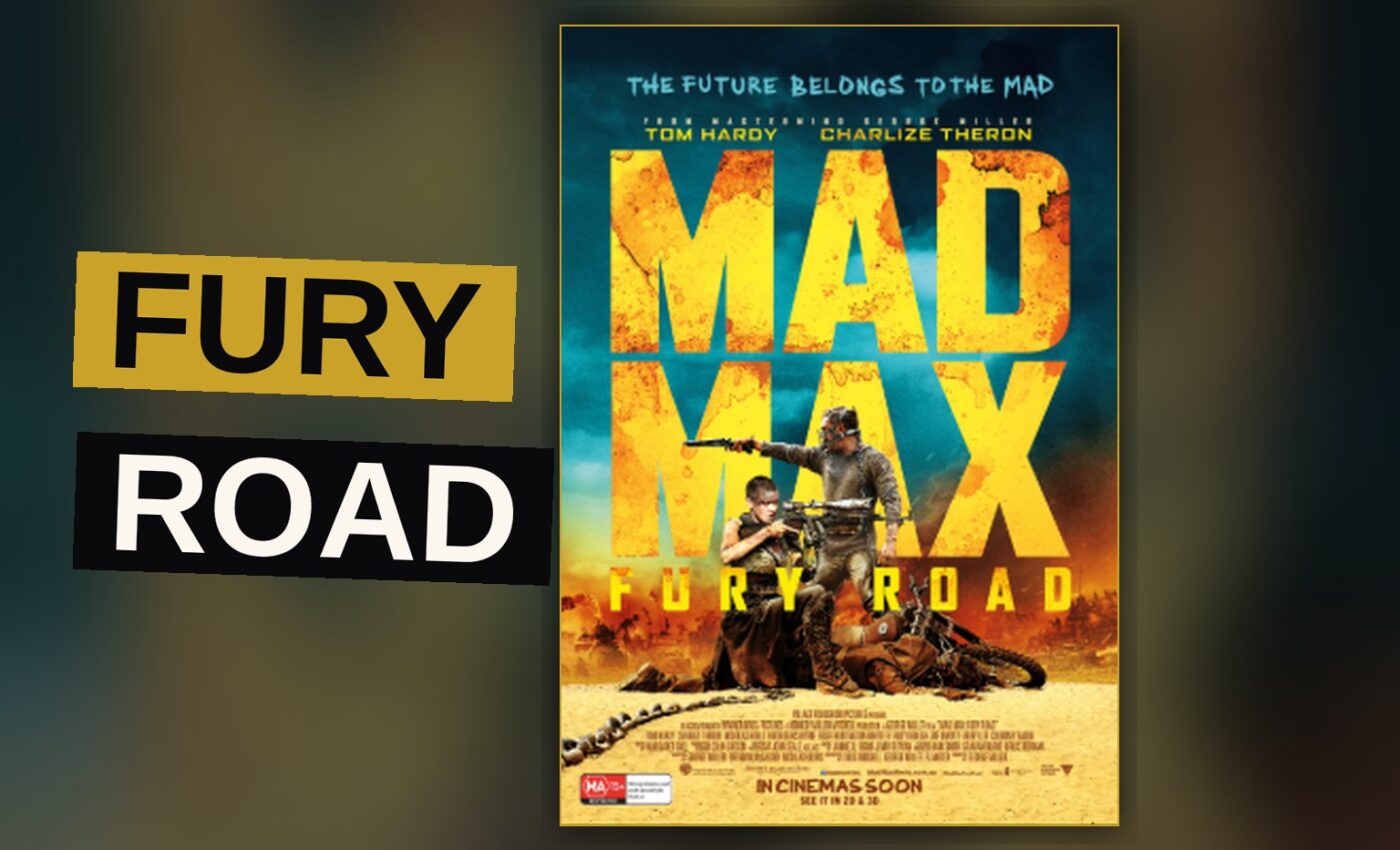
Mad Max: Fury Road is a miracle of sustained velocity, a two-hour chase sequence that somehow never runs out of gas. Released in 2015, the fourth film in George Miller’s post-apocalyptic franchise arrived three decades after the previous installment and immediately reset the standard for what an action movie can be. It is loud, it is fast, and it is almost unbearably tense from the opening frame to the closing credits.
The plot is deceptively simple.
In a desert wasteland where water is hoarded by a tyrant named Immortan Joe, a driver called Max Rockatansky is captured and used as a “blood bag” for a wounded warrior. When Joe’s trusted lieutenant Furiosa betrays him and drives off with his five breeding wives in a massive war rig, Max is dragged into the escape. What follows is a nonstop road battle across the salt flats, with Joe’s entire army in pursuit.
Trailer, via Warner Bros..
Chase Without a Breather
The structure of Mad Max: Fury Road is almost startlingly direct. There is no second act detour, no quiet subplot, no breather. The film moves from the canyon to the desert to the swamp to the salt flat, and every mile is contested. Miller, who co-wrote the screenplay with Brendan McCarthy and Nico Lathouris, treats narrative as a series of accelerations rather than a conventional three-act arc.
This works because the action is legible in a way that modern blockbusters rarely manage. The stunt work is practical, the vehicles are real, and the geography of each fight is clear. You always know where the rig is, where the pursuing cars are, and what the stakes are for the people inside. The editing, by Margaret Sixel, cuts fast but never confuses.
Every explosion lands, every crash registers.
The film’s set pieces are not just impressive; they are inventive. The polecats who swing from long poles onto the rig, the guitar player strapped to a wall of speakers, the sandstorm that swallows the entire convoy — each sequence introduces a new visual idea and then exhausts it before it grows stale. The result is a film that feels both relentless and varied.
Furiosa Takes the Wheel
The heart of Mad Max: Fury Road belongs not to Max but to Furiosa, played with fierce economy by Charlize Theron. She is the one with the plan, the history, and the moral weight. Her goal is to reach the Green Place, a homeland she remembers from childhood, and she drives the entire film toward that destination. Max, played by Tom Hardy, is a supporting player in his own movie, a man of few words and many scars who gradually commits to her cause.
Theron’s performance is largely physical. She drives, she fights, she reloads a rifle with one hand while steering with the other. Her face, smeared with grease and marked by a shaved head, carries the film’s emotional arc. When she learns that the Green Place is gone, that the land has turned to poison and the hope she carried for years was a memory of a place that no longer exists, the grief is plain.
It is a quiet moment in a very loud film, and it lands harder than any explosion.
The five wives — played by Zoë Kravitz, Riley Keough, Abbey Lee, Courtney Eaton, and Rosie Huntington-Whiteley — are given more agency than the genre usually allows. They are not passive cargo. They fight, they drive, they make choices. The film is explicit about what they are fleeing: Immortan Joe keeps them as breeding stock, and their bodies are not their own. The escape is a rebellion against that ownership, and the film treats it with seriousness rather than exploitation.
Wasteland as Character
George Miller has always been a world-builder, and the wasteland of Mad Max: Fury Road is one of the most fully realized environments in modern cinema. The production design, by Colin Gibson, is a masterpiece of scavenged aesthetics. The vehicles are welded together from junk, the costumes are made from found materials, and the architecture is a mix of brutalist concrete and rusted metal. Every inch of the frame looks lived-in and dangerous.
The villain, Immortan Joe, is played by Hugh Keays-Byrne, who also played the antagonist in the original 1979 Mad Max. His performance is grotesque and theatrical, complete with a breathing mask and a white cape. He is not a complex figure; he is a tyrant who hoards water and calls his people “half-life” and “war boys.” The film does not ask you to sympathize with him. It asks you to root for his downfall, and it delivers.
The war boys, Joe’s fanatical soldiers, are given a tragic dimension. They are young men who believe they will earn a place in Valhalla if they die in battle. They spray chrome paint on their teeth and chant prayers before they sacrifice themselves. The film shows their devotion without endorsing it.
There is a sadness to their faith, and the film knows it.
Score and Sound
The music of Mad Max: Fury Road is as relentless as the action. Composed by Junkie XL, the score is a wall of percussion and distorted guitar, anchored by the on-screen presence of the Doof Warrior, a blind guitarist who plays a flame-throwing instrument from atop a truck. The soundtrack does not so much accompany the action as drive it. It is a pulse, a heartbeat, a constant reminder that the chase is still on.
The sound design deserves equal credit. The roar of engines, the crunch of metal, the hiss of sand — every sound is recorded with precision. The film was mixed to be experienced loud, and it rewards that volume. At home, with a good sound system, it still hits hard.
On a theater screen, it is overwhelming.
Practical Magic
One of the reasons Mad Max: Fury Road feels so immediate is that the stunts are real. Miller shot the film largely with practical effects, using real cars, real crashes, and real performers. The result is a tactile quality that computer-generated imagery often lacks. When a vehicle flips, you feel the weight of it. When a body is thrown from a moving truck, you wince.
The visual effects, where they are used, are mostly invisible. The sandstorm sequence blends practical footage with digital enhancement, and it works seamlessly. The film never looks fake, never looks clean, never looks like a video game. It looks like a documentary from a world that does not exist, and that is a high compliment.
Legacy and Influence
Mad Max: Fury Road was a critical and commercial success. It earned ten Academy Award nominations and won six, including Best Film Editing and Best Production Design. It was praised by critics and audiences alike, and it has been widely discussed as one of the greatest action films ever made. Its influence can be seen in subsequent blockbusters, which have borrowed its visual language and its insistence on practical stunts.
The film also sparked a conversation about feminism in action cinema, largely because of Furiosa’s central role. That conversation was not always comfortable, but it was productive. The film proved that a big-budget action movie could center a female character without sacrificing spectacle, and that the two were not in conflict. It remains a reference point for discussions of representation in the genre.
Where It Stumbles
Mad Max: Fury Road is not perfect. The plot is thin by design, and viewers who demand intricate storytelling may find it wanting. Max himself is a cipher, a man of few words who spends much of the film reacting to events rather than driving them. The supporting characters, with the exception of Furiosa and Immortan Joe, are sketched lightly. The war boys are interesting, but they are not given enough screen time to become fully realized.
The film also has a rhythm problem in its middle section. After the initial chase, the convoy stops at the swamp, and the pace slows. This is intentional — the characters need a moment to breathe, and the plot needs a chance to shift — but it can feel like a lull after the relentless opening. The final act, which returns to the chase, recovers the momentum, but the middle stretch is the weakest part of the film.
Some critics have noted that the film’s message, while welcome, is delivered with a heavy hand. The wives are explicitly victims of sexual exploitation, and the film does not shy away from that. The dialogue is often blunt. Immortan Joe’s speeches are pure propaganda, and the film makes no attempt to complicate them.
This is not a subtle movie, and it does not want to be.
Hard Numbers
Mad Max: Fury Road was released on May 15, 2015. It was produced on a budget of approximately $150 million, and it grossed over $380 million worldwide. The film runs 120 minutes. It was directed by George Miller, who was 70 years old at the time of release. The film earned six Academy Awards from its ten nominations. It also holds an audience score of 7.6 out of 10 on TMDB, based on roughly 24,564 votes.
- Release date: May 15, 2015
- Director: George Miller
- Runtime: 120 minutes
- Budget: Approximately $150 million
- Worldwide gross: Over $380 million
- Academy Awards: 6 wins from 10 nominations
- TMDB audience score: 7.6 out of 10 (roughly 24,564 votes)
Final Assessment
Mad Max: Fury Road is a film that knows exactly what it is and does it better than anyone else. It is a chase movie, a survival story, and a rebellion narrative, all wrapped in a shell of chrome and fire. It rewards attention, rewards volume, and rewards repeat viewings. It is not a film for everyone — those who need plot depth or character complexity may be disappointed — but for those who want pure, sustained, masterful action, it is essential.
The film’s greatest achievement is its clarity. In an era of murky, overstuffed blockbusters, Mad Max: Fury Road is a model of economy. Every shot serves the story. Every sound serves the mood. Every character serves the theme. It is a film made by a master at the height of his powers, and it shows in every frame.
It is also a film that rewards the big screen. The scale, the sound, the sheer physicality of the stunts — these are elements that shrink on a phone or a laptop. If you have not seen Mad Max: Fury Road in a theater, you have not fully seen it. That is not a criticism of the film; it is a compliment. The film is designed to overwhelm, and it does.
Mad Max: Fury Road is a landmark. It is a film that will be studied and imitated for years, and it deserves its place in the canon. It is not flawless, but it is essential.
It is loud, it is fast, and it is unforgettable.