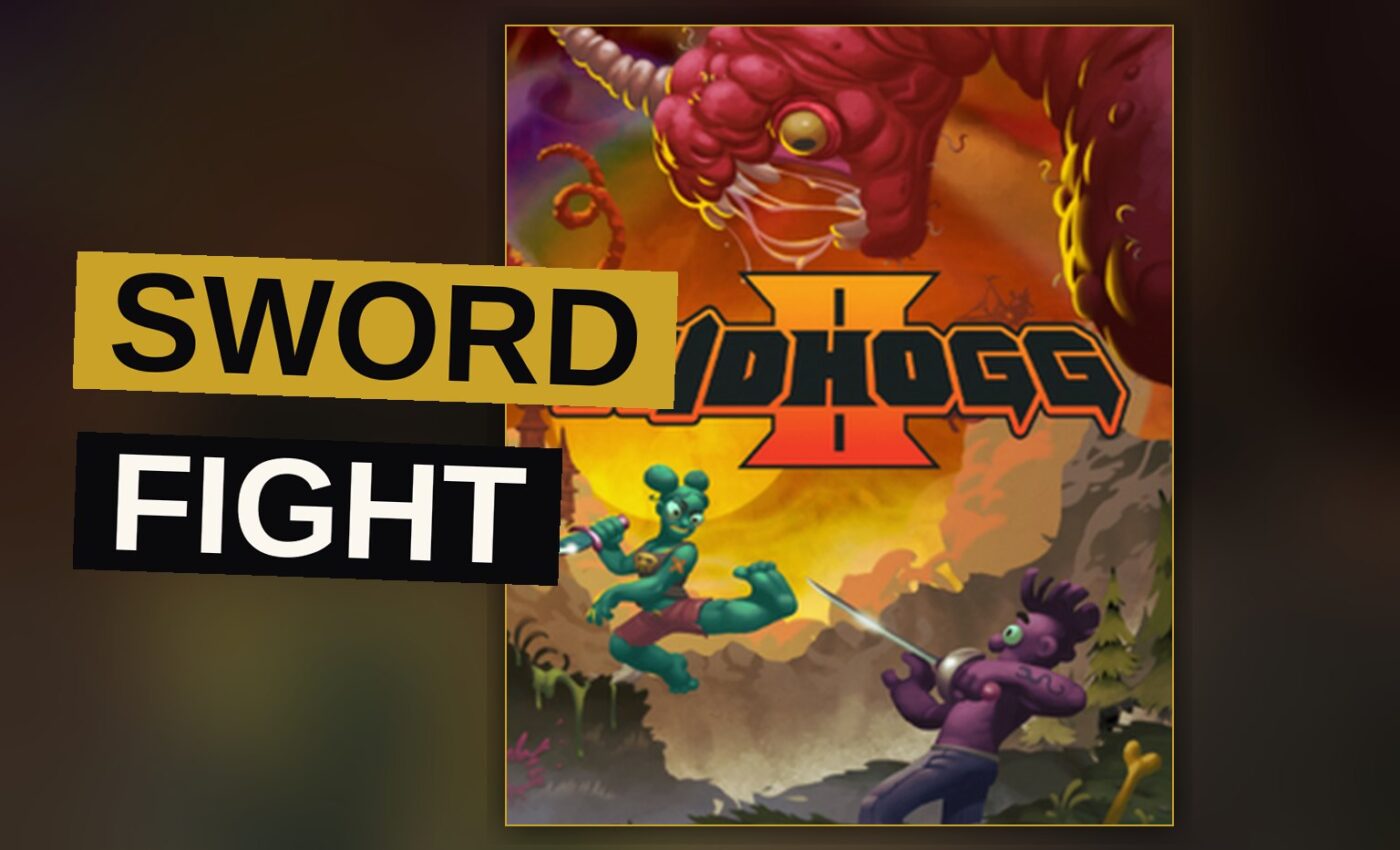
Nidhogg 2 takes the sword fight from the original game and builds it into something bigger, adding new stages, more weapons, and a story mode that tries to give the chaos some shape. The result is a game that fans of the first will recognize instantly, but newcomers might find it harder to enter.
Trailer, via messhof.
The Core Fight
The fight itself remains simple. Two players face off across a field full of hazards: traps, pits, and walls that can be used to gain height or escape an enemy. Each player controls a character who runs, jumps, and swings a sword, trying to get the other side of the field and touch the goal marker while avoiding death. The rules are easy to explain, but mastering them takes real skill.
What makes Nidhogg 2 work is the way it balances luck and skill. A player can lose a fight through a bad jump or a lucky strike, but the best players learn to read the other side’s habits and plan around them. Matches rarely feel like accidents, even when they play out that way.
New Stages and Weapons
The sequel adds several new stages to the mix, each with its own hazards and paths. Some are wide open and forgiving, while others force players into narrow passages that punish mistakes. The variety keeps matches from feeling identical, though the best maps still rely on the core design that made the original game memorable.
Weapons also expand the fight. Players can now choose between swords, spears, and other tools, each with its own reach and timing. This changes how players approach each other, since a weapon that works well in one map might fail in another. It adds depth without changing the basic challenge.
Story Mode and Multiplayer
The biggest change is the story mode, which tells a brief tale of two kingdoms locked in a war over a treasure. It plays like a series of short boss fights, each one designed to teach a new trick or punish a common mistake. These fights are optional, but they offer a reason to return to the game outside of online matches.
Online multiplayer is where Nidhogg 2 shows its strengths. Matches against strangers are fast, chaotic, and often funny, since the game rewards creativity over strict strategy. A player who tries something unusual, like using a hazard as cover, can gain an advantage that a more careful player would miss.
There is a noticeable difference between playing against friends and playing against strangers. Friends tend to be patient and forgiving, while strangers bring a rougher energy that makes matches feel more intense. Both modes are enjoyable, but they serve different purposes.
Performance and Presentation
The game runs well on PC, Mac, and the arcade machines it supports, with a stable frame rate and quick loading times. The presentation is simple but effective, with clear visuals and sound effects that make every strike and fall easy to follow. There is no fancy graphics here, just a focus on making the action readable.
The controls are tight, which matters in a game where small errors cost a life. A missed button press can mean losing a match, so the game demands attention from both players. This is not a game for casual players looking for an easy win.
What Holds It Back
Nidhogg 2 is not perfect. Some of the new stages feel like slight variations on old ideas rather than fresh additions. The story mode, while competent, does not justify spending much time on it. And the online matchmaking can sometimes take longer than it should, which frustrates players who want to jump straight into a match.
The game also lacks a strong reason to keep playing beyond the core loop. Once players know the maps and the weapons, there is less incentive to keep returning, since the matches start to feel similar. This is a problem that affects the entire genre, not just this game, but it still holds back the experience.
Ranking the Best Maps
Not every stage in Nidhogg 2 holds up equally well. Here is how the strongest maps compare:
- The original maps from the first game, which remain the most balanced and satisfying to play.
- The new maps that add interesting hazards without changing the core design too much.
- The maps that feel like minor changes to existing designs, which add little value.
- The story mode maps, which work as teaching tools but lack the replay value of the main stages.
Key Features at a Glance
- New stages: Several, with varying hazards and paths.
- Weapons: Swords, spears, and other tools to choose from.
- Story mode: A brief tale of two kingdoms and a treasure.
- Online multiplayer: Fast, chaotic matches against strangers.
- Arcade support: Available for arcade machines as well as PC and Mac.
Nidhogg 2 succeeds because it respects what made the original game work while giving players enough new content to justify a second look. The story mode and new weapons add depth, but the core fight remains the star. For fans of competitive games, it is worth returning to. For everyone else, it might be better left as a curiosity.