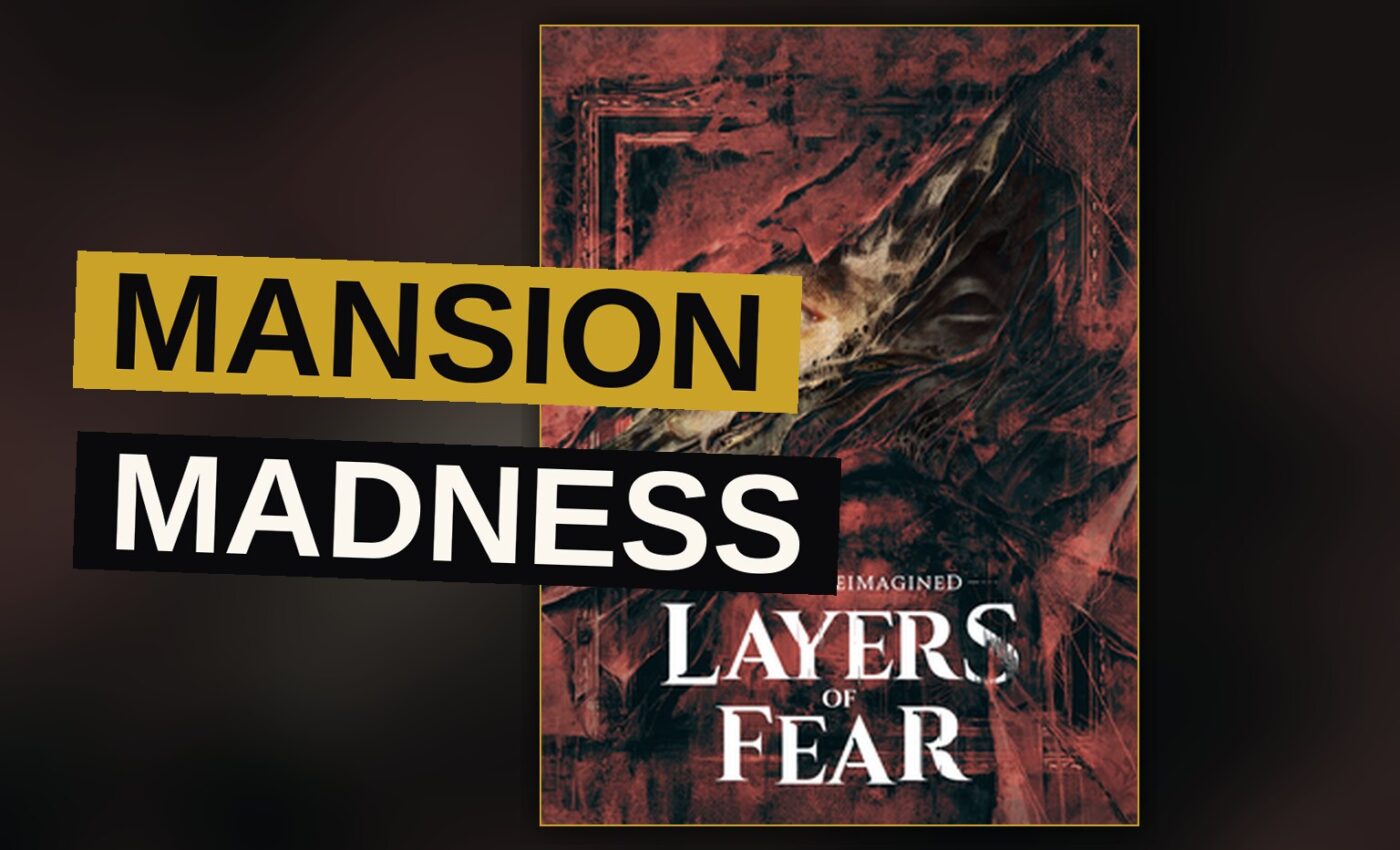
Layers of Fear is a haunted house of a game that knows exactly what it wants to be. It wants to be a slow, atmospheric puzzle box about a man losing his mind in an empty mansion. It succeeds at that. It also wants to be a thriller, a horror game, and a mystery. Those ambitions don’t always sit comfortably together, and the seams show.
The game follows an aging actor who has spent his life playing Hamlet. He has retired, sold everything, and now lives alone in a sprawling seaside mansion that keeps changing shape around him. The year is 1925, and the story moves through memory, flashback, and shifting reality to explore the actor’s descent into madness. It is a game about isolation, obsession, and the slow destruction of identity.
Trailer, via IGDBcom.
The Mansion Itself
The mansion is the star of Layers of Fear. It is a vast, rambling Victorian house that twists and shifts as you move through it. Doors open to rooms that weren’t there before. Walls slide sideways. Floors tilt. The game uses perspective tricks to make you question what you are seeing at every moment, and the effect is genuinely unsettling.
The visual design draws on the work of Edward Hopper and other painters of empty American interiors. Rooms are often empty except for a single chair, a table, a lamp. The lighting is dim and warm, with flickering shadows that seem to move independently. The sound design supports this perfectly, with distant laughter, whispered voices, and the occasional creak of floorboards that feels like a footstep behind you.
The mansion is the star of Layers of Fear.
The mansion is not a static set piece. It is a character in its own right. It grows larger, shrinks, rearranges itself, and occasionally reveals hidden rooms and passages. This is where the game’s strengths are most visible. The mansion’s behavior is unpredictable and often illogical, which fits the protagonist’s deteriorating grip on reality. It is a space that refuses to behave normally, and that refusal is the point.
The Story and Its Pacing
The story is fragmented. You play through memories, flashbacks, and dream sequences that jump between the actor’s past, his current isolation, and his relationship with his wife. The narrative is told in fragments, and the game expects you to piece it together yourself. This can be frustrating, especially in the middle portion of the game, where the pacing slows almost to a crawl.
The game is at its best when it lets the environment do the talking. A hallway that suddenly opens onto a completely different room, a door that leads to a wall, a staircase that disappears halfway up. These moments are genuinely inventive and memorable. They are the reason the game holds a 7.6 out of 10 on aggregate.
Where the game stumbles is in its attempts at conventional storytelling. The dialogue is sparse and often delivered by a voiceover that feels disconnected from the action. The plot threads involving the actor’s career, his family, and his wife’s disappearance are interesting individually but never fully resolve into a coherent whole. The game leans heavily on atmosphere over plot, and that decision is both its strength and its weakness.
The Puzzle Design
The puzzles in Layers of Fear are mostly environmental. You find keys, turn switches, and solve simple logic problems to progress. None of them are particularly difficult, but they do require you to pay attention to the layout of the mansion. Because the mansion changes shape, a door you found earlier might not exist anymore, and finding it again requires retracing your steps.
There is also a recurring mechanic involving portraits. The game asks you to collect and place portraits on walls, which triggers a brief cinematic sequence. These sequences are some of the game’s best moments, offering glimpses into the actor’s life that are both personal and strange. However, the portrait puzzles themselves are often tedious, requiring you to rotate and place images in a specific order.
The difficulty curve is uneven. Some areas are nearly impossible to navigate without dying repeatedly, while others let you walk through with barely a thought. This inconsistency is a real problem, and it breaks the tension the game works so hard to build.
Performance Across Platforms
Layers of Fear launched on PS4, PC, Linux, and iOS. The game runs at a steady 30 frames per second on all platforms, which is a deliberate creative choice rather than a technical limitation. The lower frame rate contributes to the sense of unease, making the game feel more unstable and less grounded.
On PC, the game supports mouse and keyboard controls, which works reasonably well. The movement is clunky, and the camera struggles in tight spaces, but it is playable. On iOS, the game is touch-controlled, which makes the portrait puzzles and some navigation harder than they need to be. The performance on mobile is adequate but far from impressive, and the game is not recommended on that platform unless you have nothing else to play.
The game’s look is consistent across all platforms, which is a credit to the developers. The mansion’s shifting geometry and the atmospheric lighting hold up well even on a small screen. The audio, however, suffers more on mobile. Sound effects and music are compressed, and the whispers and distant noises that work so well on a television speaker lose their menace on earbuds.
The Sound and Music
The sound design in Layers of Fear is exceptional. The ambient noise, the distant screams, the soft piano music that plays in the background — all of it creates a persistent sense of dread that never quite resolves. The game uses silence effectively, letting you hear your own footsteps and the creak of a floorboard.
The music is composed by Michal Deszczyński and Aleksander Zawada, and it is moody and atmospheric. It swells during key moments and fades into near-silence during others. The soundtrack is available separately and is worth listening to on its own.
The sound design is also used for navigation. You are often guided by a faint hum or a distant voice, and following these cues becomes a reflex. The game rewards paying attention to sound as much as it rewards paying attention to sight.
The Atmosphere
Atmosphere is the primary reason to play Layers of Fear. The game is at its best when it is simply letting you wander through an empty room, looking at a painting, and feeling the weight of the silence. The mansion is a character, and the game trusts you to read its mood.
The game’s weakest moments are its attempts at jump scares. There are a few moments where a ghost or a shadow appears suddenly, and they are effective in the moment but feel cheapened by the game’s overall tone. The game is trying to be subtle and atmospheric, and these loud, abrupt scares undercut that effort. They are the rare occasions where the game fails to respect its own rules.
The game also struggles with its pacing. The middle section, where the mansion stops changing and the story slows down, is where the game loses momentum. It is a shame, because the final stretch picks back up and delivers some of the game’s most memorable moments.
The Final Stretch
The ending of Layers of Fear is deliberately ambiguous. The game presents several possible conclusions, each tied to a different interpretation of the actor’s memories and his relationship with his wife. The ambiguity is a choice, and it works as long as you are prepared for it. If you want a definitive answer, you will not find one here.
The final scenes are the most atmospheric of the entire game. The mansion reaches its full potential, becoming a labyrinth of shifting rooms and corridors. The game’s visual design peaks in these moments, and the result is genuinely unsettling. The ending is a fitting conclusion to a game that has spent hours building dread through uncertainty.
The Verdict
Layers of Fear is a flawed but fascinating game. Its strengths are enormous: a stunning mansion, excellent sound design, and a commitment to atmosphere over spectacle. Its weaknesses are also significant: a weak narrative, inconsistent difficulty, and a few jump scares that feel out of place. The game is worth playing for anyone interested in psychological horror, but it is not a game for everyone.
The game’s 7.6 out of 10 score reflects this balance. It is a game that does one thing extremely well and a few things poorly, and the overall experience is uneven. It is a game that rewards patience and punishes haste. It is a game that you will remember for its best moments, even as you forget its worst.
If you are looking for a horror game that respects your intelligence and your senses, Layers of Fear is worth your time. If you are looking for a game that tells a clear story with a satisfying conclusion, you might want to look elsewhere. The mansion is a character worth spending time in, even when it is driving you mad.
Get the Notebook.
The day's best stories and every fresh verdict, in plain English, in your inbox by seven. One email a day, no more.