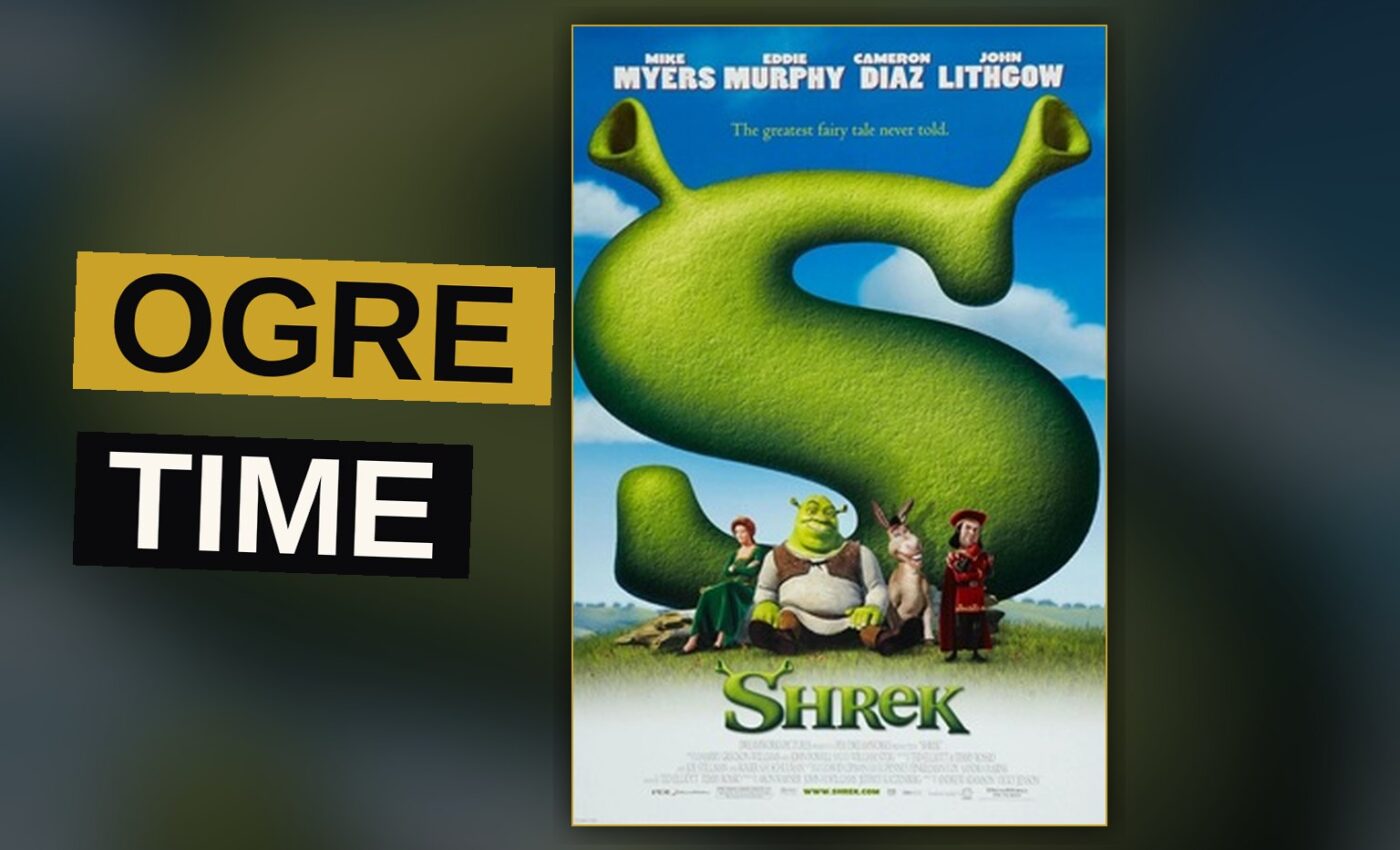
DreamWorks Animation took a gamble in 2001 when it released a fairy tale that made fun of fairy tales. The studio’s first fully computer-animated feature, Shrek, arrived with a voice cast led by Mike Myers, Eddie Murphy, and Cameron Diaz. It was a bet that paid off enormously, becoming a cultural landmark and a box office phenomenon.
The film follows an ogre named Shrek who lives a solitary, contented life in a swamp. His peace is shattered when the fairy tale creatures of the land, banished by the diminutive Lord Farquaad, are dumped onto his property. To get his swamp back, Shrek makes a deal: he will rescue Princess Fiona from a dragon-guarded tower and deliver her to Farquaad, who wants to marry her to become king.
The premise is simple, but the execution is anything but. Shrek is a film built on the collision of the classic and the contemporary. It takes the structure of a traditional fairy tale and fills it with modern jokes, pop culture references, and a distinctly cynical edge. The result is a movie that works on two levels: it is a lively adventure for children and a sharp satire for the adults in the room.
Trailer, via Universal Kids.
Casting the Voices
The casting is the film’s greatest asset. Mike Myers delivers a surprisingly warm performance as Shrek, layering the ogre with a Scottish accent that gives his grumbling a certain charm. He is gruff and antisocial, but Myers lets the vulnerability show through. The performance grounds the character, making him more than just a collection of jokes.
Eddie Murphy is a force of nature as Donkey. He is loud, fast-talking, and relentlessly needy. Murphy’s energy is the perfect foil to Myers’s more measured delivery. Donkey is the comic engine of the picture, and Murphy runs with the role, improvising with a manic glee that feels both scripted and spontaneous. His chatter is relentless, but it rarely wears thin.
Cameron Diaz rounds out the central trio as Princess Fiona. She brings a modern sensibility to the role, playing Fiona as a woman who is both a damsel in distress and a fighter. Diaz’s vocal performance captures Fiona’s intelligence and her frustration with the rigid expectations of her situation. She is not content to simply wait for a rescue.
John Lithgow is the film’s villain, Lord Farquaad. He is a petty, cruel man who compensates for his short stature with outsized ambition. Lithgow plays him with a perfect blend of petulance and menace. Farquaad is a memorable antagonist, a spoiled child with the power of a king, and his scenes are some of the film’s most effective.
Animation From 2001
Returning to Shrek after more than two decades, the animation is a product of its time. The character designs are expressive, and the filmmakers use the technology to create exaggerated, cartoonish features that work well with the voice performances. Shrek’s bulbous face, Donkey’s flapping lips, and Farquaad’s tiny legs are all pushed for comedic effect.
The world of the film is rendered with a level of detail that was impressive for 2001. The swamp is a murky, lived-in place, full of mud and slime and bugs. Duloc, Farquaad’s kingdom, is a sterile, over-sanitized theme park of a town. The contrast between the two locations is clear and effective. The film’s visual identity is strong, even if the textures and lighting now look dated compared to modern CGI.
However, the animation also shows its age. The movements can be stiff, and the facial expressions, while expressive, lack the subtlety of later animated films. The action sequences, such as the fight with the dragon, are functional rather than fluid. For a modern viewer, the technical limitations are visible. Yet the strength of the character animation and the design work means the film still holds up visually in a way that many early CGI films do not.
Music and the Montage
The music of Shrek is integral to its identity. The film opens with Smash Mouth’s “All Star,” a song that has become inseparable from the movie itself. The use of modern pop songs alongside John Powell and Harry Gregson-Williams’s orchestral score creates a unique sonic landscape. The soundtrack does not just accompany the action; it comments on it.
The most famous musical sequence is the montage where Shrek and Donkey travel to rescue Fiona. Set to “I’m a Believer” by Smash Mouth, the scene is a perfect blend of animation and music. The song’s upbeat tempo contrasts with Shrek’s grumpy demeanor, creating a comedic tension that defines the film’s approach. The music is a character in the film, driving the mood and the jokes.
The score itself is also notable. It parodies the grand, sweeping orchestral music of classic fairy tales, using it to underscore the absurdity of the situations. The music is never just background noise; it is always working to enhance the scene. This careful attention to the soundtrack was a key part of the film’s success and helped set the template for many animated films that followed.
“I’m a believer, I couldn’t leave her if I tried.”
The use of “I’m a Believer” is a masterstroke. It is a song that everyone knows, and by placing it in the mouth of an ogre, the film creates a moment of pure joy. It is the moment where Shrek lets his guard down, and the audience falls in love with him. The soundtrack of Shrek is a time capsule of 2001, but it is also a carefully curated collection that serves the story.
Fairy Tale Satire
The core of Shrek‘s appeal is its satire of fairy tale conventions. The film is built on the deconstruction of these stories. Princesses are not always beautiful, princes are not always charming, and true love’s kiss is not always the answer. The film takes the familiar elements of the genre and turns them on their head.
The most significant subversion is the character of Fiona herself. She is a princess who is trapped in a tower, but she is also a skilled fighter who can take care of herself. The film’s central twist, that Fiona turns into an ogre at night, is a direct challenge to the idea that a princess must be conventionally beautiful. The resolution of the film, where Shrek and Fiona choose to remain ogres, is a powerful statement about self-acceptance.
The film also mocks the idea of the “happily ever after.” The ending is not a traditional wedding; it is a swamp party with a gingerbread man as the guest of honor. The film is not rejecting happiness, but it is redefining it. Happiness, in Shrek, is not about conforming to expectations. It is about finding someone who accepts you for who you are, warts and all.
The satire is not subtle. The film is full of jokes about fairy tale tropes, from the singing of “Welcome to Duloc” to the mirror that is a parody of The Magic Mirror. The jokes come fast and furious, and many of them are aimed squarely at the adults in the audience. This willingness to be both a children’s movie and a grown-up comedy was a major part of its appeal. It was a film that parents could enjoy as much as their kids.
The Jokes
The humor in Shrek is a blend of slapstick, pop culture references, and character-driven comedy. The film is relentlessly funny, with jokes that range from the silly to the sophisticated. The humor is often irreverent, and the film is not afraid to be crude. The famous scene where Shrek farts in the swamp and the scene where he and Fiona belch to win over the king’s guards are examples of the film’s willingness to go for the lowbrow laugh.
The pop culture references are a key part of the film’s identity. The film makes jokes about everything from The Matrix to The Wizard of Oz. These references were fresh in 2001, and they helped to give the film a contemporary feel. The humor is rooted in the present, which makes the fairy tale setting seem even more absurd.
The best humor in the film, however, comes from the characters. The dynamic between Shrek and Donkey is the heart of the comedy. Their bickering is a constant source of laughter. Donkey’s inability to take a hint and Shrek’s frustrated responses are a classic comedic pairing. The film understands that the jokes are funnier when they come from character, and it uses this to its advantage.
A Franchise Is Born
Shrek was a massive success, and it spawned a franchise that has had a significant impact on animation. The film was followed by three sequels, with Shrek 2 often considered to be the best of the series. The franchise also included a standalone film for the Puss in Boots character, voiced by Antonio Banderas. The sequels expanded the world of the film, but they also diluted the original’s sharp satire.
The original Shrek was a fresh take on the genre. The sequels, while entertaining, became more conventional. They leaned more heavily into the pop culture references and less on the character-driven humor that made the first film so special. The franchise became a formula, and the formula was eventually exhausted.
Despite the mixed quality of the sequels, the original film’s reputation remains intact. Shrek is a landmark of computer animation. It proved that animated films could be both commercially successful and critically acclaimed. It also proved that they could be aimed at a broader audience, not just children. The film’s success helped to establish DreamWorks Animation as a major player in the industry.
Running Order of the Story
| Sequence | Scene |
|---|---|
| 1 | Shrek’s morning routine in the swamp |
| 2 | Fairy tale creatures arrive in the swamp |
| 3 | Shrek and Donkey meet for the first time |
| 4 | Journey to Duloc |
| 5 | Shrek fights the knights in the tournament |
| 6 | Shrek and Donkey set out to rescue Fiona |
| 7 | The dragon fight and rescue of Fiona |
| 8 | Return to Duloc and the wedding |
Final Thoughts
Shrek is a film that has aged better than many of its contemporaries. It is a funny, smart, and surprisingly moving movie that subverts expectations. The voice cast is excellent, the animation is charming, and the music is iconic. The film is a product of its time, but its core themes of self-acceptance and the rejection of conformity are timeless.
It is not a perfect film. The animation is dated, and some of the jokes have lost their edge. But the strength of the story and the characters carries the film through. It is a movie that rewards repeat viewing, and it remains an essential part of the animated canon. It is a film that knows exactly what it is and does it with confidence and wit.
The film’s success was a cultural event. It was a movie that everyone saw, and it became a part of the popular conversation. It is a film that is still quoted and referenced today. Shrek is a piece of pop culture history, and it is a film that continues to entertain. It earns its place as a classic of the genre.
The film is a great achievement in animation and comedy. It is a movie that has something for everyone, and it delivers on its promise of a good time. It is a film that is easy to recommend and one that is hard to forget. Shrek is a triumph of its era, a film that captured the moment and remains a joy to watch.
The score is 7.8/10.