
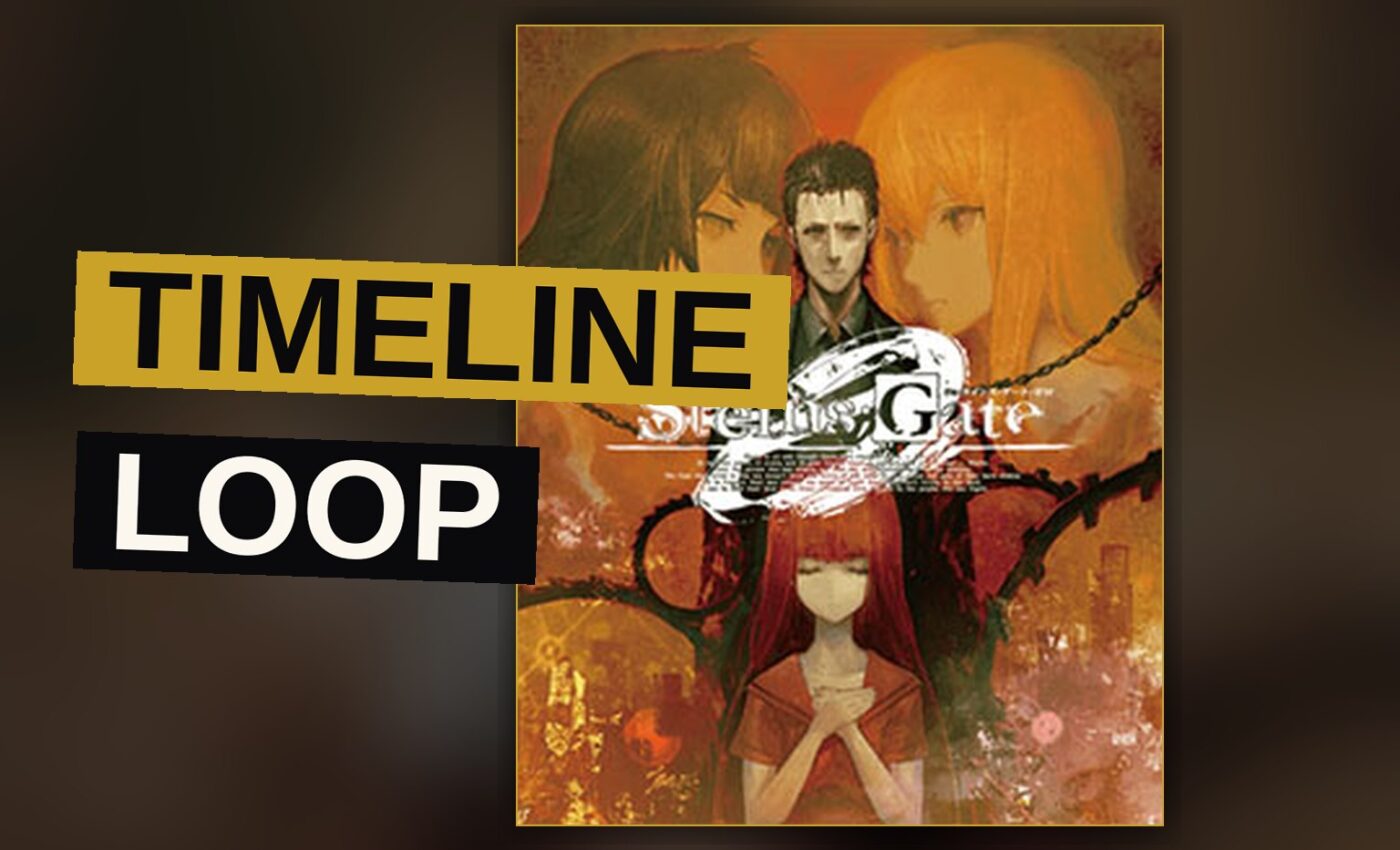
Eleven years after it first shipped in Japan, Steins;Gate 0 still asks the question its predecessor never had to: what does the hero do after he quits? The 2015 visual novel from 5pb. drops Rintaro Okabe into the aftermath of his worst failure and makes the player live there with him.
Trailer, via PlayStation.
A Bad Ending, Made Canon
Steins;Gate 0 is the fifth game in the Science Adventure series and a direct sequel to Steins;Gate. It builds on a hypothetical bad ending: Okabe travels back in time to save Kurisu Makise and fails. The source describes it as Okabe accidentally killing Kurisu himself, seemingly due to world-line convergence. He returns with post-traumatic stress disorder.
Amane Suzuha traveled to August 21, 2010 using her time machine to get Okabe to prevent a time-travel arms race that leads to World War III. She asks him to try again. He refuses.
World War III draws closer with each passing day, and the man who could stop it has given up.
Amadeus, and the Girl in the Machine
Months later, Okabe attends a lecture by Alexis Leskinen and Maho Hiyajo of Viktor Chondria University, the school where Kurisu worked. They present Amadeus, an artificial intelligence that replicates a person from their memories. Kurisu’s published thesis is the basis.
Okabe is presented with the opportunity to act as a tester for Amadeus — more precisely, a version built from the memories of the deceased Kurisu Makise. He takes it.
This is the game’s sharpest idea. Talking to a copy of the woman you failed to save is a specific kind of cruelty, and Steins;Gate 0 knows it. Maho, who worked alongside Kurisu and lives in her shadow, gives the story a second, less sentimental angle on the same grief.
Two Branches, One Phone
The structure is where Steins;Gate 0 diverges most from its predecessor. The original ran a single route from start to finish with branch points scattered along the way. Steins;Gate 0 splits near the beginning into two major story branches, which branch again into different endings: two main paths and four side stories in total.
The direction is set by whether the player answers calls from Amadeus. Okabe talks to the AI through his cell phone, and picking up or ignoring a call moves the plot. The player also takes the roles of other characters, mostly Suzuha and Maho, so the story is seen from several viewpoints rather than Okabe’s alone.
Then there is RINE, the messaging app. At points the game shows a notification that Okabe has received a message, and the player chooses a reply — text or sticker. The exchange locks the game into a conversation that changes with the answer. Unlike the Amadeus calls, these messages do not affect the branching.
In this paper’s view, that is a real flaw. A choice that changes nothing is a choice the game should not offer, and RINE is full of them. The mechanic adds texture and character beats, but a player trained by the Amadeus system to read every prompt as consequential will keep expecting weight that never arrives.
Akihabara, Still
The setting is Akihabara, Tokyo, and the cast is the one Steins;Gate built: Mayuri Shiina, the hacker Hashida “Daru” Itaru, and the rest of the lab. The time travel rules carry over. Text messages and digitized memory data go back through the PhoneWave, built from a microwave oven and a phone. “Time leaping” copies a mind’s memories and sends that data into the same user at an earlier point.
The showier machinery — divergence, the divergence meter, world lines — all returns. So does SERN, the organization that secretly researches time travel and refers to the real CERN. Mayuri’s death is a fixed point, the source says, destined to happen unless divergence is enough to reach another world line.
None of this is new. What Steins;Gate 0 does with it is quieter: it uses the rules to trap a man rather than to propel him.
Takeshi Abo’s Return
The music was composed by Takeshi Abo, who made notes of his first image for the project. Chiyomaru Shikura planned the game, using Steins;Gate audio dramas and light novels as a base for one of the routes. It is not a direct adaptation of them. The scenario is new.
The game shipped in Japan in December 2015 for PlayStation 3, PlayStation 4 and PlayStation Vita, then on Microsoft Windows in August 2016, Xbox One in February 2017, and Nintendo Switch in March 2019. It was released by PQube in North America and Europe for the PlayStation 4 and PlayStation Vita in 2016. Spike Chunsoft published it internationally for Microsoft Windows in 2018 and Nintendo Switch in 2019. A manga adaptation premiered in 2017, and an anime adaptation premiered in 2018.
What the Slow Burn Buys
Steins;Gate 0 is not a game for someone who wants the original’s momentum back. The middle sections drift. Okabe’s despair is the point, but despair is not plot, and the game sometimes mistakes the two.
What holds it together is that the sequel understands something the original only brushed: that the cost of the original’s ending was a person, and that a story willing to sit with that cost is doing work most time-travel fiction avoids. The Amadeus calls are the best version of this. Every conversation with Kurisu is a conversation Okabe should not be having, and the game never lets him — or the player — forget it.
The RINE system remains the weakest piece, in this paper’s reading. It is busywork dressed as agency.
The Numbers
- Release: December 2015 (Japan)
- Developer: 5pb.
- Platforms: PlayStation 3, PlayStation 4, PlayStation Vita, PC (Microsoft Windows), Xbox One, Nintendo Switch
- Genre: Visual novel, adventure
- Structure: Two main story paths, four side stories
- Score: 8.7/10
What Steins;Gate 0 Refuses
The best argument for Steins;Gate 0 is that it refuses the easy sequel. It does not literally resurrect Kurisu — Amadeus is a copy built from her memories, not the woman herself — and it does not hand Okabe his confidence back on schedule. It takes the ending fans hold dearest and asks what the man who lived it does the morning after. That attachment is our read, not a sourced ranking.
That is a harder game to love than Steins;Gate, and a more interesting one to think about. The Amadeus premise carries it. The branching structure gives the despair somewhere to go, even when the pacing sags. The RINE messages are a misstep the game never quite justifies.
Steins;Gate 0 is a sequel that earns its sadness rather than performing it. For a visual novel built on the premise that the hero already lost, that is exactly the right instinct.
Get the Notebook.
The day's best stories and every fresh verdict, in plain English, in your inbox by seven. One email a day, no more.


