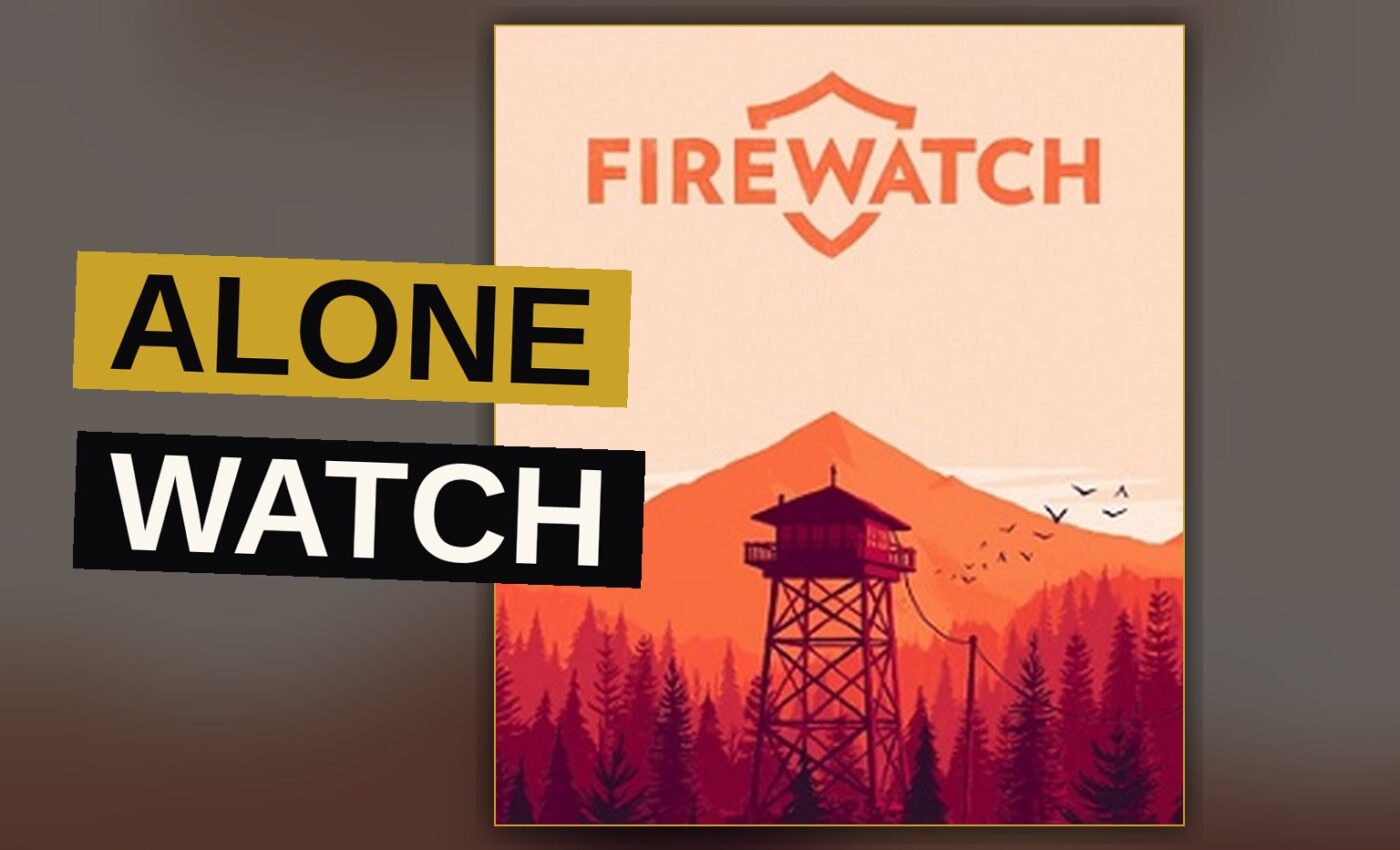
Campo Santo’s first game is a first-person story about a man in a tower, a voice on a radio, and a summer that will not stay quiet. Firewatch came out in February 2016 for Linux, OS X, PlayStation 4 and Windows, reached Xbox One that September, and landed on Nintendo Switch in December 2018. It is an adventure game with no combat and no puzzles. It is also one of the better-written games of its decade, and it is not quite the game its best moments promise.
Trailer, via Campo Santo Productions.
Henry, Julia, and the Shoshone tower
You play Henry, voiced by Rich Sommer. His wife Julia, voiced by Larissa Gallagher, has developed early-onset dementia. In the spring of 1989, Henry takes a job as a fire lookout in Shoshone National Forest in Wyoming. His job is to find smoke. His only link to the world he left is a handheld walkie-talkie.
At the other end is Delilah, voiced by Cissy Jones, a lookout in another tower. She assigns small duties — checking on campers setting off fireworks by the lake — and talks. The player picks from dialogue options, or picks none at all. The tone of the relationship bends to those choices.
That relationship is the whole machine. Everything else in Firewatch is scenery for two people learning how much they are willing to tell each other.
A locked cave and a ransacked tower
The plot does not wait. On his first day, Henry finds two teenage girls at the lake who accuse him of leering. On the way back he spots a locked cave and a shadowy figure watching him from a distance. He returns to his tower to find it ransacked.
The next day Delilah sends him to a downed communication line. He finds it cut. The two plot to scare the girls off; Henry reaches their campsite to find it ransacked and abandoned. The teens are reported missing. Fearing an inquiry, Delilah files a false report saying neither of them encountered the girls.
Then the past arrives. Henry finds an old backpack and a disposable camera belonging to Brian Goodwin, son of a former lookout named Ned. Ned was an outdoorsman who drank heavily after traumatic experiences in the Vietnam War. Brian liked fantasy novels and role-playing games. Employees were not allowed to bring children to the towers. Delilah was fond of Brian and lied about his presence. He and Ned left abruptly and never came back.
A small wildfire breaks out south of Henry’s tower. While fishing, he finds a radio and a clipboard holding transcripts of his own conversations with Delilah. An unseen assailant knocks him out. He wakes to find the clipboard and radio gone. In a nearby meadow he finds a fenced-off government research area and breaks in.
What the player actually does
Firewatch is a walking simulator in the plain sense. No combat. No puzzles. You walk, look, and talk.
- A compass and a map, which Henry adds notes to as he goes
- Supply caches holding ropes and other tools that open new routes
- A disposable camera for snapshots
- A walkie-talkie, the only way to reach Delilah
- An inventory for objects picked up in the wilderness
New areas open as the story moves, and certain events are set at different times of day. Finish the game and you unlock a free roam mode with no objectives and a day-night cycle. A developer commentary mode scatters listening stations across the map with cassettes of behind-the-scenes information.
Olly Moss, Jane Ng, and a single painting
The environment was modelled by artist Jane Ng from a single painting by Olly Moss. The design draws on New Deal advertisements by the National Park Service and on field research conducted in Yosemite National Park.
The game was directed by Olly Moss and Sean Vanaman, written by Chris Remo, Jake Rodkin, Moss and Vanaman, and produced by Gabe McGill and Ng. It was published by Campo Santo in partnership with Panic.
Where Firewatch stumbles
Two complaints followed the game at release and neither has aged out. Technical issues were one. The ending was the other. Reviews were generally positive, with praise for the story, characters, dialogue and visual style.
Firewatch builds tension around unseen forces — a shadowy figure, a ransacked tower, a cut line, a missing boy — and resolves it in a way many players found smaller than the build. That gap is the game’s real argument, and it is the one thing a new player should know going in.
What Firewatch gets right
The dialogue system is the achievement. You may answer Delilah, or you may say nothing. The player’s choices influence the tone of Henry’s relationship with Delilah, and the game tracks that tone rather than a score.
That is a harder thing to build than a puzzle. Firewatch never asks you to be clever. It asks you to decide how much of yourself to hand over, over and over, to someone who cannot see your face.
Cissy Jones and Rich Sommer carry it. Jones plays Delilah as a person rather than a quest-giver, and Sommer plays Henry as a man who has already left and is only now noticing.
Awards and the case for 7.9
Firewatch collected Best 3D Visual Experience at the Unity Awards 2016, Best Indie Game at the 2016 Golden Joystick Awards, and Best Narrative at the 2017 Game Developers Choice Awards.
| Element | What Firewatch does | What it costs |
|---|---|---|
| Dialogue | Options, including silence, shape the tone of Henry and Delilah’s relationship | No branch changes the ending |
| Environment | Modelled by Jane Ng from one Olly Moss painting; New Deal and Yosemite research | Beautiful, and mostly a corridor |
| Interaction | Compass, map, caches, ropes, disposable camera | No combat, no puzzles |
| Replay | Free roam mode and developer commentary cassettes unlock after completion | The story itself is one road |
The score is 7.9 of 10. That number is not a hedge. It is what a game looks like when its best element — two people talking across a valley — is better than the plot it is bolted to. Firewatch is worth playing for Delilah’s voice in your ear and for the way the Shoshone looks at dusk. It is worth arguing about for the last hour, which is the part that will decide whether you remember it fondly or remember being let down.
Get the Notebook.
The day's best stories and every fresh verdict, in plain English, in your inbox by seven. One email a day, no more.