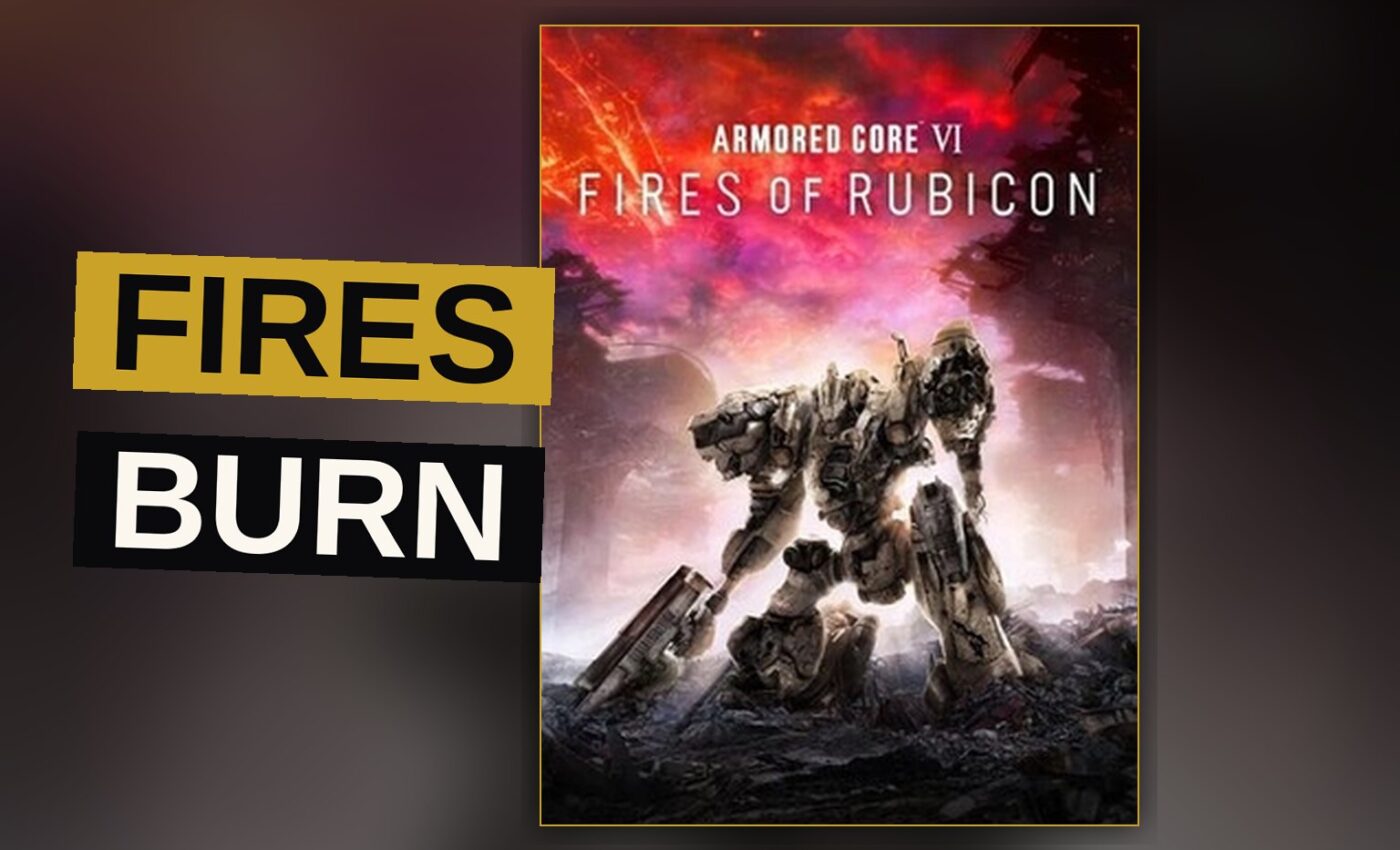
Armored Core VI: Fires of Rubicon is the first Armored Core game in a decade, and FromSoftware spent that decade becoming something else. The studio that made its name on mech combat came back to it in 2023 with the reputation of Dark Souls and Elden Ring behind it, and the question hanging over the release was whether the old series could carry that weight. It can. Armored Core VI is a reboot, not a sequel, and it treats the return as a chance to rebuild the franchise from the frame up rather than bolt new parts onto a decade-old chassis.
Trailer, via Bandai Namco Entertainment America.
A substance called Coral
The game opens on Rubicon 3, a frontier planet where a substance called Coral was discovered and hailed as the key to human advancement. It was not. The Coral triggered an explosion known as the Fires of Ibis, which burned the entire star system and left the planet contaminated. Coral was thought lost. Fifty years later it resurfaces on Rubicon 3, and the survivors of the Fires of Ibis are still there.
That premise sets the board. The Planetary Closure Administration is isolating the contaminated planet. Megacorporations including Balam Industries and Arquebus Corp want the Coral for profit. The planet’s human survivors have formed the Rubicon Liberation Front. Three powers, one resource, and a sealed planet none of them fully controls.
C4-621 takes the name Raven
The player is C4-621, a cyborg mercenary and a survivor of Coral-based cybernetic augmentation. Handler Walter acquires the pilot and sends them to infiltrate Rubicon 3, promising to reverse the debilitating procedure and give them a new life. To operate on the planet, C4-621 assumes the identity of a presumably deceased mercenary called Raven.
That borrowed name is the smartest thing in the script. Multiple characters hand it to the player, along with other nicknames, and the identity sits on the pilot like a coat that does not fit. The story keeps asking who C4-621 is underneath it, and the Coral has an answer the pilot does not expect.
Ayre, and the voice inside the machine
C4-621 takes missions for Balam and Arquebus while hunting Coral, which puts the pilot in the same rooms as G5 Iguazu, a member of Balam’s Redguns mercenary group and another Coral-based augmented mercenary who resents the newcomer. Some missions pair the player with V.IV Rusty of Arquebus’s Vespers squad, who is an undercover operative for the Rubicon Liberation Front. “Cinder” Carla, leader of an independent faction and an old associate of Walter, provides aid.
Then the player finds a Watchpoint station rich in Coral and makes contact with Ayre, a non-corporeal sentience born from the Coral who aids the player in missions. Ayre is the hinge the whole story turns on. A mercenary who came to Rubicon for a paycheck now has a voice in their head that belongs to the planet itself, and the game’s ending branches follow from what the player does with that.
Four weapons, one weight limit
The combat is the reason the series lasted long enough to earn a reboot. Players pilot mechs called Armored Cores and customize them heavily, which has always been the franchise’s spine and remains so here. Each AC carries four weapons: one in each hand and one on each shoulder. Parts and weapons have different characteristics and can be swapped between missions, bounded by the AC’s weight and energy limits.
That constraint is the whole game in miniature. An in-game menu reports the AC’s traits, including movement speed and defense against explosive attacks, so the player can see exactly what a heavier load costs. There is no build that does everything. Every choice closes a door.
Missions pay COAM, the in-game currency for buying new parts and weapons. The payout is not fixed. It shifts with in-game factors including bonuses for completing additional objectives and deductions for repairs and ammunition. Extra parts and weapons turn up in certain missions.
The briefing room and the arena
The singleplayer campaign runs as a series of combat missions that carry the story. Each one opens with a briefing that lays out success parameters, expected opposition and other details, and the player completes it by destroying targets and hitting specific goals, such as killing particular enemies. When the game offers a choice between missions, taking one typically locks out the other for that campaign. New Game Plus content is there for a second pass.
The arena concept from earlier games returns as a “combat aptitude evaluation program,” pitting the player against notable NPC mechs. It is the purest expression of the customization system, because a bad build is exposed immediately and no amount of mission context hides it.
By combining FromSoftware’s longstanding expertise in mech games and their signature robust gameplay, Armored Core VI: Fires of Rubicon will be a new action experience.
What the decade bought
Here is where the review has to take a position. Armored Core VI is the highest-selling entry in the series, with three million copies sold by July 2024, and it earned generally positive reviews from critics. It holds an 8.1 out of 10 on Metacritic. Those numbers are not the argument. The argument is that FromSoftware used its decade away to learn something the old games never had: pacing.
The mission structure gives the campaign a rhythm the series previously lacked. Briefing, sortie, accounting, next briefing. The COAM deductions for repairs and ammo turn every mission into a small ledger, and the ledger is where the tension lives. A sloppy win that costs too much in repairs is a loss the player feels before the next mission starts, because the payout that funds the next build has already been eaten.
The customization is deep, and depth is not the same as accessibility. Four weapon slots and a weight limit produce a menu system that will stop some players cold. The game does not smooth that over. It expects the player to read the traits menu and understand what explosive defense and movement speed mean for the next fight.
The story is the weaker half. Coral, the Fires of Ibis, the PCA, Balam, Arquebus, the Rubicon Liberation Front — the proper nouns arrive fast and the game does not slow down to explain them. Ayre is the exception, a genuinely strange idea that the campaign commits to, and the ending branches earn their weight because of her.
The arena is the part worth watching for anyone on the fence. It strips the missions away and leaves only the build, and it will tell a player within an hour whether the customization loop is a hobby or a wall. If the arena holds them, the campaign will too.
What the ledger decides
Armored Core VI: Fires of Rubicon is a reboot that justifies the decade off. It keeps what worked — the four-weapon loadout, the weight and energy limits, the arena — and adds a mission economy that makes every sortie cost something. It is the highest-selling Armored Core game, and the reason is not nostalgia.
The flaws are real. The proper-noun density in the opening hours is a barrier, and the customization system will lose players who wanted a shooter and got a spreadsheet. Neither is fatal. Both are the price of a game that trusts its audience to do the reading.
Get the Notebook.
The day's best stories and every fresh verdict, in plain English, in your inbox by seven. One email a day, no more.