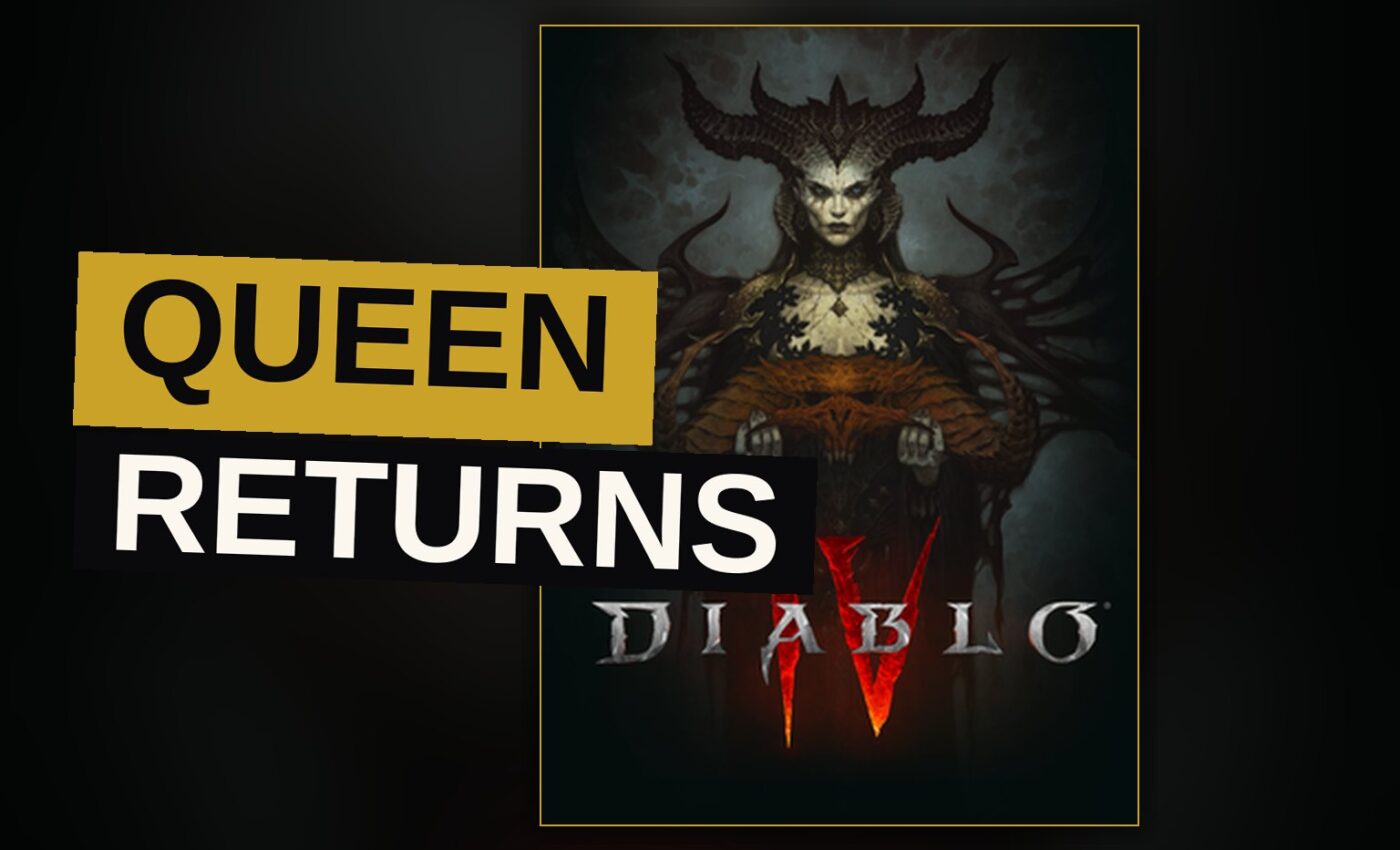
Diablo IV is a 2023 action role-playing game developed and published by Blizzard Entertainment, and it is the fourth main installment in the Diablo series. It came out on June 5, 2023 for PlayStation 4, PlayStation 5, Xbox One, Xbox Series X and S, and Microsoft Windows. It was announced at BlizzCon in 2019. As of September 2024, it has brought in more than one billion dollars in total revenue. That figure alone tells you what Blizzard built here: not a niche return for lapsed players, but a mass-market machine.
Trailer, via XBOX.
Lilith Returns to Sanctuary
The game is set in the Diablo series’ world of Sanctuary, 50 years after the events of Diablo III: Reaper of Souls. Cultists have summoned the main antagonist, Lilith, the daughter of Mephisto. Caroline Faber voices her. The forces of demons and angels have been depleted after the earlier games, which gives Lilith an opening to build power in Sanctuary.
Thousands of years before the game’s events, Lilith and the angel Inarius created Sanctuary as a refuge for those who wanted to escape the eternal conflict between the High Heavens and the Burning Hells. Gabe Kunda voices Inarius. Their relationship produced the Nephalem, a race the protagonist belongs to — neither angel nor demon, but a distinct mix of both.
The Wanderer and Lorath Nahr
Players create a character from one of eight playable classes: Barbarian, Sorcerer, Druid, Rogue, Necromancer, Spiritborn, Paladin, or Warlock. They use class skills to complete quests through combat.
The player character is known as “the Wanderer.” Villagers corrupted by Lilith drug the Wanderer and feed them petals of Lilith’s blood, creating a connection between the two. After escaping, the Wanderer meets Lorath Nahr, voiced by Ralph Ineson, one of the last Horadrim and a returning figure from Diablo III: Reaper of Souls. Lorath explains the prophecy of Lilith’s return.
Inarius believes he alone can fulfill that prophecy by killing Lilith, which would let him return to Heaven. Aided by a young woman named Neyrelle, voiced by Judy Alice Lee, the Wanderer enters the sanctum of Rathma, the first Nephalem and founder of the Necromancers. Rathma’s spirit, voiced by Scott Whyte, reveals he had a key to Hell. Inarius demands the key; Rathma refuses, and Inarius kills him. Lilith later finds the key.
Donan, Astaroth, and the Soulstone
The Wanderer then travels to Scosglen to meet another Horadrim named Donan, voiced by James Goode. Years before, Donan had defeated a demon called Astaroth, voiced by David Lodge, with the aid of two Druids. Lilith corrupts the two Druids to locate Astaroth’s prison and frees him, in exchange for safe passage through Hell.
Astaroth possesses Donan’s son Yorin, voiced by Thierry Mabonga, who dies when the demon is defeated. Donan recovers the Soulstone used to trap Astaroth and prepares to alter it to trap Lilith. It is a grim stretch of story, and it earns its weight because the game keeps its eye on ordinary people rather than on thrones.
A Grounded Story, by Design
Creative director Sebastian Stepien explained that the goal was to create a more “grounded” story than Diablo III. To achieve that, the plot revolves around the simple folk of Sanctuary rather than “politics, kings, or another high-fantasy theme.”
That choice is the smartest thing Diablo IV does. The series has always been about fighting through darkness, but the best material here is domestic: a father, a son, a demon wearing both. Blizzard has not always trusted its own small characters this much.
The playable character’s effectiveness in combat is determined by their attributes and their boosts from equipped items.
Elias, Taissa, and the Sightless Eye
Rejoining Lorath in the Dry Steppes, the Wanderer pursues Lorath’s former apprentice Elias, voiced by Anthony Howell, who summoned Lilith to Sanctuary. Elias cannot be killed. The Wanderer and Lorath retrieve an artifact called the Sightless Eye to learn Lilith’s plan: to summon the Lesser Evils to empower humanity against the Prime Evils.
She also intends to consume the essence of her father Mephisto, voiced by Steve Blum, while he is weak, and use his power to conquer Hell. Elias uses a witch named Taissa, voiced by Cherise Boothe, in a part of the plot the source material leaves hanging. The scale keeps widening, and the game mostly holds it together.
Dungeons, Loot, and Three New Attributes
The core formula for the series’ gameplay is gradual: obtain stronger equipment by defeating increasingly difficult enemies. Enemies are fought with class skills that equipment and talent trees can customize. That loop carries the story and the quests forward.
Enemies are split into monster families defined by theme, combat style, and location. Each family holds different archetypes with different roles, which allows specialty abilities to work together between family members. Unique silhouettes, stances, and weapons separate them on screen.
Offensive attributes include attack and critical chance, which raise damage output. Defensive stats include elemental resistance and defense, which raise how much damage a character can take. Diablo IV adds three new attributes: Angelic, Demonic, and Ancestral Power. Angelic and Demonic Power alter the duration of beneficial and negative effects respectively. Ancestral Power increases the chance of effects being applied to another entity.
Weapons and gear have increasing rarity, a general indicator of power. The rarest items have unique effects that alter more than the character’s parameters. Lead game designer Joe Shely and senior producer Tiffany Wat said in an interview that trading and crafting would be available in the game.
An Open World and Player Versus Player
Staple features returned from earlier installments: replayable, procedurally generated dungeons and loot-focused character-building. Mechanics new to the series include an open world and player versus player combat. Both are the right kind of risk for a fourth entry. The dungeons are the series at its most reliable; the open world is where Diablo IV occasionally loses the thread, because a game this good at claustrophobia does not always know what to do with a horizon.
Diablo IV received generally positive reviews from critics, who praised the game’s narrative and atmosphere. Its first expansion, Vessel of Hatred, was released in October 2024. Its second expansion, Lord of Hatred, was released in April 2026.
The Verdict
What matters most here is not the billion dollars or the expansions. It is that Blizzard rebuilt the series around people instead of politics, and that the rebuilding worked. The atmosphere is the strongest element, and the narrative earns the darkness it trades in. The combat loop is deep enough to carry hundreds of hours, and the three new attributes give builders something genuinely new to argue about.
The weak points are real but secondary. The open world spreads the tension thinner than the dungeons do. The plot leaves threads, including Taissa’s role, that a player will notice. And the game’s continued life now runs through expansions rather than through the base release, which is a different kind of commitment than the one the 2023 launch asked for.
None of that undoes the central achievement. Diablo IV is a rare thing: a long-running franchise that got quieter, smaller in its concerns, and better for it. The demons are still endless. The people fighting them finally feel like people.
Get the Notebook.
The day's best stories and every fresh verdict, in plain English, in your inbox by seven. One email a day, no more.