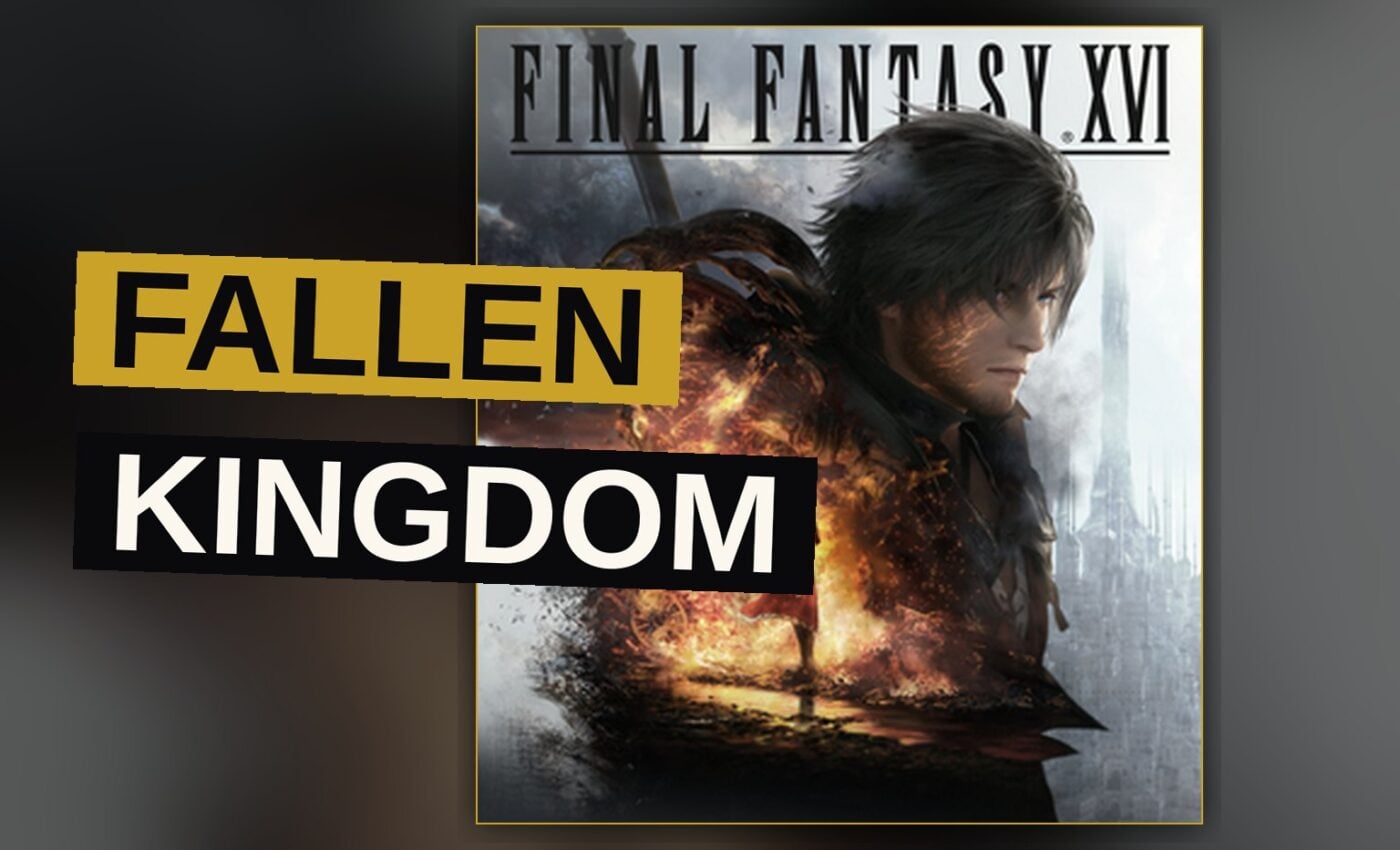
Final Fantasy XVI asks a lot of its players. Square Enix’s sixteenth mainline entry wants you to learn the politics of two continents, track eight summoned monsters and their human hosts, and keep straight which of six nations is fighting which. It also wants you to care about Clive Rosfield, a man whose kingdom is destroyed and whose brother dies, and who keeps standing up anyway.
It mostly earns the effort. Final Fantasy XVI is a confident, often thrilling action RPG that trades the series’ traditional turn-based combat for something faster and more physical. The result is the strongest Final Fantasy in years, even when its ambitions outrun its structure.
Trailer, via Square Enix.
Clive Rosfield and the Fall of Rosaria
Clive is the firstborn son of Rosaria’s ruling family. He is passed over as heir when his younger brother Joshua becomes the Dominant of Phoenix, the fire Eikon. Clive becomes Joshua’s guardian, a shield bearer. Then his kingdom is destroyed, and the game’s real story begins.
That setup matters because Final Fantasy XVI is deeply narrative-driven. It emphasizes character development over open-ended exploration, and Clive carries nearly all of it. He can acquire and wield the power of multiple Eikons, a key element of both the combat system and the story. A seemingly impossible second Eikon of fire, Ifrit, drives the plot by disrupting the balance among the eight.
Clive’s childhood friend Jill Warrick joins him. She is the eventual Dominant of Shiva, and she spends much of her life as a political hostage. In this reviewer’s view, the game writes her better than the series has often managed.
Valisthea, the Blight, and the Bearers
The setting is Valisthea, twin continents named Ash and Storm. Colossal crystals called Mothercrystals provide aether, the energy that fuels magic and civilization. As aether fades and lifeless deadlands spread, the struggle for what remains grows more fierce. That drought is the Blight, and it drives the nations into war.
The politics are dense but legible. The Grand Duchy of Rosaria, the Holy Empire of Sanbreque, and the Dhalmekian Republic sit on Storm. The Kingdom of Waloed dominates Ash. The Crystalline Dominion sits neutral between them, and the Iron Kingdom is an isolated outlier off Storm’s coast.
Then there are the Bearers: humans who can use magic without crystals. Valisthea subjects them to prejudice and slavery, and their overuse of magic gradually petrifies them. It is the game’s sharpest piece of worldbuilding.
| Faction | Continent | Notes |
|---|---|---|
| Grand Duchy of Rosaria | Storm | Clive and Joshua’s homeland |
| Holy Empire of Sanbreque | Storm | Holds power through its Mothercrystal |
| Dhalmekian Republic | Storm | One of the three Storm powers |
| Kingdom of Waloed | Ash | Dominates the Ash continent |
| Crystalline Dominion | Between Ash and Storm | Neutral ground |
| Iron Kingdom | Off Storm’s coast | Isolated, overseen by the Crystalline Orthodox |
Combat, Eikons, and the Hideout
Players control Clive and a rotating party of AI-controlled companions through segmented open areas. Clive is the only controllable character. Companions fight on their own, and the dog Torgal responds to commands for special attacks or healing.
Combat happens in the same space you navigate. Enemies spot the party, or you attack something like an antelope, and the fight begins. Clive gets normal attacks, a dodge, and elemental abilities drawn from Eikons. He can switch between Eikon abilities mid-battle and string them into combos. Parries, heavy weapons, and cinematic set pieces round it out.
The eight Eikons map to elements: Phoenix for fire, Shiva for ice, Ramuh for thunder, Leviathan for water, Titan for earth, Garuda for wind, Odin for darkness, Bahamut for light. Ifrit breaks the pattern.
Between fights, Clive’s hideout acts as a hub. You talk to NPCs, track relationships, visit potion sellers and blacksmiths to make and upgrade equipment, and accept side quests that range from character requests to monster hunts. A database called Active Time Lore holds information on locations, characters, and terminology, and you can open it at any time. It is the single best quality-of-life addition here.
Travel across open zones happens on foot or via Ambrosia the Chocobo, with fast travel from a map menu.
What Works and What Wears Thin
The staff behind this is serious. Naoki Yoshida produced it, Hiroshi Takai directed, Kazutoyo Maehiro served as creative director and lead writer, Masayoshi Soken composed, and Capcom veteran Ryota Suzuki designed the battle system. Yoshida’s aim was a dark fantasy storyline that would have broad appeal.
Concept development began in 2015. The game first released for the PlayStation 5 in 2023, with a Windows version in September 2024 and an Xbox Series X/S version in June 2025.
The combat customization is the real achievement. Layered combos, parries, and skill upgrades give Clive’s moveset room to grow without drowning the player in menus. The Eikon boss fights are, to this reviewer, the spectacle the series has long aimed for.
The weakness is pacing. Segmented open environments mean the world never feels as vast as its politics suggest, and in this reviewer’s view the side quests in the hideout are uneven. The Active Time Lore may well exist because the game knows how much it is asking you to remember.
Still, this is the right direction. Final Fantasy XVI commits to a single character and a single dark story instead of hedging. In this paper’s reading, Clive’s vengeance arc and Valisthea’s crystal economy are the strongest material here, and the Bearers give the fantasy a moral edge worth noting.
Play it on PlayStation 5, PC, or Xbox Series X/S. The Windows and Xbox Series X/S versions arrived later than the PlayStation 5 release.
Get the Notebook.
The day's best stories and every fresh verdict, in plain English, in your inbox by seven. One email a day, no more.