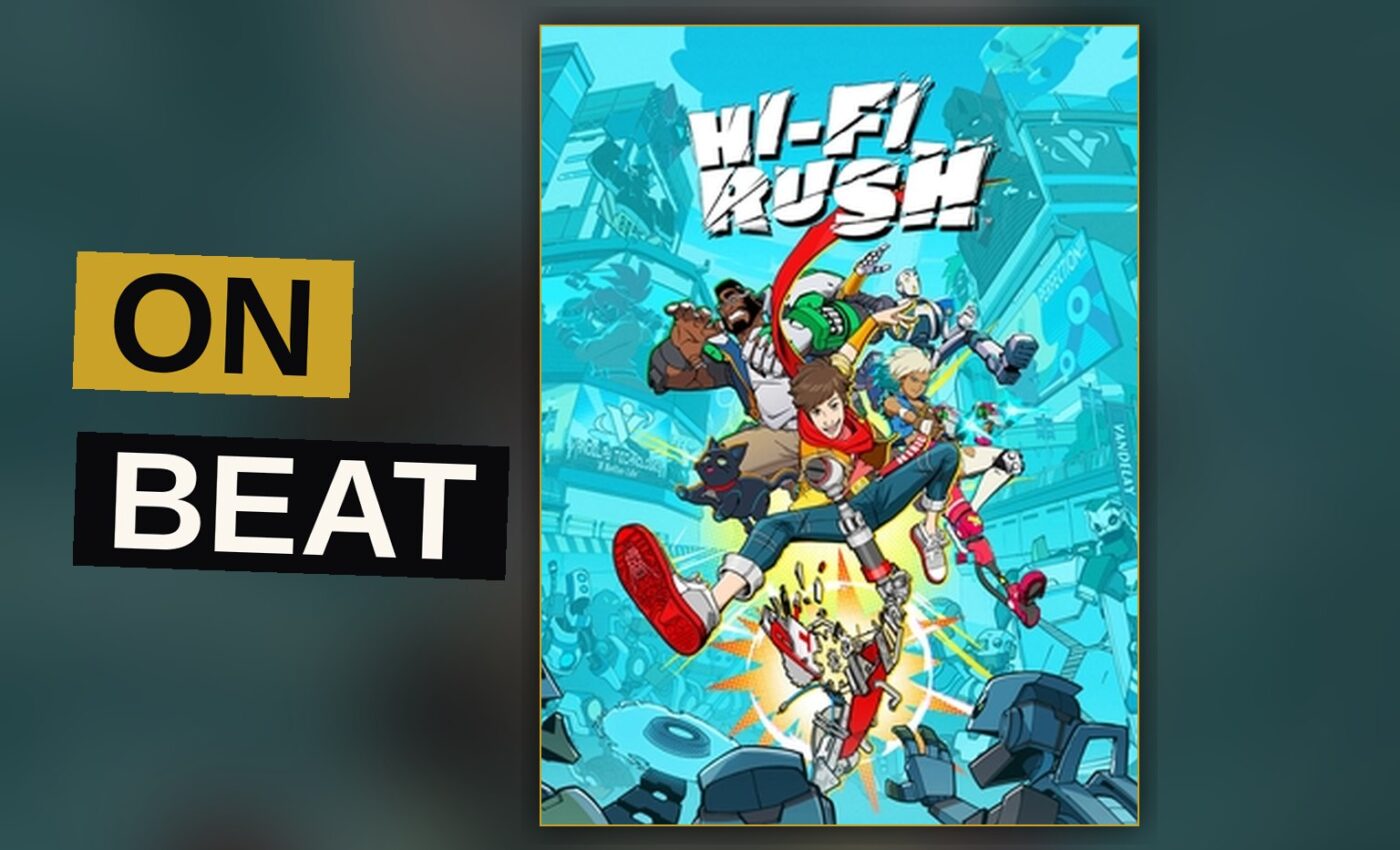
Hi-Fi Rush opens with a man volunteering to have his arm replaced so he can become a rock star. What he gets instead is a music player embedded in his chest and a corporation hunting him. Tango Gameworks builds a rhythm-action game out of that mistake, and it never once stops moving to the beat.
The setup is a joke that turns into a plot. Chai is 25, has a disabled right arm, and arrives at the Vandelay Technologies campus for Project Armstrong, a test program for cybernetic limb replacement. He wants the procedure so he can chase his dream of being a rockstar. What he does not know is that CEO Kale Vandelay has secretly designated him to work as a garbage collector for the company’s waste management division.
Trailer, via IGN.
A music player lands in Chai’s chest
The accident that makes the game possible is petty and perfect. As Chai’s limb replacement is about to begin, Kale throws away Chai’s music player. It falls into Chai’s chest and embeds there during the process, and Chai starts to feel a musical connection with everything around him. Vandelay labels him a defect. The facility’s robotic security forces come after him.
Chai discovers his new arm can deploy an electromagnetic grabber stick, meant for garbage collecting, and he turns it into a guitar-like weapon. He meets 808, a robotic cat named after the Roland TR-808 drum machine. An unseen ally, Peppermint, talks through the cat and leads him to her hideout, where she offers an escape in exchange for help investigating a conspiracy behind Project Armstrong. Chai agrees, and the two form a reluctant alliance.
That alliance carries the story. Chai helps Peppermint break into a Vandelay executive computer, and they learn about SPECTRA, an AI program that uses Project Armstrong’s cybernetic implants as a back door for mind control. Their plan is to collect passkeys from each executive, Kale included, and shut SPECTRA down. Along the way they pick up more allies, and Chai bands together with them to defeat the company’s executives and stop their plans.
Robbie Daymond voices Chai in English, with Hiro Shimono in Japanese. Roger Craig Smith and Takehito Koyasu voice Kale. Erica Lindbeck and Toa Yukinari voice Peppermint.
Combat that pays you for timing
Hi-Fi Rush is a rhythm-action game, and the rhythm is not decoration. Chai, his enemies, and parts of the environment all move to the beat of the soundtrack. Attacking on rhythm is not required — actions sync up with the music automatically — but timing button presses correctly pays out higher damage, and timing-based combo finishers deal additional damage on top.
A parry lets players cancel enemy attacks by pressing the button at the exact moment of an attack. That single move does more for the game’s feel than any damage number. It turns every enemy swing into a question with a right answer, and it keeps the player listening instead of mashing.
The game also runs rhythm-based minigames, where players repeat cues in a call-and-response fashion or press buttons in a rhythmic sequence based on on-screen cues. These break up the fighting without feeling bolted on, because they use the same audio language as everything else.
Linear stages, distinct musical identities
Progression moves across multiple linear stages, each representing a division of Vandelay. Every division is built around a particular musical style, and Chai fights boss battles at various points. Platforming segments and arena-like encounters with enemies and minibosses sit between them.
Upgrades are bought with gears, an in-game currency earned in combat or by exploring levels. Players unlock new moves, abilities and perks. Permanent upgrades to health and the special meter appear in stages as collectibles, which gives exploration a reason beyond scenery.
The structure is old-fashioned in the best way. There is no open world to pad the runtime, no map full of icons. You go forward, you fight, you listen.
What each mechanic does
| Element | What it asks of the player | What it gives back |
|---|---|---|
| Beat hits | Chain attacks in time with the music | Higher damage output and a better end-level ranking |
| Parry | Press at the exact moment of an enemy attack | Cancels the attack |
| Rhythm minigames | Repeat cues or press in rhythmic sequence | On-screen interactions and puzzles |
| Gears | Earn in combat or by exploring levels | New moves, abilities and perks |
| Collectibles | Find permanent upgrades in stages | Higher health and special meter |
The table is the whole design in miniature. Everything the game asks you to do, it pays you for in the same currency: attention.
Why the timing system holds up
Plenty of action games claim to be about rhythm. Most of them mean a combo counter. Hi-Fi Rush means it literally — the environment moves on the beat, the enemies move on the beat, and the game’s soundtrack is the clock the whole thing runs on. That is a harder thing to build than it sounds, because it constrains level design, enemy animation and audio at the same time.
The choice to make rhythm optional is the smartest call here. Players who cannot or will not keep time can still finish the game; the music carries them. Players who can keep time get a second layer on top, and a ranking at the end of each level to prove it. Nobody is locked out, and nobody is let off.
Completing the game once unlocks bonus features: the ability to revisit past levels and previously inaccessible areas, a new difficulty setting, and Rhythm Tower, a survival mode similar to Bloody Palace from the Devil May Cry series. That is a real second pass, not a victory lap.
A route through the unlocks
The source does not prescribe an order for the bonus content. This is our advice, not its fact.
- Finish the campaign before touching anything else, because the story beats land better when you have not seen the levels out of order.
- Go back for the health and special meter collectibles you missed, since they change how much punishment you can absorb on harder settings.
- Clear the previously inaccessible areas that open up on a second visit.
- Take on the new difficulty setting.
- Save Rhythm Tower for last, once your move set is complete. It is a test of everything the campaign teaches.
Where the game runs thin
Hi-Fi Rush is the rare game where the gimmick and the genre are the same thing. Tango Gameworks did not bolt a rhythm system onto a character action game; it built the action game out of the rhythm system, then let the story about a corporation that turns people into hardware play out inside it. Vandelay wants Chai to be a component. Chai answers by turning his own body into an instrument. That is a clean idea, and the game holds it from the first stage to the last.
Our own impression, not a fact the source states: the linear stages mean the game shows you most of what it has fairly early, and the back half leans on boss battles and escalation rather than new ideas. The minigames are good but they recur, and by the end you know the call-and-response pattern before it starts. None of that sinks it. It just means the game is a tight, well-made thing rather than an endlessly surprising one.
What matters is that the combat has a spine. The parry is the best thing in it, because it makes every enemy in the game a metronome you have to read. Add a soundtrack that the entire world obeys and a plot about mind control delivered through prosthetic limbs, and you have something that knows exactly what it is. Chai’s fixation on becoming a rockstar reads as funny to us; the source does not describe his humor.
Hi-Fi Rush is not the biggest game of its year, and we are not claiming it is. It is one of the sharpest. If you have any patience for action games and any affection for music, this is the one to play with the sound up.
Get the Notebook.
The day's best stories and every fresh verdict, in plain English, in your inbox by seven. One email a day, no more.