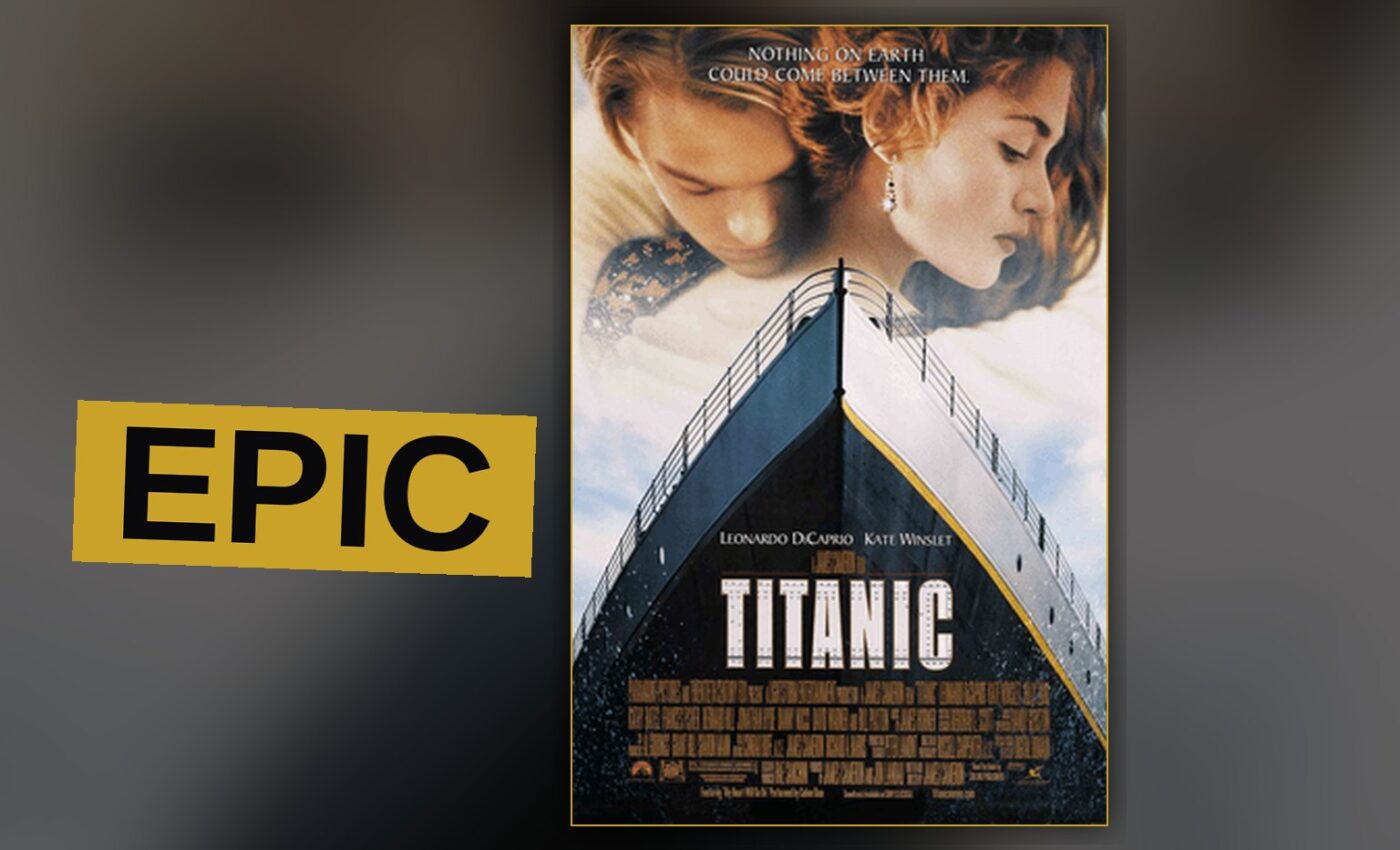
James Cameron’s Titanic runs 194 minutes and ends with a 101-year-old woman telling a story she has kept for 84 years. That is the whole trick of the thing. The ship sinks because it hit an iceberg on April 15, 1912, and about 1,500 people died. Cameron knew a disaster alone would not hold an audience for three hours. So he built a love story on top of it, and the love story is what people remember.
Trailer, via 20th Century Studios.
Jack Dawson and the Third-Class Ticket
Leonardo DiCaprio was 21 when he played Jack Dawson, a poor nomadic artist who wins a third-class ticket aboard the Titanic. Cameron has said DiCaprio did not want the part at first and refused to read his opening romantic scene. The director’s account of the audition is worth keeping: “He read it once, then started goofing around, and I could never get him to focus on it again. But for one split second, a shaft of light came down from the heavens and lit up the forest.”
That is a director talking himself into a movie star. Cameron also told DiCaprio he would not write the character as brooding and neurotic, and he meant it. Jack is not a tortured artist. He is a man with a sketchbook and no money, and DiCaprio plays him with an open face that makes the second half of Titanic hurt more than it should.
Rose DeWitt Bukater and a Loveless Engagement
Kate Winslet plays Rose DeWitt Bukater, 17 years old, boarding at Southampton with her wealthy fiancé, Cal Hockley, and her mother, Ruth. Rose is miserable. Ruth’s answer is that the marriage will fix their financial problems. Billy Zane plays Cal as a man who owns things, and Frances Fisher plays Ruth as a woman who has already sold her daughter and cannot afford to notice.
Rose walks to the stern and considers jumping. Jack stops her. From there Cameron builds the friendship, then the confession, then the turn where Rose admits she loves Jack against her mother’s and Cal’s disapproval. She brings him to her stateroom and asks him to draw her nude, wearing only the necklace called the Heart of the Ocean. The sketch is dated April 14, 1912, the day the ship struck the iceberg.
The Necklace, the Frame, and the Sinking
The plot engine is a necklace. In 1996, treasure hunter Brock Lovett, played by Bill Paxton, is aboard the research vessel Akademik Mstislav Keldysh, searching the wreck for the Heart of the Ocean. His team recovers a safe holding the drawing instead. Rose Dawson Calvert sees a television report about it and calls. She is the woman in the sketch, and Lovett brings her and her granddaughter aboard hoping she can find the necklace.
Gloria Stuart plays old Rose, and she is the film’s spine. Cameron shot the modern scenes on the Keldysh, the same Shirshov Institute of Oceanology vessel he used as a base when he filmed the actual wreck starting September 1, 1995.
Back in 1912, Cal finds Jack’s sketch and has his valet, Spicer Lovejoy, plant the necklace on Jack to frame him for theft. Jack is arrested and locked in the master-at-arms’ office. Cal pockets the necklace. Then the ship hits the iceberg, and all of it stops mattering.
Nothing on earth could come between them.
What $200 Million Actually Bought
Titanic was the most expensive film ever made at the time, with a production budget of $200 million. Fox had it in development alone until delays and the mounting cost pushed the studio into partnering with Paramount. Filming ran from July 1996 to March 1997. Cameron recreated the sinking with scale models, computer-generated imagery, and a reconstruction of the Titanic built at Baja Studios.
That money is on screen, and it is the least interesting thing about the movie. The sinking sequence is enormous and precise, but the reason it works is that Cameron spent the first half teaching you the geography of the ship. You know the stern, the forward deck, the stateroom, the cargo hold. When the water arrives, you know what is being lost.
The weaker material is the framing device. Lovett is a plot device with a submarine, and the 1996 scenes exist to justify the flashback. They also give Stuart her final act, which is a fair trade. Her face when she sees the drawing again does more than any line of dialogue.
The Case for 7.9
Titanic premiered at the Tokyo International Film Festival on November 1, 1997. Nearly three decades later the arguments against it have not changed: the dialogue is blunt, Cal is a cardboard villain, and the film’s class politics are simpler than its production design. The arguments for it have not changed either. Winslet and DiCaprio are genuinely good together, Bernard Hill’s Captain Smith carries the weight of a man who knows, and Victor Garber’s Thomas Andrews quietly apologizes to a room of strangers for a ship he built.
The casting history is its own comedy. Tom Cruise wanted the part but asked too much. Matthew McConaughey was passed over for refusing to drop his Southern drawl. Jared Leto declined to audition. Billy Crudup turned it down to make Without Limits instead and later said Titanic would not have been as successful with him in it. He is probably right, and that is not a knock on Crudup. DiCaprio’s Jack is the reason the last hour lands.
The film’s real achievement is structural. Cameron wrote and directed a 194-minute movie that spends half its runtime on a romance and the other half on a mass casualty event, and neither half feels like a concession to the other. The love story gives the disaster a face. The disaster gives the love story a deadline.
That is why 7.9 is the right number, and why it is not higher. The craft is remarkable and the emotion is real, but the script reaches for simple answers where the history offers hard ones, and the modern-day bookends never earn their place. Titanic is a great piece of engineering wrapped around a good melodrama. The engineering is what you notice. The melodrama is what you feel, and it is still working.
Get the Notebook.
The day's best stories and every fresh verdict, in plain English, in your inbox by seven. One email a day, no more.