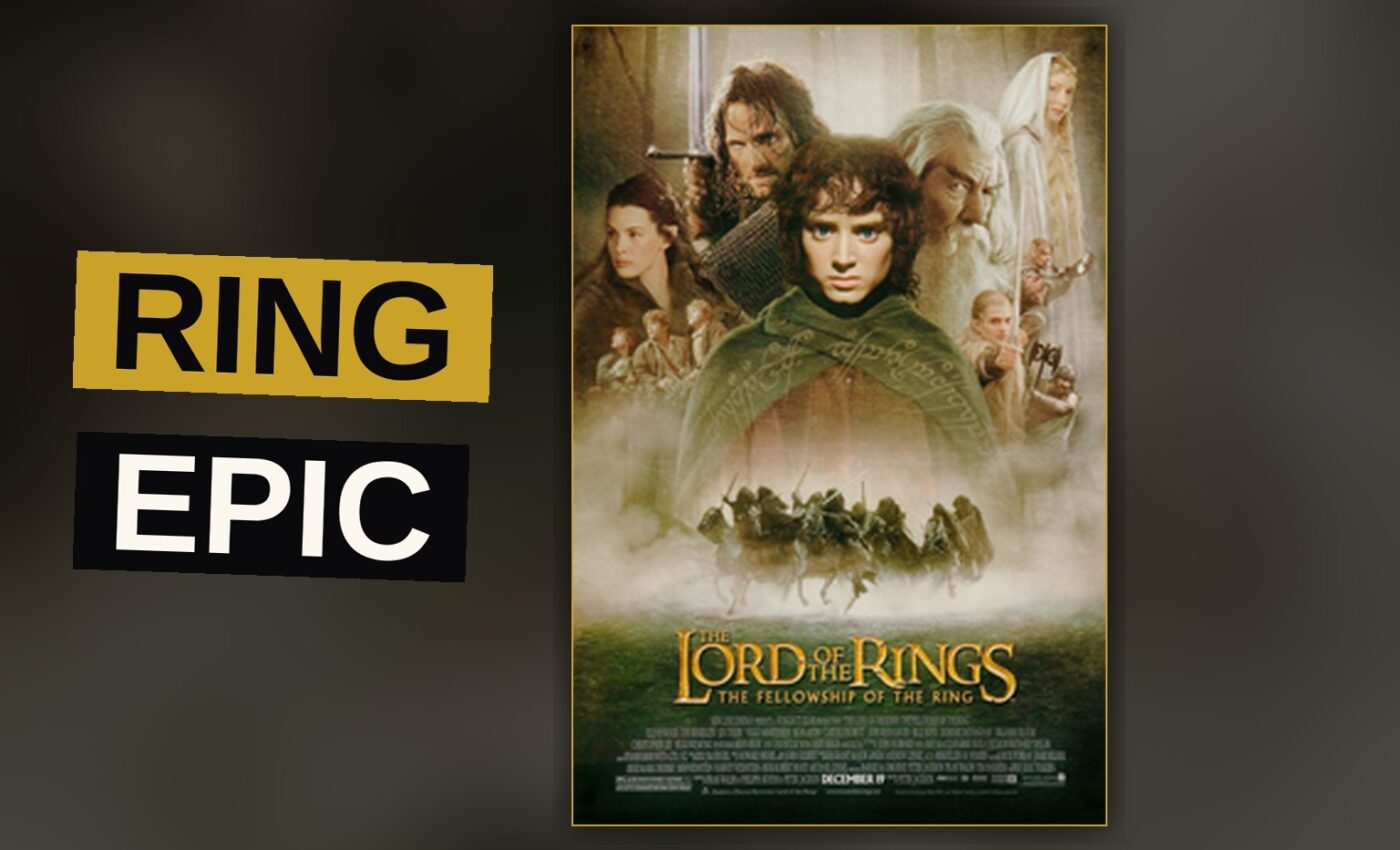
Peter Jackson’s The Lord of the Rings: The Fellowship of the Ring premiered at the Odeon Leicester Square in London on 10 December 2001. It was released in the United States on 19 December and in New Zealand on 20 December. It runs 179 minutes. It is the first instalment of a trilogy shot and edited entirely in Jackson’s native New Zealand, concurrently with the other two parts, and financed and distributed by New Line Cinema. It carries a tagline that has since outgrown the film: “One ring to rule them all.”
Trailer, via Warner Bros. Entertainment.
A Ring Forged In The Second Age
The film’s backstory begins in the Second Age, when the lords of Elves, Dwarves and Men each receive Rings of Power. Sauron, the Dark Lord, forges the One Ring in secret and puts his own power into it, so that it can command the others. An alliance of Men and Elves fights his forces in Mordor. Isildur of Gondor cuts the finger from Sauron’s hand and returns him to spirit form, which begins the Third Age.
Isildur keeps the Ring. It corrupts him, and Orcs kill him. The Ring lies in a river for 2,500 years, is found by Gollum, stays with him for five centuries, then abandons him and passes to the hobbit Bilbo Baggins.
That is a lot of history to move through before a single hobbit speaks, and the film moves through it without hurrying or apologising.
Bilbo’s 111th Birthday
Decades later, Bilbo celebrates his 111th birthday in the Shire. Gandalf the Grey, played by Ian McKellen, is there. Bilbo leaves for one last adventure and hands his inheritance, the Ring among it, to his nephew Frodo, played by Elijah Wood.
Gandalf investigates. He learns what the Ring is. He also learns that Gollum was captured by Sauron and gave up two words under interrogation: “Shire” and “Baggins.”
Gandalf tells Frodo to leave. Frodo goes with Samwise Gamgee, his gardener and friend, played by Sean Astin. Gandalf rides to Isengard to consult Saruman, played by Christopher Lee, who reveals that Sauron has sent his nine Nazgûl after the Ring and then imprisons Gandalf, having already allied himself with Sauron.
The Road To Bree And Rivendell
Frodo and Sam are joined by Merry and Pippin, played by Dominic Monaghan and Billy Boyd. They evade the Nazgûl and reach Bree to meet Gandalf, who never comes. A Ranger called Strider, played by Viggo Mortensen, helps them get to Rivendell, but they are ambushed on Weathertop by the Nazgûl, who wound Frodo with a Morgul blade.
Arwen, Strider’s Elf beloved, played by Liv Tyler, finds them, rescues Frodo and takes him to Rivendell.
The film’s structure is a chain of handoffs, and it works because each handoff costs something. The Shire is safe and small. Bree is not. Weathertop is worse. Jackson never lets the party arrive anywhere better than where it started.
Nine Walkers, One Tattoo
The cast trained for six weeks before shooting began on 11 October 1999, in sword fighting with Bob Anderson, riding and boating. Jackson wanted them to bond so the chemistry would show on screen and so they would get used to life in Wellington. They were also trained to pronounce Tolkien’s verses correctly.
After the shoot, the nine cast members playing the Fellowship got a tattoo of the Elvish symbol for the number nine. John Rhys-Davies, who plays Gimli, did not; his stunt double got it instead.
The ensemble, in the roles the film gives them:
- Elijah Wood as Frodo Baggins, the hobbit who inherits the Ring
- Ian McKellen as Gandalf the Grey, the wizard and Frodo’s mentor
- Viggo Mortensen as Aragorn, the Ranger called Strider
- Sean Astin as Sam, Frodo’s gardener and companion
- Ian Holm as Bilbo Baggins
- Liv Tyler as Arwen
- Christopher Lee as Saruman
- Sean Bean as Boromir
- Billy Boyd as Pippin and Dominic Monaghan as Merry
- John Rhys-Davies as Gimli and Orlando Bloom as Legolas
Wood was the first actor cast, on 7 July 1999, chosen from 150 who auditioned. He was a fan of The Hobbit and sent in an audition dressed as Frodo, reading lines from The Lord of the Rings.
The Casting That Didn’t Happen
The role of Gandalf passed through a remarkable number of hands before it reached McKellen. Sean Connery was approached and did not understand the plot. Patrick Stewart turned it down because he disliked the script. Patrick McGoohan was offered it and declined for health reasons. Anthony Hopkins and Christopher Plummer also said no. Richard Harris wanted it. John Astin and David Bowie auditioned. Sam Neill was offered it and passed because of a scheduling conflict with Jurassic Park III.
In 2026, Jackson said he is glad Connery declined, because he does not think Connery would have had the same chemistry with the rest of the cast that McKellen did.
That is the right call, and the record backs it. McKellen is the film’s load-bearing wall. He plays Gandalf as a man who is fond of hobbits, annoyed by them, and genuinely afraid of what he has just learned, often in the same scene.
How The Fellowship Ranks
The trilogy’s three films do different jobs, and this one does the most thankless of them. Ranked by what each has to accomplish rather than by which plays best on a rewatch, the order runs roughly like this:
- The Fellowship of the Ring, which has to build Middle-earth, the Ring, the Shire and the Fellowship from nothing
- The second instalment, which inherits all of that and only has to move it
- The third, which inherits an audience that already knows the rules
The Fellowship of the Ring is the instalment with the least to resolve and the most to establish. It establishes it.
What The 179 Minutes Buy
The Fellowship of the Ring is a prologue that refuses to feel like one. It has to introduce a Second Age, a Ring, a Shire, four hobbits, a wizard, a Ranger, an Elf, a Dwarf, a kingdom, a villain who never appears in person, and a destination that is three films away. It does all of it inside 179 minutes and still finds room for Bilbo’s birthday party.
The film’s best decision is the one it makes about scale. The Shire is shot as a place worth saving, not as a cute detour, which is why the later ugliness lands. The Nazgûl are frightening because they are patient. The Ring is frightening because it is not.
It is not the best film in the trilogy. It is the one doing the heaviest lifting, and heavy lifting shows.
The published audience score is 8.4/10, from 28,305 votes on TMDB. That is about right. The Fellowship of the Ring holds up as a film on its own terms: a long, careful, confident opening move that earns the 179 minutes it takes.
Get the Notebook.
The day's best stories and every fresh verdict, in plain English, in your inbox by seven. One email a day, no more.