
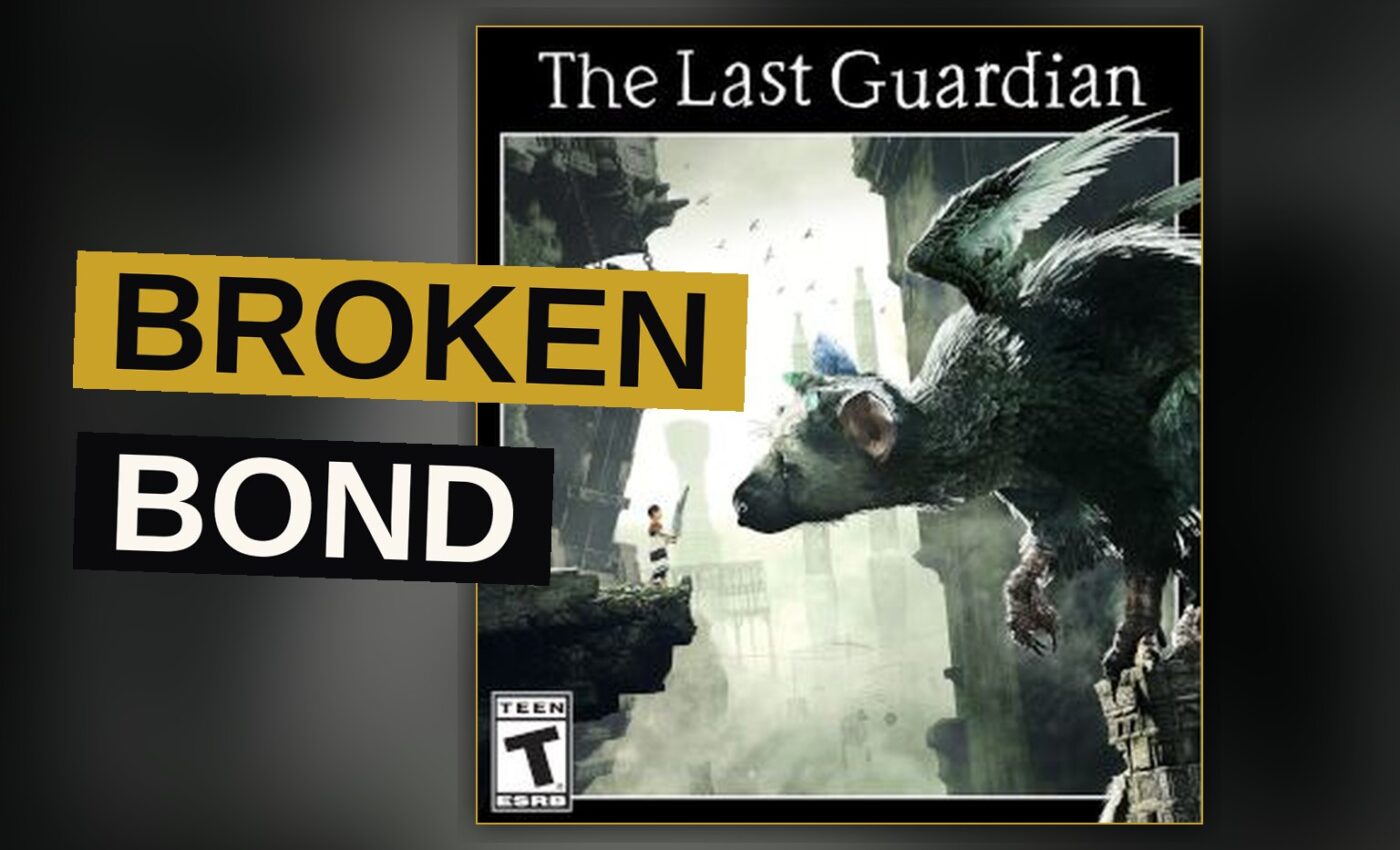
The Last Guardian arrived on PlayStation 4 in 2016 carrying ten years of history. Sony first announced it at E3 2009 with a 2011 release planned for the PlayStation 3. Delays piled up. Fumito Ueda and other Team Ico members left Sony and formed GenDesign. Hardware difficulties pushed the game to the PlayStation 4 in 2012, and plenty of people assumed it would never come out at all. Ueda stayed on as director, with GenDesign as creative consultants, while Sony’s Japan Studio handled technical development. Sony reintroduced it at E3 2015, and a year later it was real.
Trailer, via IGN.
A Boy Wakes in the Nest
The Last Guardian opens with a young boy waking disoriented in the crumbling ruins of a vast, ancient valley called the Nest. He has no memory of how he got there. He finds Trico, an enormous creature that is part bird and part mammal, chained and wounded. The beast is wary and frightened. The boy earns its trust by pulling the spears from its body and bringing it food.
That is the whole relationship in miniature, and the game builds everything on it. The pair set out to escape a labyrinth of towers, bridges and caverns. Trico’s strength and the boy’s cleverness carry them through. The story is framed as a memory recounted by a grown man, voiced by Hiroshi Shirokuma, looking back on what happened to him as a boy, voiced by Tatsuki Ishikawa.
Trico Is the Best Character of 2016
Trico is the reason this game works. The creature is a piece of design built around a single idea, and it holds. Its name can be read as “prisoner,” as “baby bird,” or as a portmanteau of “bird” and “cat.” All three readings fit. Trico is chained, it is young, and it moves like something between a hawk and a housecat.
Ueda and his team used the “design through subtraction” approach he had used on Ico and Shadow of the Colossus, cutting anything that did not serve the core theme of the connection between the boy and Trico. The result is a creature that feels alive in ways most games never attempt. Trico is wary, then curious, then loyal. It is also stubborn. It wanders. It ignores you.
The Boy Cannot Do This Alone
The Last Guardian is a third-person game that mixes action-adventure and puzzle elements, the same shape as Ico (2001) and Shadow of the Colossus (2005). The boy climbs structures, carries objects such as barrels, and operates mechanisms such as levers. Trico reaches places the boy cannot reach alone and fights off guards who try to capture him.
The dependency runs both ways. Gates and glass eyes frighten Trico and stop it cold. The boy has to clear them. He has to find barrels to feed Trico when it is hungry, pet Trico to calm it after a battle, and pull out the spears enemies throw at it. The player starts with almost no command over Trico. Over hours, the boy learns to tell Trico to leap onto ledges or head in a certain direction.
Letting Trico Wander Is the Point
Here is the thing that separates The Last Guardian from every other game in its genre. Players are encouraged to train Trico to move the right way, but new areas turn up by letting Trico wander on its own. The game rewards patience with discovery. It punishes impatience with a creature that simply will not do what you want.
The mirror is the other tool. At various points the boy wields a reflective shield that summons lightning from Trico’s tail, and the lightning breaks certain objects. The player is sent back to the last checkpoint if the boy is captured by guards or falls from too great a height. Multiple playthroughs unlock costumes based on Ueda’s earlier games.
Ghostly Soldiers and the Master of the Valley
The plot moves through the castle ruins as the pair evade ghostly soldiers. Trico’s broken horns and wings slowly regrow. A flashback shows Trico flying to the boy’s village and stealing him from his dormitory, then getting struck by lightning and chained up by the soldiers.
In the present, Trico resuscitates the boy after a cave collapse. After fending off an attack from a second, armored creature, the two enter a mysterious tower and find a malevolent force called the “master of the valley,” which manipulates creatures and soldiers. It summons several creatures of Trico’s kind. They regurgitate stolen children into the tower and savage Trico, tearing off the end of its tail. The boy uses the mirror to summon energy from the severed tail segment and destroy the master of the valley. The creatures plummet from the sky.
Wounded, Trico carries the near-death boy to his village. The terrified villagers attack, and the boy tells Trico to leave. Years later, the boy, now grown, finds the shield and raises it to the sky. A beam of light reaches the Nest, where Trico lives and appears to have had a child since.
What the Game Does Well, and What It Does Not
The Last Guardian earns its reputation on art direction, story and Trico. It stumbles on gameplay. The camera fights the player constantly. Commands that should be simple take several attempts. The boy’s movement is loose in ways that feel less like weight and more like a lack of control.
Set that against what the game is actually doing. This is a puzzle game where the puzzle is a living thing with its own moods. Compare the two halves of the design and the tradeoff becomes clear.
| Element | What The Last Guardian does | What it costs |
|---|---|---|
| Trico’s behavior | Wanders, ignores commands, bonds over time | Commands fail at the worst moments |
| Camera and control | Loose, physical, deliberately imprecise | Sections that should be quick turn tedious |
| Puzzle design | Built around cooperation and clearing obstacles | Solutions can be unclear for long stretches |
| Story and art | Framed as memory, ruins full of scale and light | Nothing — this is the game at its best |
The camera and control problems are real. They are also the price of a game that refuses to turn Trico into a vehicle. The Last Guardian would be a tighter game if Trico obeyed instantly. It would also be a smaller one.
Why the Delays Did Not Break It
Ten years is a long time for a game to sit in development. The Last Guardian came out and drew praise for its art direction, its story and its depiction of Trico, while some criticized the gameplay. That split is honest. It is also the correct read of what shipped.
What matters is that the long development did not sand the strangeness out of the thing. Plenty of delayed games arrive as compromises. The Last Guardian arrived as itself. The Nest still feels ancient and hostile. Trico still feels like an animal rather than a tool. The flashback structure still lands, and the final image of the grown boy raising the shield to the sky still works.
Here is how the pieces of this game rank against each other, from the part that will keep you playing to the part that will make you put the controller down.
- Trico itself — the bond, the moods, the way it moves and refuses to move.
- The Nest — towers, bridges and caverns that sell the scale of an ancient civilization.
- The story’s frame — a grown man recounting what happened to him as a boy.
- The mirror and the lightning — a clean tool that pays off the tail.
- The camera and the command system — the part that fights you at every step.
That ranking is the review in short. The top four carry the game. The fifth one costs it points.
The Score
The Last Guardian is a flawed masterpiece, and the flaws are load-bearing. The camera will frustrate you. The commands will fail. Trico will ignore you at the exact moment you need it most. Then it will do something no scripted companion has ever done, and you will understand why the game took ten years to finish.
Get the Notebook.
The day's best stories and every fresh verdict, in plain English, in your inbox by seven. One email a day, no more.


