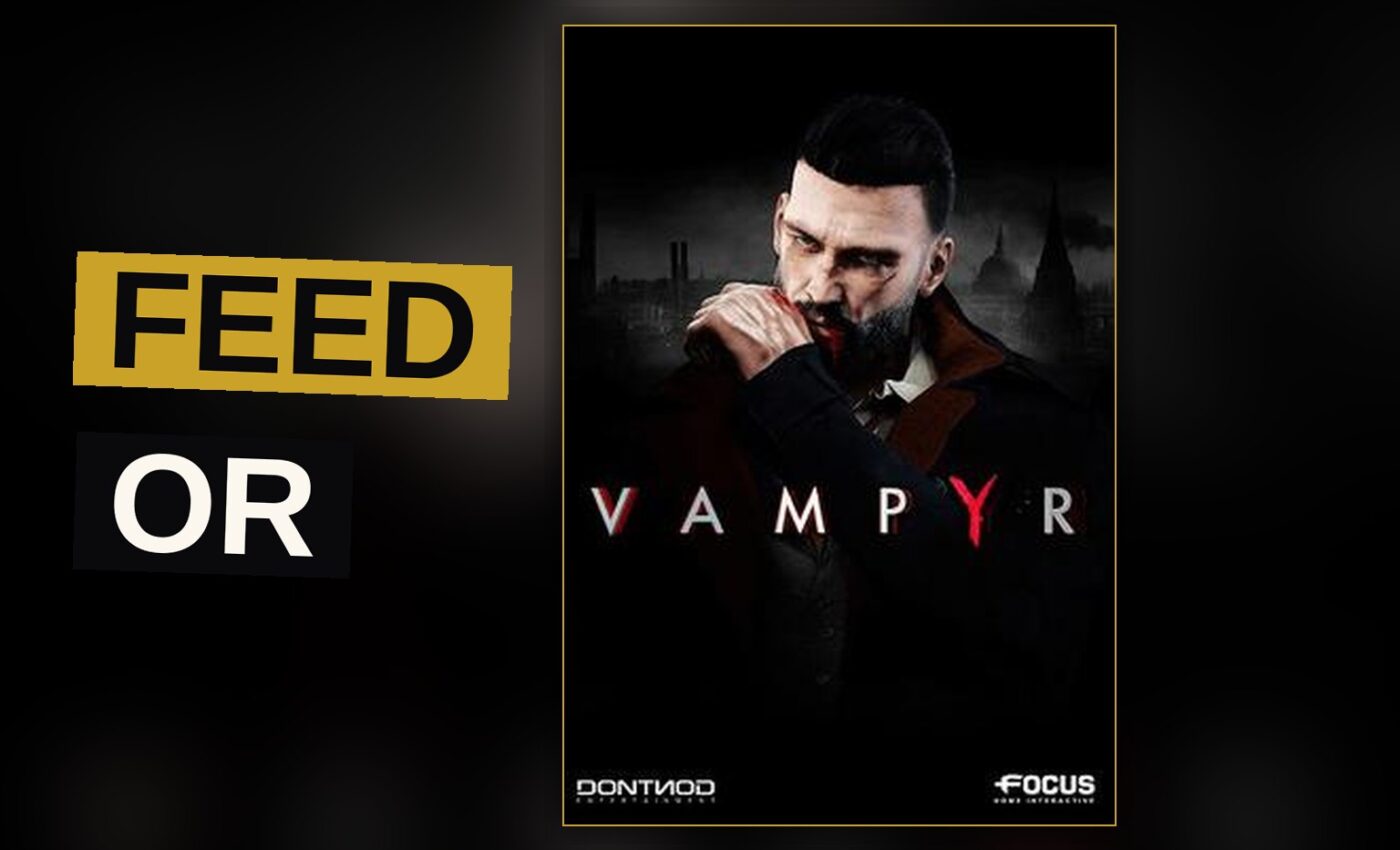
Vampyr drops you into London in 1918, at the height of the Spanish flu, as Dr. Jonathan Reid — a military surgeon who comes home from the Great War and wakes up in a mass grave as a vampire. Dontnod Entertainment built the whole game on that split: Reid swore to heal people, and now he has to drink them.
It is a strong premise. It is not always a strong game.
Trailer, via IGDBcom.
Jonathan Reid’s Oath and His Thirst
The central mechanic is the choice. London is a semi-open world of four districts, and sixty citizens live in it. Each has a background, relationships and a daily routine. You can study them, learn their habits, and feed — or you can leave them alone. Feeding unlocks new vampiric powers and levels Reid up. Refusing to kill anyone is possible, and it unlocks one of four endings, but it leaves him nearly incapable of growing stronger.
That tension is the best thing Vampyr does. The game makes you sit with the cost. Every character is a potential victim, and if you kill one, they are gone for good and their death changes the world around you. Locals you kill leave a last thought. The “Mesmerise” ability lets you control weaker targets — coax out information, or lead them somewhere dark and quiet so you can feed without a fight.
The game also keeps Reid’s cover as a doctor in play. You can craft medicine and heal the sick and injured. If you later eat someone you healed, they give more experience. That is a cruel, clever loop, and it lands.
Combat Drains the Blood It Needs
Where Vampyr stumbles is the fighting. It is real-time, mixing melee, ranged shooting and supernatural powers, and it runs on a single resource: your health and the energy that fuels your powers are the same pool. Using an ability drains your own blood, so every strong move leaves you weaker. You have to feed mid-fight to stay upright.
That idea is sharp. The execution is where the mixed reviews came from — combat drew criticism for feeling stiff, and the technical problems and animation did not help. Boss battles are mandatory. Most other combat can be avoided, which is the smarter way to play.
The crafting system is deeper than it needs to be. You loot materials from corpses and during exploration to build and improve melee weapons, ranged weapons, ammunition and coatings that exploit enemy weaknesses. It works. It rarely excites.
Four Districts, One Coughing City
The setting is the game’s second-best asset. Dontnod researched it by travelling to London and consulting history books and documentaries, and it shows in the fog, the coughing, the half-empty streets. The four districts can be damaged by your choices, and the game tracks that.
Olivier Deriviere composed the score and infused it with industrial music, which fits a city running on disease and fear better than a traditional orchestral arrangement would.
The cast around Reid carries their own identities and importance, and the voice acting was one of the things reviewers praised. The narrative as a whole was not — it was called out for losing momentum, and the choice system drew its own criticism for not always paying off the weight it promised.
A Schedule Worth Keeping
| Phase | What Vampyr asks of you |
|---|---|
| Arrival, 1918 | Wake as a vampire, learn the bloodlust |
| Investigation | Study the sixty citizens, collect clues |
| Feeding | Seduce, alter routines, isolate a target |
| Combat | Fight hunters, skals and other vampires |
| Crafting | Loot corpses, build weapons and coatings |
| Endgame | Live with four possible endings |
What the Choice Actually Costs
Here is the part worth defending. Vampyr is one of the few games that makes mercy a mechanical disadvantage. Sparing all sixty citizens preserves Reid’s cover as a doctor and costs you power. That is not a bug. It is the argument.
But the argument is buried under combat that does not carry it. When the fighting is the weakest system in a game about violence, the theme leaks. You avoid combat not because the game rewards restraint, but because the combat is not good enough to seek out. Those are different things, and Vampyr never quite separates them.
The technical problems and animation hold it back further. A game this atmospheric should not keep reminding you that it is a game.
The Verdict on Vampyr
Vampyr is a smart game with a dull sword arm. The premise, the setting, the score and the feeding loop are worth your time. The combat, the narrative pacing and the rough edges are not.
It earns its mixed reputation honestly. There is a better game inside it — one where every fight is a decision and every decision is a fight. Dontnod got halfway there.
Get the Notebook.
The day's best stories and every fresh verdict, in plain English, in your inbox by seven. One email a day, no more.