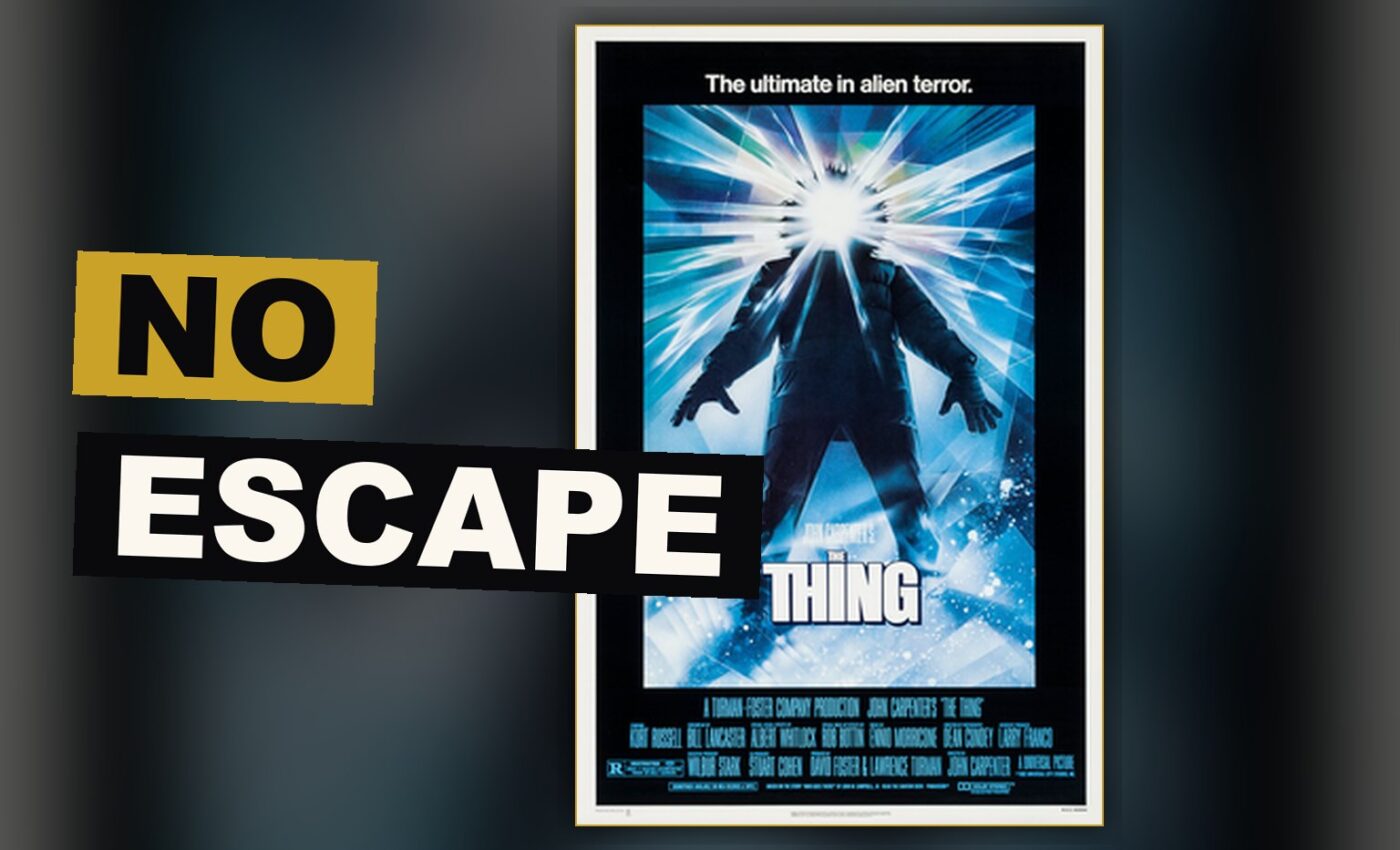
A team of American researchers sits in a camp set deep in the frozen south. Something from outside gets in. What follows, in John Carpenter’s The Thing, is one of the coldest, most patient horror films ever made, and this paper rates it 9.8 out of 10. That is our own high regard for the film, not the IMDb rating, which sits at 8.1 out of 10. The difference between those two numbers is wide, and we will not pretend otherwise.
The Setting Does the Work
The frozen station in The Thing is not just a setting. It is a place with no way out. No one can leave. No one can call for help that will arrive in time. Carpenter uses that fact to remove every easy escape a lesser horror film would depend on, and the result is a film where dread has no direction to travel but deeper into the group itself.
Practical Effects, Real Terror
The creature work in The Thing still holds up decades later. There is no trick of the eye standing between the audience and what is happening on screen. When the Thing reveals itself, in whatever grotesque form it takes at that moment, the effect lands because it was built by workers’ hands, not made on a computer. That physical presence gives the film a weight that many modern horror films, built on computer effects, simply cannot match.
Suspicion as the Real Monster
The sickness, whatever one wishes to call it, can be anyone. That is the engine of the film’s terror. The team turns on itself, testing blood, testing trust, testing every bond built over months spent together in the cold. Carpenter draws out that suspicion gradually, letting doubt do more damage than any single attack.
Three things make that doubt work as well as it does:
- A cast that plays doubt as exhaustion, not high drama.
- A script that keeps back answers long after the audience expects them.
- A score that hums under the silence instead of filling it.
The Pilot Holds the Center
The film’s lead plays the pilot who flies the group’s aircraft and becomes its unwilling center. He does not play the part as a hero. He plays it as a man trying to keep a small, cold world from falling apart, and failing to fully manage it. That quiet performance gives the film’s final part its force.
An Ending That Refuses Comfort
The Thing does not close with relief. It closes with two survivors, a fire, and a question neither one answers. Carpenter lets that open question sit there, troubling, and the choice still troubles audiences decades later.
The IMDb rating of 8.1 out of 10 treats The Thing as a strong genre film among many. This paper sees something rarer: a horror film built entirely on patience, distance from the world and plain skill of hand, with almost nothing wasted. That difference in judgment is why our score sits so far above the general view, and we say so plainly.
The dread in The Thing never depends on frights piled one after another. It depends on time, on quiet, on the gradual understanding that no one in the room can be trusted. Carpenter lets that understanding build across the full length of the film rather than rushing it, and the film is stronger for the discipline.
Few horror films from 1982, or any year since, commit this fully to dread without relief. The Thing does not offer its characters an easy way out, and it does not offer its audience one either.
This paper’s score: 9.8 out of 10. The IMDb rating: 8.1 out of 10. We stand by the higher number, because The Thing earns it scene by scene, right up to that final, open fire.