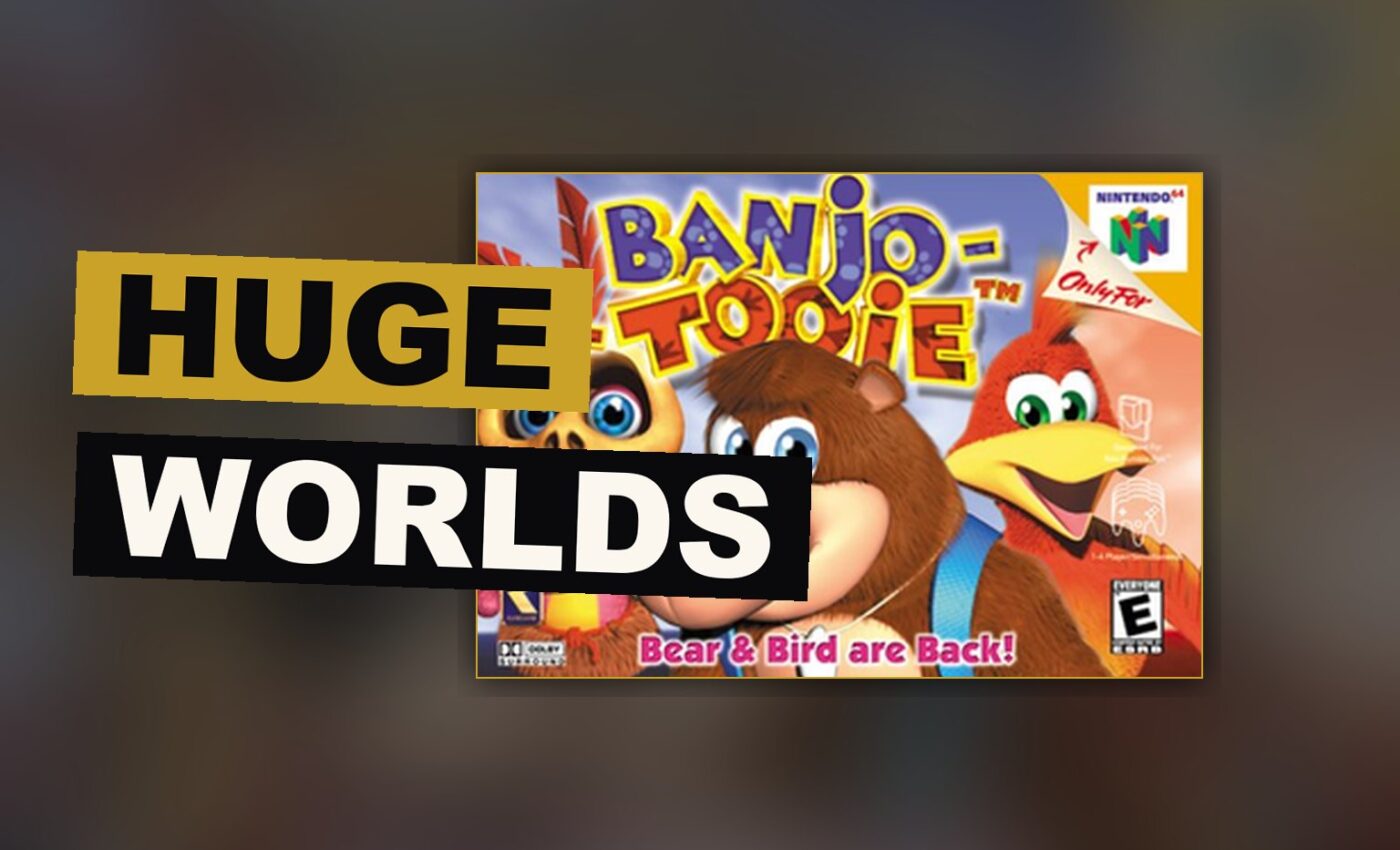
The 2009 Xbox 360 remaster of Banjo-Tooie is the version worth talking about, and it is a cleaner, kinder game than the one Rare shipped on the Nintendo 64 in 2000. The witch Gruntilda is back, her sisters are digging her out of the ground, and the Isle O’ Hags is about to be drained of every living thing on it. This is a platformer that trusts you to keep up, and the port developed by 4J Studios removes two of the old version’s sharpest edges.
Gruntilda’s Sisters and the HAG 1
The story picks up two years after Gruntilda was defeated and trapped beneath a boulder. Banjo and Kazooie are playing poker with Mumbo Jumbo and Bottles when Mingella and Blobbelda arrive in the HAG 1, a massive digging machine, and free their sister. She has withered into a living skeleton underground, and she is not grateful. She destroys Banjo’s house with a spell and flees with her sisters.
Bottles does not heed the warnings and is killed by the blast. His ghost asks the remaining friends to find a way to resurrect him, which gives the campaign a second engine beyond revenge. The witches then unveil the Big-O-Blaster, a device that extracts life force from any target. They test it on King Jingaling and turn him into a zombie. Gruntilda plans to charge B.O.B. long enough to blast the entire island and use the stolen life force to restore her body.
That is a lot of plot for a platformer, and Banjo-Tooie carries it without slowing down. The Isle O’ Hags is the overworld, and it is not a menu. It connects to the worlds, and the worlds are significantly larger than anything in Banjo-Kazooie.
Jiggies, Jamjars, and the Master Jiggywiggy
The structure has changed in ways that reward attention. Instead of hunting incomplete puzzle boards across the overworld, Banjo-Tooie uses a singular board inside a temple where Master Jiggywiggy resides. You can only reach him if you have the number of Jiggies required to open a new world. A timed puzzle-completion challenge follows, and then he grants access. Each world costs more Jiggies than the last.
Musical notes return, but they now buy moves from Bottles’ brother Jamjars, a drill sergeant who takes over Bottles’ role. Every move from the first game is available immediately, which is the right call. New additions include first-person aiming, new egg types, and the ability to play as Banjo and Kazooie separately, with each gaining moves only usable alone. Empty honeycomb pieces and Jinjos return with their original functions intact, and Mumbo Jumbo becomes a playable character.
The increased focus on puzzle-solving over Banjo-Kazooie is the defining shift. Challenges usually reward collectible items that permit progression, and the game expects you to solve rather than simply jump.
- Jiggies open new worlds through Master Jiggywiggy
- Musical notes buy new moves from Jamjars
- Empty honeycomb pieces and Jinjos return
- Mumbo Jumbo is playable
- Up to four players compete in minigames repurposed from the campaign
Notes That Stay Put
The remaster’s biggest quality-of-life change is easy to miss if you never played the original. In the 2009 version, the player does not lose the notes after getting out of a stage. That is a major difference from the Nintendo 64 release, which required the player to collect everything again after leaving or dying. The port also reimplements the Stop ‘n’ Swop feature, using save data from the Banjo-Kazooie remaster to unlock new content.
The source describes the remaster as having visual and performance improvements over the Nintendo 64 version. That matters, because the criticism attached to the original release was its inconsistent frame rate, a complaint the source ties to the 2000 game rather than this one. The Widescreen format was a feature of the original Banjo-Tooie, not a remedy introduced by the port.
Key facts
- Released: 2009
- Developer: Rare
- Publisher: Microsoft Game Studios
- Platform: Xbox 360
- Genres: Platform, Quiz/Trivia, Adventure
- Perspective: Third person
- Modes: Single player, multiplayer, split screen
Why the Puzzles Matter More Than the Size
The size of the worlds drew praise on release, and the graphics did too. But the size is not the achievement. The puzzle design is. Banjo-Kazooie was a collectathon with momentum. Banjo-Tooie asks you to stop, look, and work out what a room wants from you. The Master Jiggywiggy gate is a pacing mechanism disguised as a temple, and it forces you to engage with the worlds you have rather than sprinting to the next one.
The original Banjo-Tooie was developed by Rare and published by Nintendo for the Nintendo 64 in 2000. It is the final Banjo-Kazooie game released by Nintendo prior to Rare’s purchase by Microsoft, and several features were cut during its development because of time constraints and the limits of that hardware. Development started in June 1998, directly after the release of its predecessor. The 2009 port arrived as an Xbox Live Arcade game, and the game was later included in Rare Replay for the Xbox One in 2015.
None of that changes what this remaster is. It is the same dense, demanding Banjo game with the friction sanded down, and the notes fix alone justifies the version. The reward is a campaign with a real antagonist, a real plan, and a villain who spends the whole game trying to charge a machine that will kill everyone on the island.
Gruntilda’s henchman Klungo is sent to hinder Banjo and Kazooie, loses repeatedly, takes beatings from Gruntilda for it, and eventually abandons her. That is a small thread, but it is the kind of detail that separates Banjo-Tooie from its contemporaries. The cast has motives. Jamjars teaches, Humba Wumba aids, King Jingaling gets zombified for his trouble.
Banjo-Tooie is not the cleaner game by design. It is the more ambitious one, and ambition ages better than polish. The 2009 remaster is the way to meet it now, because it keeps the ambition and drops the busywork.
Get the Notebook.
The day's best stories and every fresh verdict, in plain English, in your inbox by seven. One email a day, no more.