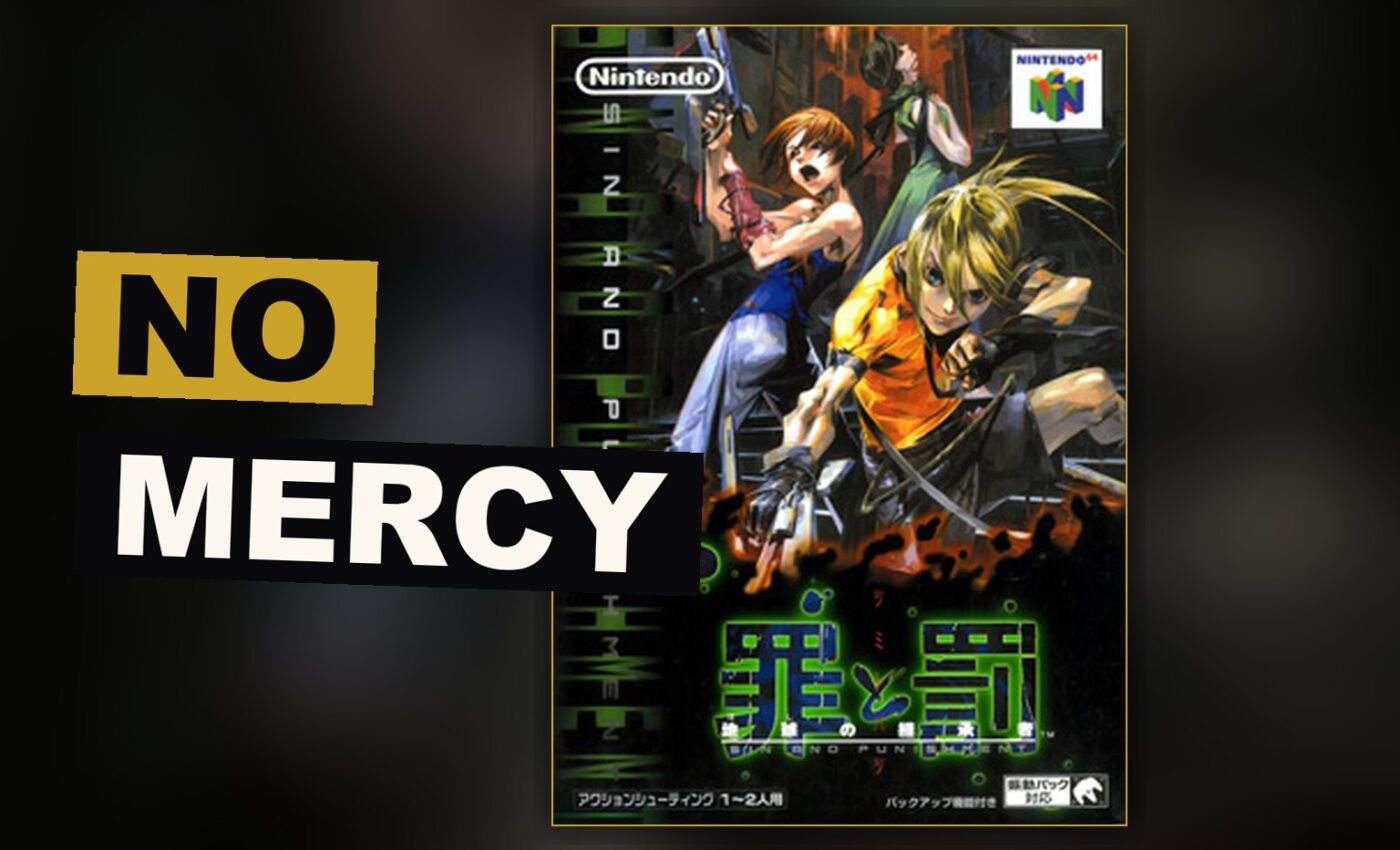
Nintendo never brought Sin and Punishment to the West in 2000. The Nintendo 64 rail shooter stayed in Japan, and for years the only way to play it outside that country was to import a cartridge and fight the language barrier. That has changed. Sin and Punishment is now available outside Japan, and it holds up as one of the sharpest action games on the system.
Treasure built it with Nintendo R&D1, and the guiding idea came from the controller itself. The team wanted players holding the left side of the Nintendo 64 pad instead of the right, which was the norm across the console’s library. That single decision shapes everything.
A controller held the wrong way
Sin and Punishment is a rail shooter. Your character moves forward through each stage automatically, so you never steer the camera or pick a path. You strafe left and right, double-jump, and roll to dodge. The analog stick aims a targeting reticle while the D-pad moves the character — or the reverse, since the game supports left- and right-handed control schemes that swap movement between the D-pad and the C-buttons.
The reticle has two modes you can switch between at will. Lock-on snaps to visible targets and lets you jump the reticle quickly from one to the next. Free aim hands you full control and a more powerful shot. A sword covers anything that gets close, damaging nearby enemies and knocking projectiles back at them.
It sounds like a lot to hold in your head. It is. That is the point.
Saki, Airan, and a famine gone wrong
The story runs on a grim premise. Sin and Punishment is set in a near-future 2007, when humanity is struggling with a planet-wide famine. Scientists engineer a species to raise as food. The creatures are herded in northern Japan until they mutate and start attacking citizens. They get a name: Ruffians.
An international peacekeeping force called the Armed Volunteers moves in to stop the creatures, then turns on the Japanese people it came to protect. A resistance group led by Achi, a mysterious woman with unusual powers, rises up against both. Saki and Airan are the two playable protagonists inside that group.
A blood tide in Tokyo
The plot does not stay small. Saki morphs into an enormous Ruffian after falling into a rising tide of blood filling Tokyo. Achi tells Airan she must shoot Saki to bring him back, and Airan refuses. Achi responds by dropping Airan into a dream set ten years in the future in Long Island, New York, where she meets the son she shares with Saki and watches a Ruffian Saki rampage through the city.
The dream ends with her shooting him — and waking to find Achi manipulated her into shooting the real Saki in the present. Achi later reveals she is not from Earth, and that the war between the Ruffians and the Armed Volunteers was her ploy to groom Saki into an ultimate warrior for a cosmic battle. She creates a new Earth and attacks the current one.
That is a lot of story for a shooter, and it lands with more force than the premise suggests.
Two players, one character
Cooperative play splits the character between two people. One player handles movement while the other handles firing. It is an unusual arrangement, and it works better than it has any right to, because the game’s control split already assumes two hands doing separate jobs. Handing one job to a second person is a natural extension rather than a bolt-on.
How the modes and systems compare
| Feature | Lock-on mode | Free aim mode |
|---|---|---|
| Reticle control | Auto-locks to visible targets | Full manual control |
| Shot power | Standard | More powerful |
| Best for | Fast target switching | Precision on tough enemies |
| Feature | Single player | Cooperative |
|---|---|---|
| Character control | One player does everything | One player moves, one fires |
| Reticle | Same player | Second player |
| Difficulty | Full load on one person | Split load across two |
The scoring system rewards clean play. Bonuses grow the longer you land hits without losing all your health. Health items refill your gauge, time items extend the stage timer, and point items feed the score. Lose all your health or run out the clock and the stage is over. Combos earn extra continues, which matters because the game ships with three difficulty modes — easy, normal, and hard.
The bosses are the argument
Treasure’s reputation rests on shoot ’em ups, and Sin and Punishment is the studio applying that craft to a 3D rail shooter. The enormous bosses are where the design pays off. You are reading attack patterns, switching reticle modes mid-fight, and using the sword to bat projectiles back when the screen fills up. The intensity critics flagged at release is real, and it comes from the control scheme rather than from raw enemy counts.
Development was not quick. Work began in 1997 with four staff and wrapped in 2000 with more people involved than in any previous Treasure project. The team ran into trouble with the system’s complex 3D rendering and with translating 2D gameplay ideas into 3D spaces. You can feel that struggle in the game’s shape: it is a 2D shooter wearing 3D clothes, and it never pretends otherwise.
What the score means
Sin and Punishment earned an 8.6 out of 10 against a GameRankings average of 85.5 percent across eight critic reviews. That number is fair, and the reasons are specific.
Here is our ranking of what makes it work:
- The control scheme. Holding the left side of the pad and aiming with the stick is the whole game, and nothing else on the Nintendo 64 feels like it.
- The two-mode reticle. Lock-on for crowd control, free aim for power — switching between them is a skill you build, not a menu you open.
- The sword. Redirecting projectiles turns defense into offense and gives close-range enemies a reason to exist.
- The cooperative split. Handing the reticle to a friend is the best local multiplayer idea on the system.
- The boss fights. Enormous, readable, and built to test everything the controls taught you.
The weak point is the plot. Achi’s cosmic-war reveal and the dream sequence in Long Island are ambitious, but they arrive in bursts between stages and never get room to breathe. The blood tide in Tokyo and the ten-years-later dream are memorable images, yet the story leans on them harder than it earns. This is a game you play for the shooting, and the narrative is scaffolding around that.
The other caveat is accessibility. The dual-input scheme is the reason to play, and it is also the wall. Players who bounce off the first stage will not be rescued by difficulty settings.
None of that changes the verdict. Sin and Punishment is a Treasure shooter that treats the Nintendo 64 controller as an instrument rather than a compromise, and its arrival outside Japan is overdue. The rail shooter format keeps every stage moving, the reticle modes give you real decisions under pressure, and the cooperative mode turns a solo exercise into something you can hand to a friend. It is not the system’s best-looking game and it is not its best-told story. It is one of its best pure action games, and the 8.6 out of 10 reflects exactly that.
Get the Notebook.
The day's best stories and every fresh verdict, in plain English, in your inbox by seven. One email a day, no more.