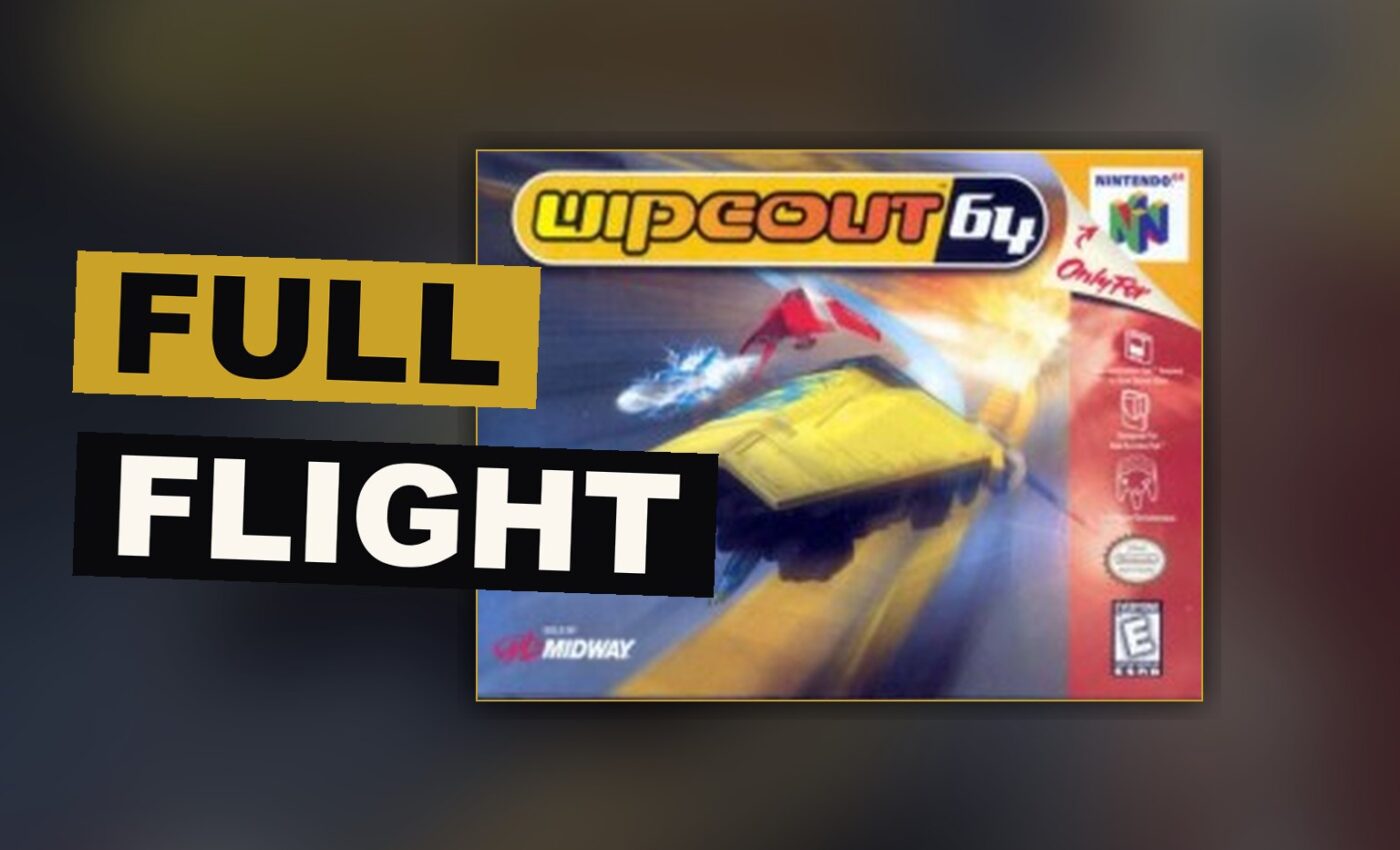
Wipeout 64 is the odd one out in its own series, and that is the first thing worth saying about it. Psygnosis built the game for the Nintendo 64 in 1998, published it through Midway Games, and it remains the only Wipeout published on a Nintendo console. By the time it shipped, Sony Computer Entertainment had owned Psygnosis for five years, and all subsequent Wipeout games have been released exclusively on Sony hardware. Wipeout 64 is a Sony studio’s game on a rival’s machine, a one-off that happened because the timing allowed it.
It holds up anyway. Wipeout 64 scores 8.4 out of 10.
Racing at 2098 in a Hovercraft
The setup is the same anti-gravity racing the series was built on. Pilots steer hovercraft around futuristic circuits against each other or against computer-controlled opponents, and the goal is to finish as high as possible. Wipeout 64 takes place in 2098, one year after Wipeout 2097, and it follows Wipeout XL as a direct follow-up.
The handling borrows its logic from Formula One, but not its mechanics. Where a real race car uses aerodynamics and down-force to press the tires into the track for faster cornering, Wipeout uses a fictionalized version of air braking to generate turning force. That is the whole feel of the game in one detail: you are not gripping a road, you are shoving against nothing.
Most of the gameplay does not differ from the previous two titles. Craft selection, the look of the thing, the handling system — all of it stays close to Wipeout 2097. The new material sits on top of that base rather than replacing it.
Analog Control and the Nintendo 64 Stick
The biggest addition is analog control. The Nintendo 64 controller’s stick made it possible, and it changed how the craft responded. That sounds like a small technical note. It is not. The earlier Wipeout games were built around digital input, and analog steering gave the series a level of control it had not had before.
New weapons, teams and tracks came with it. The weapons interface picked up the ability to fire three rockets at once and rear-locking missiles. Homing missiles, machine guns and electro-bolts all returned from earlier games.
Each team got its own special weapons. That is a structural change, not a cosmetic one — it means the craft you pick shapes how you race, not just how fast you go.
The Cyclone and the Elimination Counter
Wipeout 64 has one weapon power-up no other game in the series has: the Cyclone, an unlockable pickup that strengthens the power of your weapons.
It also added an elimination counter, which tracks how many opponents the player takes out during a race. That counter is the seed of something bigger. It paved the way for the Eliminator mode that showed up in Wipeout 3.
- Fire three rockets at once
- Rear-locking missiles
- Homing missiles
- Machine guns
- Electro-bolts
- Team-specific special weapons
- The Cyclone power-up
Four Players on One Screen
Split-screen multiplayer is the headline feature. Earlier Wipeout games allowed two players on separate screens. Wipeout 64 puts up to four players on one screen, split, for the first time in the series.
That is a real technical concession and a real social one. Four-way split-screen racing on a Nintendo 64 is the kind of thing the console was built for, and it is the feature that most clearly separates Wipeout 64 from its PlayStation siblings.
Challenge Mode is the other new addition. The player works through sets of challenges in predefined classes and tracks, and each challenge has its own win condition.
| Challenge type | What the player must do |
|---|---|
| Time Trial | Set the fastest time |
| Race | Finish in the highest placing |
| Weaponry deathmatch | Eliminate the most opponents |
Mirrored Tracks and Borrowed Circuits
Most of the tracks in Wipeout 64 are mirrored layouts of circuits from Wipeout and Wipeout XL, moved to different locations. Some of those conversions are not perfectly accurate.
That is the part of the game that invites the most skepticism, and it should. Reusing layouts and flipping them is a shortcut, and the inaccuracies in the conversions are the kind of thing a player notices on a lap they have run a hundred times before. The track design still drew praise at release — the phrase used was “superior track design” — and critics also praised the game for offering more tracks and racing craft.
Both things can be true. Wipeout 64 has plenty of content and it built some of that content by turning old circuits around.
A Sequel, or a Side Story
Reviews at the time were generally positive. Critics liked that Wipeout 64 had its own identity inside the series, liked the graphics, liked the extra tracks and craft and the atmosphere. The one thing they could not agree on was whether it counts as a true sequel to Wipeout 2097.
That disagreement is the most interesting thing about the game, and it is not really about quality. It is about what a sequel is supposed to be. Wipeout 64 shares its setting, its handling and its craft with Wipeout 2097, then adds analog control, four-player split-screen, Challenge Mode, team weapons and the Cyclone. That is a substantial list of additions. It is also a list of additions bolted onto a game that already existed.
The mirrored tracks are the tell. A true sequel builds new ground. Wipeout 64 mostly re-laid old ground in a new direction and gave players better tools to drive on it.
What Wipeout 64 Actually Is
Judged as a Nintendo 64 game, Wipeout 64 is easy to recommend. It is fast, it looks good for the hardware, and four-player split-screen racing is worth the price of the cartridge on its own. The analog control makes the craft feel better than they ever did on digital input, and the team-specific weapons give the roster a reason to exist beyond stat differences.
Judged as the third Wipeout, it is a side story with excellent production values. The Challenge Mode and the elimination counter matter more than they look — the counter led directly to Eliminator mode in Wipeout 3, so Wipeout 64 is where a whole mode of the series was tested.
The split-screen mode is the part that ages best. Four players, one screen, no network, no subscription, nothing to download. That is a design problem the Nintendo 64 solved by having four controller ports, and Wipeout 64 is one of the games that used them properly.
The mirrored circuits are the part that ages worst. A player who knows Wipeout XL will recognize the bones of these tracks, and the conversion errors will show up on the laps that matter. It is a compromise, and it is visible.
What this paper makes of it: Wipeout 64 is the best argument that the series could have survived outside Sony hardware, and it is also a clear marker of why it didn’t. Psygnosis made a game good enough to stand with the PlayStation entries on a console Sony did not own, and then every Wipeout after it went to Sony hardware. The four-player split-screen and the analog stick are not nostalgia. They are the two features that make this version worth playing in a way the others are not.
Wipeout 64 is a genuine high point of the Nintendo 64 racing library and a genuine oddity in its own series. Both of those are reasons to play it.
Get the Notebook.
The day's best stories and every fresh verdict, in plain English, in your inbox by seven. One email a day, no more.