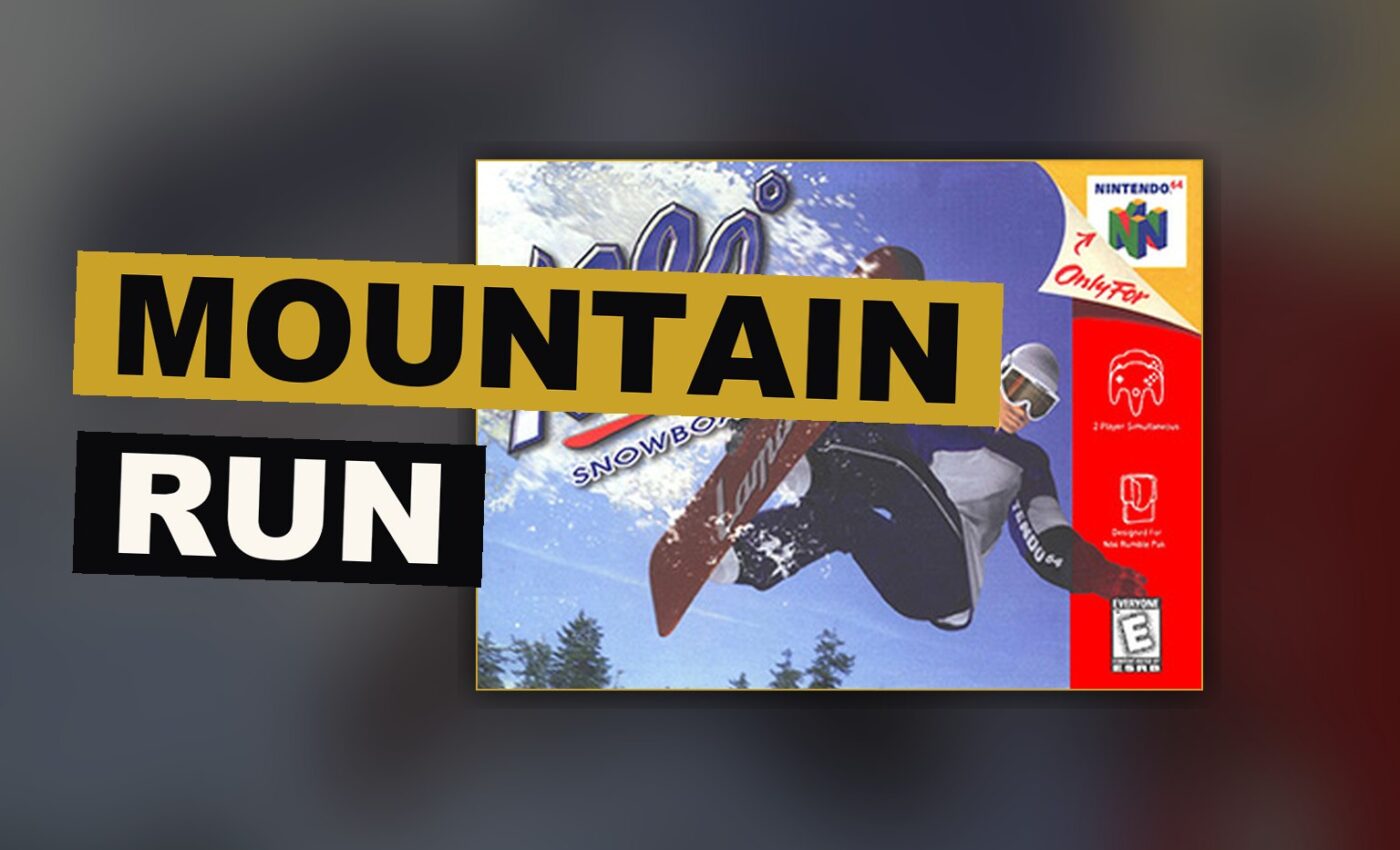
Nintendo dropped 1080° Snowboarding on the Nintendo 64 in 1998, and the game has not left the conversation since. It was announced in November 1997 and built over nine months. It sold more than two million units. It won an Interactive Achievement Award from the Academy of Interactive Arts & Sciences. That is a lot of hardware for a game about sliding down a hill.
Five Boarders, Eight Lamar Boards
The setup is thin in the way that great arcade games are thin. You pick one of five snowboarders. You ride one of eight Lamar snowboards. You point the board downhill and try not to lose speed. The game runs from a third-person perspective, which keeps the rider in view and the course in front of you. That camera choice matters more than it sounds. You need to see the landing before you commit to the spin.
1080° Snowboarding splits its modes cleanly. There are two trick modes, Trick Attack and Contest. There are three race modes, Race, Time Attack, and 2 Players. Training and Options round out the menu. The goal in any mode is simple: reach the finish line fast, or score high with trick combinations. Eight levels hold all of it.
24 Tricks and 5 Secret Tricks
The trick system is where the game earns its name. There are 24 tricks and 5 secret tricks, all mapped to circular movements of the control stick plus the R, Z, and B buttons. Points scale with complexity, combos, and how long the trick takes. The tricks come in two families. Grab tricks mean the snowboarder grabs the board a specific way. Spin tricks mean the board rotates a set number of degrees.
The 1080° spin is the hardest thing in the game. It takes nine distinct actions to pull off. That number is the whole design in miniature. Nintendo could have made the signature move a single button. Instead it built a nine-step sequence and trusted players to learn it.
In Contest mode, you perform tricks and snowboard past flags to gain points. In Trick Attack, you chain a series of tricks across a designated level. Both modes reward the same instinct: keep moving, keep the combo alive, do not stop to admire the landing.
Race Modes Reward Route Choice
The race modes play by different rules. Tricks are still scored, but they do not help you win. Victory comes from picking alternate routes inside a course and balancing the snowboarder after jumps so you do not lose speed. That balance mechanic is the quiet spine of the whole game. Land wrong and the speed bleeds out. Land right and the course opens up.
Match Race puts you against AI-controlled snowboarders in a series of races. The game tracks your time through each level. It also assigns a damage meter that fills when the snowboarder falls or gets knocked over. Difficulty can be set to normal, hard, or expert, and that setting changes both the complexity and the number of races.
In Match Race mode, the player competes in a series of races against AI-controlled snowboarders.
A Half-Pipe and Six Courses
The course list is the part that has aged best. The original pitch promised a Half-Pipe and six different courses, and the shipped game delivers eight levels of downhill variety. You are taking a Tahoe 155 snowboard down a steep, bumpy incline at night, and the game wants you to top off an Indy Nosebone with a 360° Air.
That line comes from the game’s own marketing, and it is not overselling. 1080° Snowboarding is as close as you get to the real thing without hopping on the next ski lift. The intensity is the point. The game is built so you are brushing the snow off your goggles before you have left the living room.
Nine Months, Two Million Units
The production story is worth naming. Nine months is a short build for a game with this much mechanical depth. Nintendo Entertainment Analysis & Development handled it, with Nintendo publishing and Gradiente on board in some regions. The result was critical acclaim and that Interactive Achievement Award.
The sales figure tells its own story. Over two million units is not a niche cult hit. That is a game that reached a mainstream audience on a console that already had plenty of reasons to own it. 1080° Snowboarding earned its place in the Nintendo 64 library the old-fashioned way: it was fun on the first run and hard to master on the twentieth.
The franchise did not stop here. 1080° Avalanche arrived on the GameCube in November 2003. The original came back on the Wii in 2008, on the Wii U Virtual Console in 2016, and on the Nintendo Classics service in 2023. Nintendo keeps reissuing it because people keep wanting to play it.
What Still Holds Up
The trick system is the reason to return. Twenty-four tricks plus five secrets is a real vocabulary, and the nine-action 1080° spin gives the game a summit to climb. Most snowboarding games since have simplified the input and lost something in the trade. 1080° Snowboarding asks for your hands, not just your attention.
The race modes are the weaker half. Tricks do not count toward winning, which makes the scoring feel decorative in Race and Time Attack. The damage meter adds pressure, but it also punishes the kind of experimentation that makes the trick modes sing. You learn to play safe, and safe is less interesting.
The balance and route-choice mechanics are the part more games should steal. Choosing a line and sticking the landing is a better test than any combo counter. It turns each course into a decision rather than a checklist.
Eight Levels, One Score
1080° Snowboarding is a Nintendo 64 game that understood its own name. The 1080° spin is not a gimmick; it is a thesis about how much a player will practice for one perfect run. Nine months of development produced a game that still plays clean more than two decades later, and the re-releases on Wii, Wii U, and Nintendo Classics are not nostalgia exercises. They are maintenance on a classic.
The flaws are real. The race modes underuse the trick system. The difficulty curve in Match Race can spike hard on expert. But the core is sound, the courses are varied, and the control scheme rewards mastery instead of luck.
Get the Notebook.
The day's best stories and every fresh verdict, in plain English, in your inbox by seven. One email a day, no more.