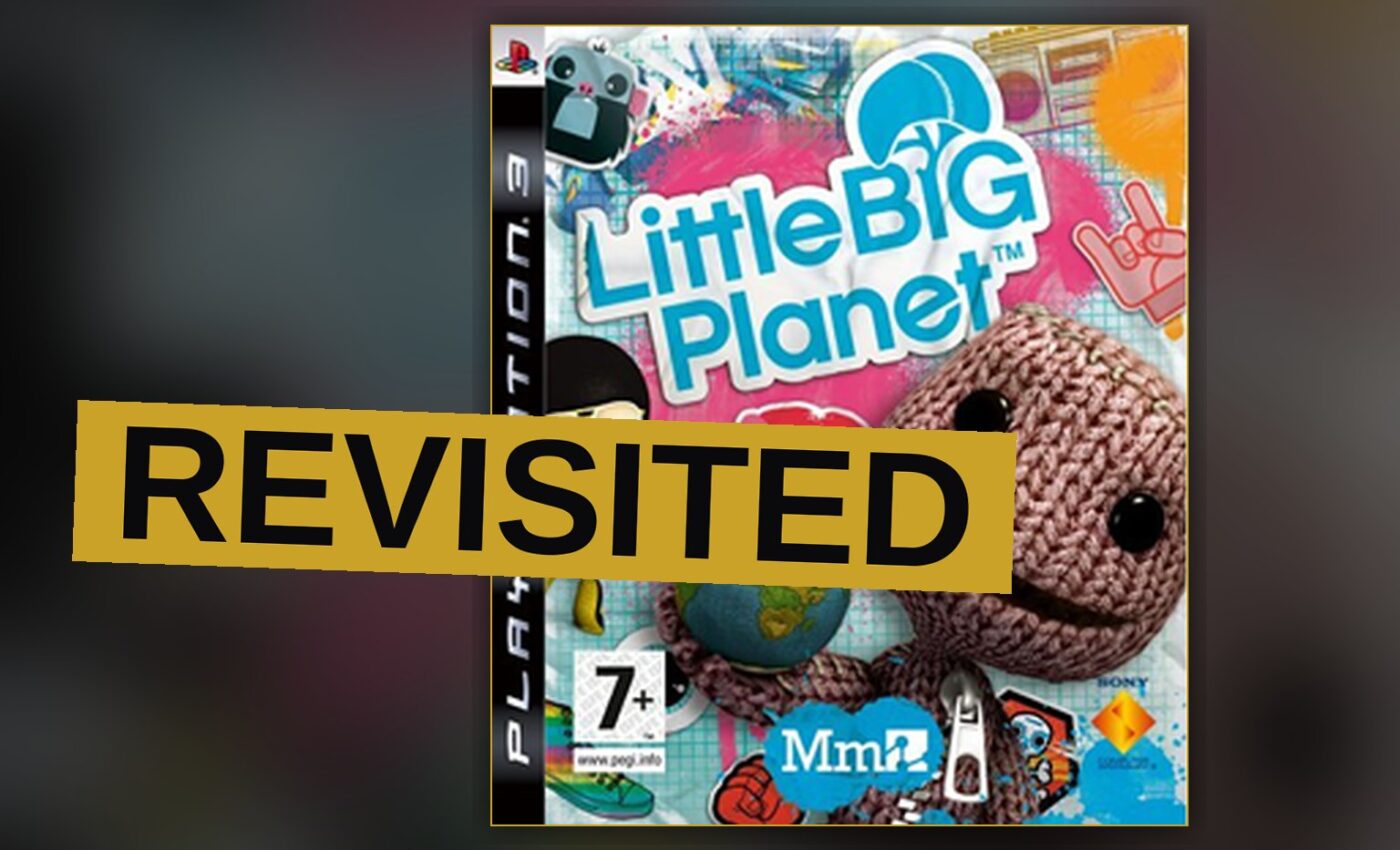
LittleBigPlanet arrived on the PlayStation 3 in 2008 with a promise that sounded too big for a platformer: if you can think of it, you can create it. Media Molecule, a studio formed by four former Lionhead Studios employees after the release of Rag Doll Kung Fu in 2005, built the whole game around that promise. You play as Sackboy, a brown, customizable ragdoll, and the game hands you the tools to build the world you are running through.
Trailer, via John GodGames.
A Cardboard Spaceship Called the Pod
Everything in LittleBigPlanet starts from two ideas: a character you can dress up and a menu you can build with. Sackboy runs, jumps, grabs objects made of certain materials, and shifts between the three layers of the game’s 2.5D plane. The Popit is the portable menu that holds your customization tools, stickers, and objects.
The game splits into two modes, each shaped like a celestial body. LittleBigPlanet is where you play levels. MyMoon is where you create them. Both open from a hub called the Pod, a cardboard spaceship that serves as the game’s front door.
That structure is the smartest thing here. It puts playing and making in the same room, so the leap from consumer to creator never feels like a separate hobby.
Eight Areas and Fifty Levels
The story mode runs through eight themed areas, each with three or four main levels. Hidden keys unlock bonus levels, bringing the total to fifty. Each area is built around Sackboy’s control scheme and its own theme. The Metropolis levels, for instance, send you through sewers and onto subways.
The settings draw on locations around the world: the United Kingdom, Africa, South America, Mexico, the United States, Japan, India, and Siberia. The eight areas are the Gardens, the Savannah, the Weddings, the Canyons, the Metropolis, the Islands, the Temples, and the Wilderness.
Each one has a Creator Curator: the King, Zola the Lion King, Frida, Uncle Jalapeño, Mags the Mechanic, Grandmaster Sensei, the Great Magician, and the Collector. The King sends Sackboy to the Savannah after the Gardens. In the Savannah, Sackboy accidentally destroys one of Zola’s creations on arrival.
The Collector Refuses to Share
The story has a rogue at its center. The Collector is stealing the other Curators’ creations and refusing to share them, which cuts against the game’s own stated value. Sharing is one of the core elements of LittleBigPlanet, so the villain is a hoarder by design.
The journey runs through the Weddings, a story arc with a Day of the Dead theme, where Sackboy helps find a Bridegroom. In the Canyons, the player rescues Uncle Jalapeño and defeats Sheriff Zapata. On the Islands, Sackboy trains in martial arts and fights the Terrible Oni. In the Temples, the Great Magician points the way to the Collector’s Wilderness.
After the final battle, the Collector turns out to be a little, lonely man who kidnapped everyone because he had no friends. Everyone, including the player, offers to be his friend. He accepts, and that ends his being evil.
It is a soft ending, and it works. The game’s villain is defeated by inclusion, which is the same argument the level editor makes about its players.
If you can think of it, you can create it if you can create it, you can share it if you can share it, you can play it
Prize Bubbles and Checkpoints
Levels are full of prize bubbles holding costumes, stickers, songs, and objects. Score bubbles multiply your score when you collect them in a chain. Checkpoints let Sackboy respawn after dying, with three uses each, or infinite in some cases. Run the last checkpoint out of uses and the level ends.
Up to three other players can join. Some prize-bubble puzzles in story mode require more than one player, which quietly forces cooperation on anyone chasing full completion. That is a deliberate design choice, and it is the right one for a game about sharing.
From Craftworld to Store Shelves
Media Molecule pitched a prototype called Craftworld to Sony Computer Entertainment Worldwide Studios president Phil Harrison, who praised the concept and agreed to fund it. Harrison announced LittleBigPlanet at Game Developers Conference 2007. A marketing campaign, beta testing, and heavy anticipation followed.
The game was delayed briefly to remove controversial lyrics from an in-game licensed song. It then released worldwide between October and November 2008, published by Sony Computer Entertainment for the PlayStation 3.
That delay is worth noting because it shows how much the licensed music mattered to the finished product. The soundtrack was treated as part of the identity, not filler.
Where the Ragdoll Fights Back
The creation suite is the reason to play LittleBigPlanet, and it holds up. The Popit is a clean idea, the Pod is a clean hub, and the fifty-level story mode gives you enough raw material to understand what a good level looks like before you try building one.
The physics are the friction point. A ragdoll platformer with three depth layers and grab mechanics asks for precision the engine does not always deliver. Sackboy is charming and slightly unwieldy, and some jumps land on the wrong side of that line.
The story mode is also thinner than its structure suggests. Eight areas and fifty levels sounds generous, but the themes carry more weight than the individual stages. The Metropolis sewers and subways are a good example of a level designed around the controls rather than around a memorable challenge.
LittleBigPlanet earns its reputation on the strength of one idea executed at scale: a platformer that treats its players as creators and then gives them a place to publish. The Collector’s arc, the eight Curators, and the Pod all serve that idea rather than distract from it.
The rougher physics and uneven story levels keep it short of greatness. But the community tools and the sharing loop are the part that lasted, and they are the part worth remembering. This is a game that asked its audience to make something and meant it.
Hard Numbers
- Release: worldwide between October and November 2008
- Developer: Media Molecule
- Publisher: Sony Computer Entertainment
- Platform: PlayStation 3
- Story mode: 8 themed areas, 3-4 main levels each, 50 levels total
- Players: up to 4
- Score: 7.8 of 10
Get the Notebook.
The day's best stories and every fresh verdict, in plain English, in your inbox by seven. One email a day, no more.